Vashti is a human in Jewish folklore, from Persia. Vashti (Hebrew Vaštī) is the first wife/queen of King Ahasuerus in the Book of Esther. In the biblical narrative she is a human royal who refuses the king's command to appear at his banquet; rabbinic midrash expands her story with divergent interpretations—moral judgments, alleged illnesses, genealogical additions, and miraculous interventions—while the Bible itself presents only her refusal and subsequent dismissal.
In the Hebrew Bible (Book of Esther) Vashti appears as the queen married to King Ahasuerus whose refusal to present herself at the king's banquet leads to her dismissal and replacement by Esther. Rabbinic midrashic traditions expand and rework this terse biblical account: some midrashim give her Babylonian royal lineage (connecting her to Nebuchadnezzar II and figures like Belshazzar), offer motives or punishments (claims that she enslaved Jewish women and forced Sabbath labor), and narrate supernatural alterations (e.g., an account in which the angel Gabriel 'fixed a tail on her'). These midrashic elements are interpretive expansions and are distinct from the biblical narrative itself. Scholarly etymologies (e.g., Jacob Hoschander's proposal linking Vashti to an unattested vashtateira/Stateira) are conjectural reconstructions offered by modern scholars, not attestations in the primary text.
The Book of Esther characterizes Vashti as beautiful; that is the plain biblical depiction and the immediate narrative reason for the royal demand that she display herself. Later rabbinic midrash offers alternative or supplementary portrayals for explanatory or moral purposes: some midrashim say she was afflicted with tzara'at (often translated as leprosy) which would have disfigured her, while other midrashic sayings claim the angel Gabriel altered her body by 'fixing a tail on her.' These midrashic accounts are later interpretive additions and not descriptions in the biblical text.
The biblical account describes no supernatural powers—Vashti's central action is a human political/personal refusal to appear before the king and courtiers. Rabbinic literature attributes behaviors and motives to her (vanity, wickedness, alleged enslavement of Jewish women and forcing them to work on the Sabbath) as moral explanations for her punishment; these are midrashic imputations rather than independently attested abilities. A midrashic agent (the angel Gabriel) is sometimes said to have acted upon her body, but that is presented as divine/supernatural intervention affecting her, not a power she wields.
Weaknesses
- conditionpolitical/legal vulnerability (dismissal/banishment by royal decree)
- conditionmidrashic attributions of tzara'at or bodily alteration (presented as causes for refusal in rabbinic explanations)
Wards
- othernone (Vashti is presented as a human royal figure; sources do not record apotropaic wards or ritual protections targeted at her)

Esther
Esther is the eponymous human heroine of the Book of Esther in the Hebrew Bible (Megillat Ester). Presented as a Jewish woman who becomes queen in the Persian royal court, her strategic concealment of identity, intercession with King Ahasuerus, and the communal fast she requests are narrated as securing the survival of the Jewish people in that story and underpin the festival of Purim.
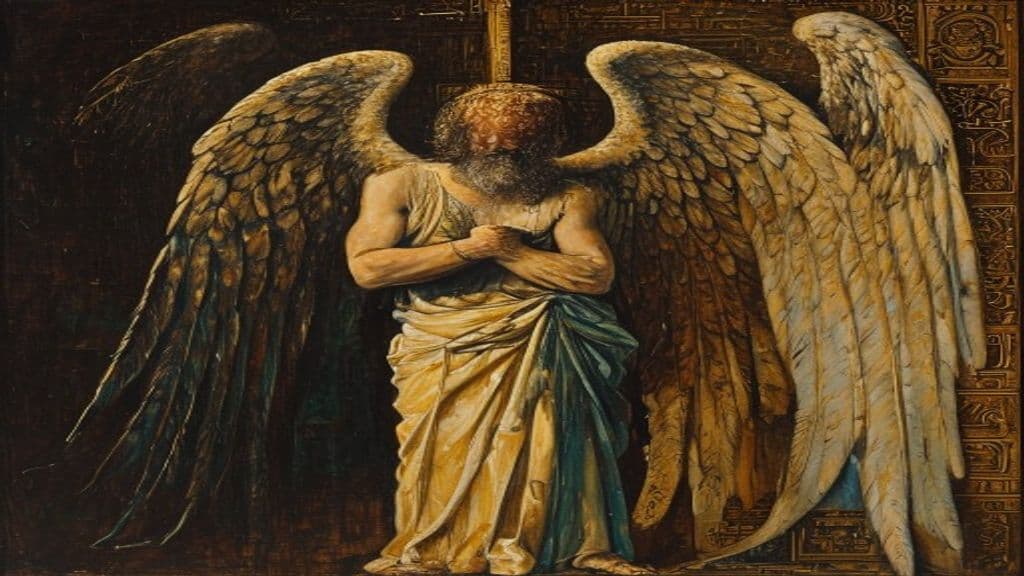
Gabriel
A principal heavenly messenger in Jewish, Christian, and Islamic literatures, Gabriel is portrayed as an archangel who reveals and explains divine messages, announces births and divine intent, and executes certain divine judgments in apocalyptic texts.
3-D Man
3-D Man is a Marvel Comics superhero identity associated with a 1950s-era origin in which the body of Chuck Chandler can materialize in three-dimensional existence when activated by his brother Hal via a pair of glasses. The mantle was later assumed by Delroy Garrett (formerly Triathlon) in modern continuity.
5 Ronin
5 Ronin is a 2011 Marvel Comics five-issue limited series that reimagines five Marvel superhero archetypes as rōnin (masterless samurai) in a fictionalized post‑Sekigahara feudal Japan. The work places Wolverine, Hulk, Punisher, Psylocke, and Deadpool analogues into period roles to explore displacement, revenge, and identity in an era of political upheaval.
A Elbereth Gilthoniel
An Elvish hymn in Sindarin addressed to Elbereth (Varda) from J. R. R. Tolkien's legendarium. Presented in The Lord of the Rings and later musical and dramatic adaptations, the hymn functions as devotional poetic language that evokes Elvish reverence for the star-kindler rather than an independent supernatural agent.
A.R.G.U.S.
A.R.G.U.S. is a fictional clandestine United States government agency in the DC Comics universe that investigates, contains, and manages superhuman, meta-human, and supernatural incidents and assets. Introduced in The New 52 continuity, it functions as an institutional actor providing intelligence, logistical support, covert task forces (notably Task Force X / the Suicide Squad), and a dedicated magic division across comics and media adaptations.
Aaron
Aaron is a central human figure in Israelite sacred literature: the elder brother of Moses, the first high priest (progenitor of the Aaronide priesthood), and a spokesman/prophet who mediates between Israel and God in Exodus–Deuteronomy narratives. His role in the texts establishes hereditary priestly authority, ritual functions (sacrifices, blessing, use of Urim and Thummim), and institutional norms for Israelite cultic life.
Ab-Zohr
Ab-Zohr is the culminating rite of the Zoroastrian Yasna service: a formal offering to the waters (Aban/Apas) that creates the consecrated liquid parahaoma and functions to purify, strengthen, and atone for damage done to waters. It is a ritual action rather than an independent supernatural being.
Abaddon
In Hebrew scripture Abaddon is primarily a noun meaning 'destruction' or a section/condition of the underworld paired with Sheol; in the New Testament Book of Revelation Abaddon is personified as an angelic figure (Greek Apollyon) described as the king of an army of locusts released from the abyss during the apocalypse.
Abagtha
Abagtha (Hebrew: אבגתא, ’Ǎḇaḡṯā) is a named human court official in the Hebrew Bible’s Book of Esther, listed among seven chamberlains who ministered before King Ahasuerus and were commanded to bring Queen Vashti before the king. He is attested only in Esther 1:10 and is presented as an institutional palace attendant rather than a supernatural being.
Aban (Āb/Ābān)
Aban (Avestan apas; Middle Persian āb/ābān) is the collective, sacred principle of the waters in Zoroastrian cosmology — both the element water and its personified hypostases (the Apas/Ahuranis). Aban functions as a primordial, life-giving creation, a calendrical and liturgical focus (day-name, month-name, Abanagan feast), and a ritual object of veneration (ape zaothra, Aban Yasht) rather than a malign force to be expelled.
Aban Yasht
The Aban Yasht is a hymn from the Persian tradition that praises Anahita, a goddess associated with water, fertility, and wisdom. It consists of 132 stanzas and is part of the 21 Yashts collection. (Note: - Power tier should be "Primordial" or possibly "Cosmic", given that it's a hymn of great spiritual significance and associated with a goddess. - The article incorrectly states that Anahita is associa)
Abdiel
Abdiel (Hebrew עֲבְדִּיאֵל) is primarily a theophoric Hebrew personal name meaning "servant of El/servant of God," attested once in the Hebrew Bible (1 Chronicles 5:15). In later literature—most notably John Milton's Paradise Lost—Abdiel is reimagined as a faithful seraph who opposes Satan's revolt. The provided sources do not treat Abdiel as an autonomous folkloric spirit type or record rituals or wards associated with the name.
Abel
Abel is the second son of Adam and Eve in the Genesis narrative, a shepherd whose accepted offering and subsequent murder by his brother Cain form the biblical account of the first death. Later interpretive traditions expand his role, treating him as an archetypal righteous victim, a postmortem avenging or adjudicating figure, and in some systems (notably Mandaean) identifying him with an angelic lightbeing.
Community Record
- [1]Vashti - Wikipedia. Wikipedia contributors, 'Vashti,' Wikipedia, The Free Encyclopediawiki
- [2]Vashti - International Standard Bible Encyclopedia. International Standard Bible Encyclopedia, entry 'Vashti'other
- [3]Midrashic references summarized (e.g., Megillah 12b) and modern summaries. Summaries of rabbinic midrash cited in the research notes (including Megillah 12b references)other