
Across the surveyed traditions the World Tree appears in origin and cosmological accounts rather than as a single unified narrative. In Mesoamerican sources the world tree appears in creation accounts and civic-ceremonial cosmography, marking cardinal directions and participating in cosmogony (Source 9). In Siberian shamanic descriptions a great Tree grows upon a mountain at the center of the world and contains multiple planes through which shamans travel; these accounts present the tree as a preexisting cosmic structure that orders existence (Source 12). Norse tradition names the central cosmic tree Yggdrasil and treats it as the pivotal arboreal axis of that cosmology (Source 10). Comparative summaries note the motif's presence in Indo-European and Native American cosmologies and emphasize its role in ordering heaven, earth, and the underworld (Source 1).
The World Tree is depicted as a colossal, singular tree far larger than ordinary trees, whose trunk and crown reach the heavens while its roots extend into the underworld, making it a vertical axis between cosmic levels (Source 1). Siberian descriptions place a great Tree on a central mountain that contains waters and internal planes, with the Waters of Life rising on one side and healing Waters of Death on the other (Source 12). Mesoamerican iconography represents world trees stylized in codices and monuments as central trunks with directional branches that mark the four cardinal directions and cosmological points (Source 9). Norse references invoke Yggdrasil as the central tree of that mythic landscape (Source 10).
Rather than acting as an animate agent, the World Tree functions cosmologically: it supports or upholds the heavens, connects heaven, earth, and the underworld, and thereby mediates passage or relation between realms (Source 1). In some Siberian accounts the tree channels symbolic waters—life on one side and healing/death waters on the other—indicating a mediating role in life, death, and healing symbolism (Source 12). Mesoamerican world trees order space by embodying the four cardinal directions and participate in creation accounts, giving them a role in spatial and civic cosmography (Source 9). The surveyed sources do not describe consistent volition, speech, or direct interpersonal agency for the tree; its functions are structural and symbolic within cosmologies (Sources 1, 9, 12).

Naga
Divine serpent beings of Hindu, Buddhist, and Jain cosmology — powerful guardians of water, earth, and underground treasures. Revered as deities in South and Southeast Asia.
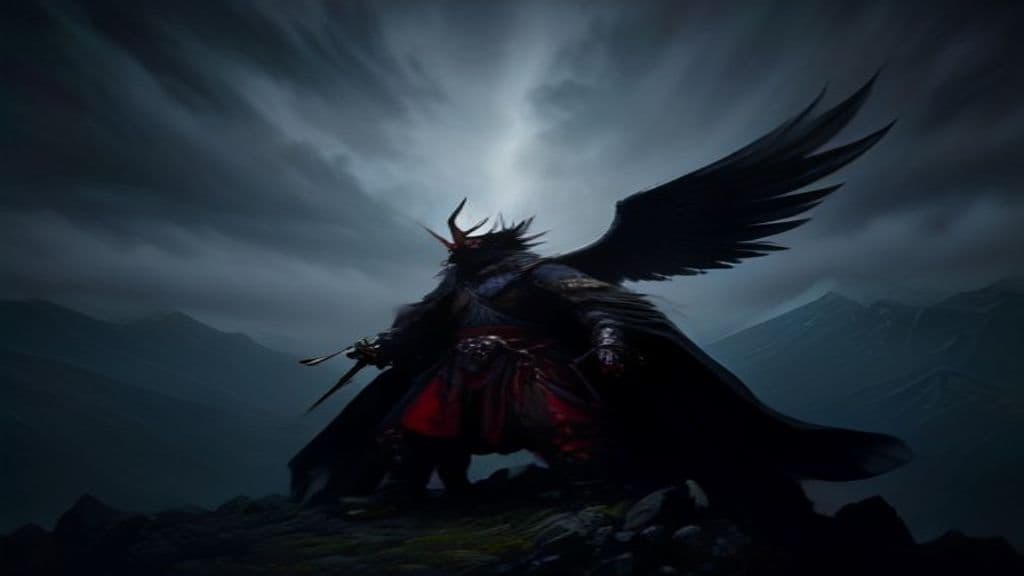
Tengu
Proud, warrior-like mountain spirits of Japan, associated with martial arts, pride, and the wild mountains. Neither fully good nor evil — they test and train warriors and monks, but punish the arrogant.
Abaasy
Abaasy (Abaahy, Abasy; Yakut: Абаасы, Abaası) are beings of the Sakha (Yakut) underworld, depicted in sources as destructive underworld spirits or demons associated with the long deceased. They inhabit the lower cosmic layer, serve an underworld ruler, are blamed for disease and madness, and may be appeased by blood sacrifice.
Acolnahuacatl
Acolnahuacatl is a name attested in central Mexican sources both as a historical Tepanec ruler of Azcapotzalco and, in several modern compilations and trivia lists, as a minor chthonic or underworld-associated figure (often given the variant Acolmiztli). The evidence in the provided material is divided: the historical/genealogical reading is supported by standard reference entries, while the deity reading appears mainly in secondary online god-lists and quizzes and is not substantiated by detailed primary ritual or mythic texts in the supplied set.
Adils
Adils (Old Norse Aðils; also Eadgils, Adillus, Athisl, Adhel) is a semi‑legendary sixth‑century Swedish king attested in Old Norse saga material and later medieval traditions. He appears in saga episodes as a storied royal figure involved in warfare, court acts, and marriage suits rather than as a supernatural being.
Agilaz (Egil)
Agilaz (reconstructed Proto-Germanic) — commonly recorded in medieval sources as Egil or Ægil — is a legendary archer attested in Germanic heroic tradition. He appears as the brother of Völund (Wayland/Weland) in the Old Norse poem Völundarkviða and in the Thidreks saga, and his name is also inscribed on early medieval objects (Franks Casket, Pforzen buckle). The attested material presents him as a named heroic human archer within saga and inscriptional contexts rather than as a recurrent supernatural species.
Agnarr Geirröðsson
Agnarr Geirröðsson is a mortal prince attested only in the Poetic Edda poem Grímnismál; he aids Odin (disguised as Grímnir) during Geirröðr's torture and, after Odin reveals himself and King Geirröðr dies, Agnarr succeeds as king.
Agne
Agne (also attested Agni, Hogne, Agni Skjálfarbondi) is a semi-legendary king of Sweden in Old Norse saga tradition, preserved in the Ynglingatal corpus and prose expansions such as Snorri Sturluson's Ynglinga saga. He is portrayed as a mighty and famous warrior-king whose campaign in Finland, marriage to Skjalf, and death by hanging form a remembered episode connected to local place-names and a burial mound.
Ahuiateteo
Ahuiateteo (Āhuiatēteoh; also rendered Mācuīltōnalequeh) are a quintet of Aztec deities associated with excess, pleasure, and the dangers that accompany over‑indulgence. They appear in calendrical and codical contexts, are invoked in divinatory practice, and are thematically linked to pleasures (feasting, drinking, gambling, sex, music) and the misfortunes that follow excess.
Ahuitzotl
Ahuitzotl is both the personal name of the eighth tlatoani (ruler) of Tenochtitlan (reigned ca. 1486–1502) known for military expansion and monumental rebuilding, and an onomastic term in Nahuatl for an aquatic animal/legendary creature (commonly glossed 'water thorny' and often associated with an otter or water opossum). The sources treat these registers—historical ruler and animal-name—as related but distinct uses of the same Nahuatl lexeme.
Aiy (Aiy-auk)
Aiy (also rendered Aiy-auk) is a name mentioned in relation to Siberian contexts in the queryer's sources, but the provided documents do not contain usable folkloric descriptions or ethnographic data about the entity. This entry records what the supplied materials do and do not establish and points to the research gap.
Ak Ana
Ak Ana (also Ağ Ana, Ak Ene) is the primordial water-mother of Turkic and some Siberian (Khanty, Mansi) traditions: a holy maternal creator principle associated with the pre-earth expanse of water, fertility of the land, and the threshold to the spirit world.
Akateko
Akateko (赤手児, lit. 'red child's hand') is a yōkai from Japanese folklore commonly told as a small, red, disembodied child's hand that appears from trees—especially the Japanese honey locust—and startles travelers; in some regional variants it is accompanied by a specter of a young woman or manifests as paired foot- or leg-like apparitions. Accounts vary between mostly harmless trickster apparition and a violent variant that attacks humans.
Alf and Alfhild
Alf and Alfhild are legendary human figures from Old Norse/early Scandinavian narrative tradition preserved principally in Saxo Grammaticus' Gesta Danorum. The tale presents Alf as a Danish prince and Alfhild as a Geatish princess who becomes a shieldmaiden and leader of a fleet of female raiders; their story includes combat, recognition, marriage, and later dynastic conflict.
Community Record
- [1]World Tree (Wikipedia). Wikipedia, 'World tree' article — comparative summary noting motif in Indo-European, Siberian, and Native American religions and functions linking heavens, earth, and underworld.wiki
- [2]Mesoamerican world tree (Wikipedia). Wikipedia, 'Mesoamerican world tree' — notes prevalence of world-tree motif in pre-Columbian Mesoamerican cosmologies, creation accounts, and iconography marking cardinal directions.wiki
- [3]World Tree — shamanic summary (users.lmi.net). Web summary of shamanic/world-tree motifs — describes Siberian cosmology where a great Tree grows on a mountain at the center of the Earth, mentions Waters of Life and healing Waters of Death and that seven planes exist within the Tree.folk
- [4]Heimdall, the World Tree, and All of Us (Norse Mythology Blog). Norse-focused blog invoking Yggdrasil as the World Tree central to Norse mythology; used here to identify Yggdrasil as the Norse instance of the world-tree motif.other