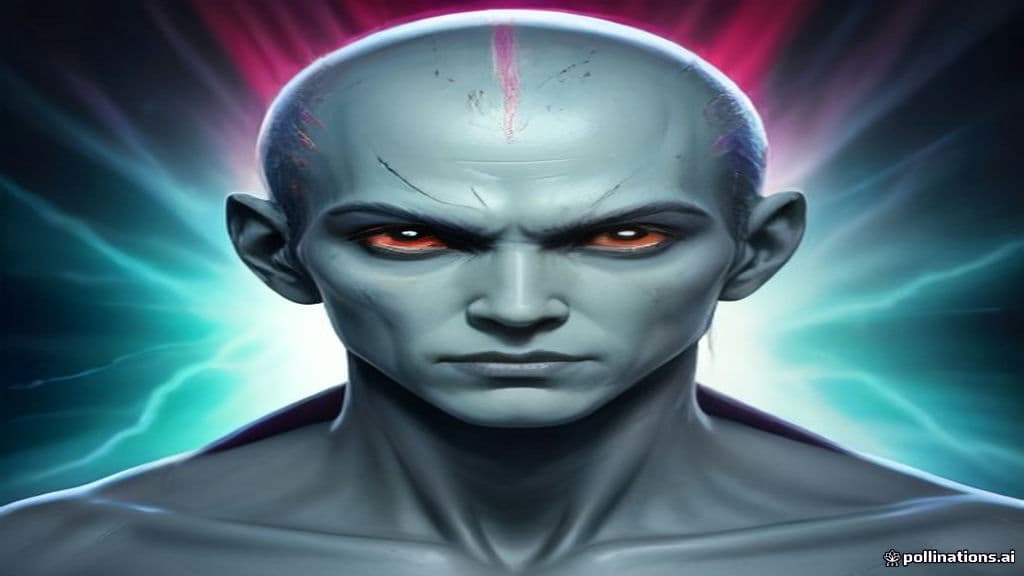
Blastaar
Blastaar is a fictional extraterrestrial monarch and recurring antagonist in Marvel Comics, a warlord from the planet Baluur in the Negative Zone who pursues conquest, rules Baluurians at times, and repeatedly clashes with Earth heroes.
791 documented Modern and Internet supernatural beings from the Evil Eye grimoire, including 380 lesser and 197 minor spirit in power tier.
page 5 of 14

Blastaar is a fictional extraterrestrial monarch and recurring antagonist in Marvel Comics, a warlord from the planet Baluur in the Negative Zone who pursues conquest, rules Baluurians at times, and repeatedly clashes with Earth heroes.

Blaze and Satanus are fictional demonic twin siblings in the DC Comics cosmology who have, in various storylines, claimed rulership over infernal domains (such as Purgatory, the Nether World, or the Dark Realm) and act as recurring supernatural antagonists to magical heroes.

The Blazing Skull is a fictional Golden Age comic-book superhero first published by Timely Comics (later Marvel Comics). Mark Anthony Todd, a foreign correspondent, is transformed and trained by a non-human group called the Skull Men and operates as a wartime and later-era champion with a flaming-skull motif and superhuman abilities.

Bleez is a fictional comics character appearing in DC Comics, identified with the Red Lantern Corps — an organization whose power derives from the emotional spectrum of anger. The provided sources classify Bleez as a comics character and link her affiliation to the anger-powered Red Lantern Corps.

Blind Al (Althea Winifred Sanderson) is a fictional, non-supernatural supporting character in Marvel Comics who serves as a long-term companion, housemate, and verbal foil to Wade Wilson (Deadpool). Presented as an elderly, blind woman with a sharp tongue and complex interpersonal authority, she appears across Deadpool comics and film adaptations.

A Golden Age American costumed crime-fighter published by Timely Comics (later Marvel Comics). The Blonde Phantom is the masked vigilante identity of secretary Louise Grant (later Louise Mason), a glamorous alter ego who aids detective Mark Mason and starred in her own comics in the late 1940s and was revived in Modern Age stories beginning in 1989.

Bloodwynd is a legacy superhero identity in DC Comics tied to a mystical 'blood gem' created by an ancient ritual. The gem houses the spirit Rott (the incarnate spirit of Jacob Whitney in the gem's microscopic world) and bestows necromantic and psychic powers on its bearers while exacting moral and metaphysical costs.

A mirror-associated apparition invoked by chanting a female name in dim or candlelit conditions. Originating in catoptromantic divination practices, the figure functions in modern youth-lore and urban legend as an ambiguous ghost/witch who may reveal future information or enact violent harm on participants.

Blue Beetle is a published fictional superhero identity in American comic-book tradition that has been held by multiple human protagonists. The Jaime Reyes incarnation is the modern, scarab-bonded teenager whose scarab morphs into an armored battle suit; the mantle as a whole illustrates editorial legacy, shifting origins (chemical, mystical, technological), and reinvention across publishers (Fox, Charlton, DC).

A fictional interstellar organization in DC Comics that channels the blue light of the emotional spectrum—hope—through power rings and constructs. Founded by former Guardians Ganthet and Sayd on the planet Odym, the Corps acts as a structured order whose abilities often function cooperatively with other Lantern Corps, especially the Green Lantern Corps (willpower).

A reported large feline/phantom cat alleged to inhabit the Blue Mountains region west of Sydney, Australia. Treated in local belief and contemporary folklore as an outsized cat—often described as panther-sized—sustained by repeated eyewitness reports, occasional physical traces, and periodic investigations rather than by scientific confirmation.

The Blue Nile patas monkey (Erythrocebus poliophaeus), also called Heuglin's patas monkey, is an Old World monkey species native to the Blue Nile river valley of Ethiopia and Sudan and possibly South Sudan. Described in 1862, it was long treated as conspecific with other patas monkeys until re-elevation to species status in 2017; its distribution, ecology, and population status remain poorly known.

The Blue Snowman is a fictional comic-book supervillain in the DC Comics universe who acts as a recurring adversary of Wonder Woman. Portrayed as Byrna Brilyant, the character employs genius-level inventiveness and specialized cold/cryogenic technology—most notably devices that generate "blue snow"—while wearing a distinctive snowman-themed blue costume or exo-suit. The Blue Snowman has no innate supernatural powers; threats are technological and resolved by heroic intervention.

Blue Trinity (Russian: Голубая Троица, Golubaya Troitsa) is a fictional team of three Soviet-engineered superhuman operatives in DC Comics, created by Soviet scientists as state-controlled assets in a Cold War narrative; they are described in sources as abnormally strong, emotionally unstable, and raised for loyalty to the Soviet Union.

The boar principally denotes the species Sus scrofa (wild boar) in natural-history contexts and a recurring mythic motif in which monstrous or divine boars ravage lands or act as avatars of deities. Appears across Greek heroic myths (Calydonian, Erymanthian), Indic theistic narrative (a divine boar-form assumed by the Lord), and modern fiction (horror film, comics).

Bob the Galactic Bum is a fictional comic-book character created for a 1995 four-issue DC Comics mini-series. Presented as a satirical, idiosyncratic protagonist, Bob is a low-status, bumbling figure transposed into a spacefaring, science-fiction setting and used as a vehicle for humor and pastiche.

Bob, Agent of Hydra is a fictional, non‑superpowered human character from Marvel Comics who functions as a low‑level HYDRA operative and recurring comic relief sidekick to Deadpool. He appears in Deadpool‑adjacent narratives (notably Cable & Deadpool) and in fandom, merchandising, and tabletop hobby contexts.

A folkloric, non‑canonical monster figure invoked across cultures as a disciplinary device to frighten children into compliant behaviour; presented in sources as a flexible category rather than a single, systematized being and often used figuratively as a personification of terror.

The supplied sources do not document Bolg as a traditional supernatural being. Available references identify 'Bolg' primarily as a proper name in modern popular culture (a Middle-earth character in J. R. R. Tolkien's fiction) and as an ordinary lexical item in other contexts (e.g., Irish 'bolg' meaning 'belly'). No ethnographic or folkloric description of a supernatural entity named Bolg is present in the provided materials.

Booster Gold (Michael Jon "Booster" Carter) is a fictional superhero from DC Comics: a 25th-century human who travels to the 20th/21st century using future technology to operate as a publicity-minded hero in Metropolis and later matures into a more responsible protector involved in time-travel storylines and Justice League membership.

Borimir is a South Slavic masculine given name formed from Slavic elements meaning 'battle' (boj/bor-) and 'peace/world' (mir). The name appears in contemporary use in South Slavic regions and in online cultural contexts; there is no evidence in the provided sources that Borimir denotes any supernatural being.

Borus is attested in the provided sources primarily as an onomastic item — an ancient Greek personal name attested in mythographic genealogies — and secondarily as a modern place-name, vessel name, and various contemporary or fictional name-uses. The supplied material contains no evidence that Borus is a spirit, deity, or other supernatural being.

Bouncing Boy is a fictional superhero (Charles Foster 'Chuck' Taine) appearing in DC Comics, best known as a member of the Legion of Super-Heroes whose primary Silver Age power is to inflate into an elastic sphere and bounce. Across continuities he functions as comic relief, morale officer, and occasional tactical asset; in some reboots he is non-powered and serves as the Legion's engineer/architect.

Brainiac is a recurring supervillain in the Superman/DC Comics fictional universe: a hyper-intelligent non‑human agent—variously depicted as an android, cyborg, or extraterrestrial—obsessed with collecting knowledge and known for shrinking cities (notably Kandor) and preserving them aboard a skull‑shaped spaceship. First appearing in Action Comics #242 (July 1958), he is portrayed across continuities as a persistent strategic threat whose artificial consciousness is repeatedly resurrected in new physical forms.

Brainiac 5 (Querl Dox) is a fictional Coluan genius and long‑standing member of the Legion of Super‑Heroes in DC Comics, notable for prodigious scientific inventions and for being a descendant of the original Brainiac. His stories center on invention, unintended consequences from his creations, and his attempts to atone for or distance himself from his ancestor's villainous legacy.

Bree is a proper name and toponym attested across multiple geographic and cultural referents (places in Belgium, France, Ireland, the Netherlands, South Africa) and as a personal and fictional name (including a village in J. R. R. Tolkien's Middle-earth). It is not presented in the supplied sources as a supernatural or folkloric being.

A contemporary English-language personal name borne by multiple real persons (politician, developer/designer, CEO, academic) and a fictional Marvel Comics character associated with S.H.I.E.L.D. and Weapon X. The corpus shows no evidence that the name denotes any supernatural or folkloric entity.

Brian David Banner is a fictional human character in Marvel Comics whose lifelong abuse, alcoholism, institutionalization, death, and posthumous spectral appearances function as recurring psychological antagonists in the life of his son, Bruce Banner (the Hulk). Created for The Incredible Hulk (vol. 2) #267 (1982), he appears as a violent, unstable man in flashbacks and later as a taunting apparition and a temporarily resurrected assailant in crossover storylines such as Chaos War.

Bridge Worms are a contemporary internet urban-legend creature described in online fandom as lairing beneath bridges and overpasses and using fake faces to lure human victims. They are presented as part of a modern artist-created mythos circulated on the web rather than a traditional folkloric being.

A modern folkloric and cryptozoological category in Britain referring to reported sightings of large non-native felines (panthers, pumas, lynx, 'black cats') across the United Kingdom; treated variously as escaped exotic animals, media-driven urban legend, and a continuation of older large-cat motifs in local tradition.

Bronze Tiger (Benjamin 'Ben' Turner) is a fictional DC Comics character: an African-American, world-class martial artist, operative, and recurring figure who has served as assassin, mercenary, instructor, and member/second-in-command of Amanda Waller's Suicide Squad. Created in the Bronze Age of comics, his history includes training under O-Sensei, capture and brainwashing by the League of Assassins, and later rehabilitation and multimedia adaptations.

No attested folkloric entity called 'Brook horse' appears in the supplied sources. The corpus contains a general note on Germanic water-spirits (nixie family) and several toponymic references to brooks and places named with 'Horse' or 'Brook'; any linking of these materials into a distinct 'Brook horse' folk-entity is not documented in the provided research notes.

Brother Jonathan is a literary and pictorial personification and stock character representing New Englanders (and at times the United States) in 18th–19th century Anglo‑American print culture. He functions rhetorically in satire, political commentary, and self‑identification rather than as a supernatural being.

A recurring organized team of superpowered mutants in Marvel Comics who oppose the X-Men and pursue mutant-centered political and militant goals. Formed in the 1960s and reconstituted in multiple incarnations, the Brotherhood ranges from a band of supervillains to a political/militant movement advocating mutant supremacy.

A long‑reported series of unexplained nocturnal lights observed near Brown Mountain in Burke County, North Carolina. Local storytelling treats them as mysterious 'ghost lights,' while early 20th‑century USGS investigations and later skeptical accounts correlated many sightings with ordinary light sources such as locomotive and automobile headlights and brush fires.

Bruce Wayne is a fictional human persona in American popular culture and the DC Extended Universe: a wealthy playboy, philanthropist, and industrialist who adopts a bat-inspired vigilante identity to combat crime in the fictional Gotham City. In the shared franchise he functions as an urban protector and connective figure among other major heroes and villains.

Bruenor Battlehammer is a recurring fictional dwarf character in the Forgotten Realms setting, portrayed as a warrior-king, master smith, and member of the adventuring group the Companions of the Hall. He is chiefly associated with Mithral Hall and the Icewind Dale region and appears across novels, game products, and fan compilations.

Bruno Mannheim is a recurring fictional organized-crime boss in DC Comics and derivative media, leader of Intergang and a recurring antagonist of Superman and allied heroes. Across continuities he functions as a power broker who sometimes employs or is empowered by Apokoliptian/New God elements (notably Darkseid and agents such as Kanto).

James Buchanan "Bucky" Barnes is a fictional human character created for American comic books published by Marvel Comics (originally Timely Comics). Introduced in 1941 as the youthful sidekick of Captain America, he was later retconned and reinvented in modern comics as the brainwashed cyborg assassin the Winter Soldier before regaining memories and seeking redemption.

Buer is a named spirit recorded in Renaissance grimoire tradition (notably the 16th-century Pseudomonarchia Daemonum) described there as a Great President of Hell who commands fifty legions of demons. Modern occult, gaming, and fan sources have elaborated visual and ritual details not attested in the supplied historical extracts.

A nom-de-crime used by two DC Comics supervillains and later media adaptations for insect-themed criminal inventors who employ robotic or biologically inspired insect devices to commit theft, extortion, and assaults on technology-rich targets. The identity has appeared as Bertram Larvan (original comics), an unnamed son (later comics), and as a female reinterpretation Brie Larvan in Arrowverse television.

A stock figure and visual trope of early- to mid-20th-century speculative fiction and related fan cultures, characterised by oversized, bulging or compound eyes and used as a conventionalised nonhuman antagonist signalling sexualized danger, abduction or general menace.

A folkloric scare-figure historically invoked to frighten disobedient children, classed among boogeyman-type beings. Medieval descriptions in English sources portray it as a creepy, bear-like lurker in woods; modern popular culture and gaming have reimagined it as a large goblinoid monster.

Bulgasari (불가사리, also romanized Bulgasali) is a kaiju-style iron-eating monster originating in mid-20th-century Korean cinema. The creature is best known from the lost 1962 South Korean film Bulgasari, in which a martial artist (Nam Hyeong) is resurrected as the iron-eating monster to enact revenge on his murderers; a distinct later North Korean film titled Pulgasari (1985) is related in film-history discussions but is a separate production.

Golden Age American comic-book heroes created for Fawcett Comics: Jim Barr (Bulletman), a ballistics expert/inventor who developed a chemical "crime cure" and a bullet-shaped Gravity Regulator Helmet, and Susan Kent (Bulletgirl), who received a second helmet and the same enhancements. Human inventors/experimenters rather than supernatural beings, they act as engineered, helmet-enabled crimefighters in wartime-era and later shared-universe stories.

The Bunny Man is an American urban-legend figure that grew out of two late-1970 criminal incidents in Fairfax County, Virginia (October 19 and October 31, 1970). Reported as a man associated with a rabbit costume who threatened or attacked people with a hatchet/axe, the story expanded through newspapers, school rumor, folkloristic research, and the early internet into dozens of highly variant retellings, some supernaturalized.

A fragmentary modern-media term rather than a coherent traditional spirit in the supplied sources; the clearest folkloric-like depiction within the provided materials is the fictional burabura chochin — a benign 'wandering lantern' spirit from the video game Final Fantasy XIV. Other occurrences of 'bura'/'burabura' in the sources are mainly Japanese-language titles and modern media that use the lexical sense of 'wandering' rather than describing a single supernatural being.

Attested chiefly in Final Fantasy XIV game materials, the Burabura Chochin is presented as a benign 'lantern ghost' or wandering lantern spirit associated with Mount Rokkon; the label 'burabura' evokes wandering or dangling in contemporary Japanese usage. It functions in-game as a summonable minion/mount and as a narrative creature that befriends other wanderers rather than haunting them.

Busang is not attested as a supernatural being in the supplied sources; rather it is a polyvalent proper name found as a toponym (places in Borneo), a lect name (Busang Kayan), a mining prospect label (Busang deposit in the Bre‑X scandal), and as a personal name. No mythological origin, appearance, powers, or ritual practices directed at a supernatural Busang are recorded in the provided material.

Bêlit is a fictional Shemite pirate-queen from Robert E. Howard's Hyborian Age, captain of the ship Tigress and romantic partner of Conan in the short story "Queen of the Black Coast" (1934). Presented as a mortal warrior-leader whose life and death intersect with supernatural elements in the tale, she is remembered as an avaricious and charismatic sea-queen in later adaptations and comics.

A term originating in Ancient Greek (κακοδαίμων, kakodaimōn) denoting an "evil spirit" — the morally malign subset of daimōn — later reused in literature, psychiatry (cacodemonia), occult fragments, and popular culture where it appears as a videogame monster. Sources present the cacodemon both as a moralized spirit-type in classical-language summaries and as various modern imaginative creatures rather than a single fixed biological species.

Cafall (also spelled Cavall) is named in Welsh Arthurian tradition as King Arthur's hunting dog, associated particularly with the hunt for the great boar Twrch Trwyth. The figure appears both in brief traditional notices and in modern literary reuse (notably Susan Cooper's The Grey King).

Cagnazzo is a named member of Dante Alighieri's Malebranche, the infernal squad of demons encountered in Cantos XXI–XXIII of the Inferno. His name (Italian for "nasty dog") and Dante's single verbal reference to a "muzzle" suggest canine implications in the poem, while modern media later reuse the name for various antagonists and guardians.

Caiera is identified in the provided sources as a fictional character from Marvel Comics, associated with the Planet Hulk storyline. The available materials do not provide folkloric attributes, rituals, or traditional beliefs about her.

Caim is a named infernal intelligence attested in modern compilations of Western grimoire-derived materials. In secondary occult summaries he is listed among Goetic/solomonic demons, variably called Caim, Camio, or Caym, and is described as a ranked officer associated with imparting knowledge about animals and nature.

Calafia (also Califia) is a fictional queen introduced in Garci Rodríguez de Montalvo’s early 16th‑century chivalric romance Las sergas de Esplandián (c. 1510). In the narrative she is ruler of a mythical Island of California, portrayed as a regal Black woman who commands women warriors and griffins and is later captured, converted to Christianity, and integrated into the chivalric plot.

Calcabrina is one of the Malebranche — a named demon/jailer appearing in Dante Alighieri's Inferno who helps guard the fifth bolgia of the eighth circle of Hell. The name has been reused in modern fiction and games where adaptations portray Calcabrina as a guardian or combatant (gargoyle, construct, or voidsent), distinct from Dante's literary role.

Calendar Man (Julian Gregory Day) is a human, themed criminal persona in DC Comics who plans crimes and adopts costumes tied to dates, holidays, weekdays and seasons. A recurring antagonist in Batman stories, he has been portrayed across continuities as a Silver Age gimmick-villain, a darker Arkham inmate and a Hannibal Lecter–like informant in modern noir tales.

Caligo is a taxonomic genus of large Neotropical butterflies commonly called owl butterflies, noted for conspicuous eyespot markings. The name appears in modern artistic/media contexts (e.g., music tracks, video titles) but the supplied sources do not present Caligo as a supernatural being or part of any traditional mythological cosmology.

Callirhoe (also Callirrhoe, Callirhoé) is a name attested across Greek myth, classical literature, toponymy, and botanical taxonomy. The provided sources do not present Callirhoe as a single supernatural spirit or consistent cosmological entity; instead the name refers to several mythological characters, an ancient Greek novel and its artistic adaptations, a place with baths near the Dead Sea, and a genus of mallow-family plants used in horticulture and traditional herbal practice.