
Classical mythic accounts place Aegipan among goat‑legged liminal beings connected to pastoral deities; some sources (e.g., Hyginus as summarized in later compendia) call him a son of Zeus (others supply Apollo or different genealogies), while other traditions identify him with or as father of Pan. He is chiefly attested in the narrative of the gods’ struggle with Typhon, where he acts as a helper who aids in restoring Zeus's stolen sinews. Subsequent Roman and medieval writers repurposed the name (Aegipanes/Oegipans) as a label for satyr‑like or bestial humanoids alleged to inhabit remote regions such as Libya.
In classical and iconographic traditions Aegipan is represented with goat attributes—goat legs or goatheaded features—and in some accounts (and in stellar/constellation iconography) as part goat, part fish, producing the sea‑goat image linked to Capricornus. Later natural‑history and bestiary descriptions use the term to denote satyr‑like or ape‑like wild men; these later accounts emphasize bestial or monkey‑like features rather than the semi‑divine, cultic aspect of the mythic figure.
In the surviving mythic narrative Aegipan's notable action is his role (alongside Hermes in some accounts) in retrieving and restoring the sinews of Zeus after they had been removed during the Typhon episode—an act that associates him with cunning, resourcefulness, and service to the Olympian order. Classical sources do not ascribe broad magical powers beyond this episode. Later natural‑history uses do not attribute supernatural abilities to the so‑called aegipans, describing them instead as bestial peoples.
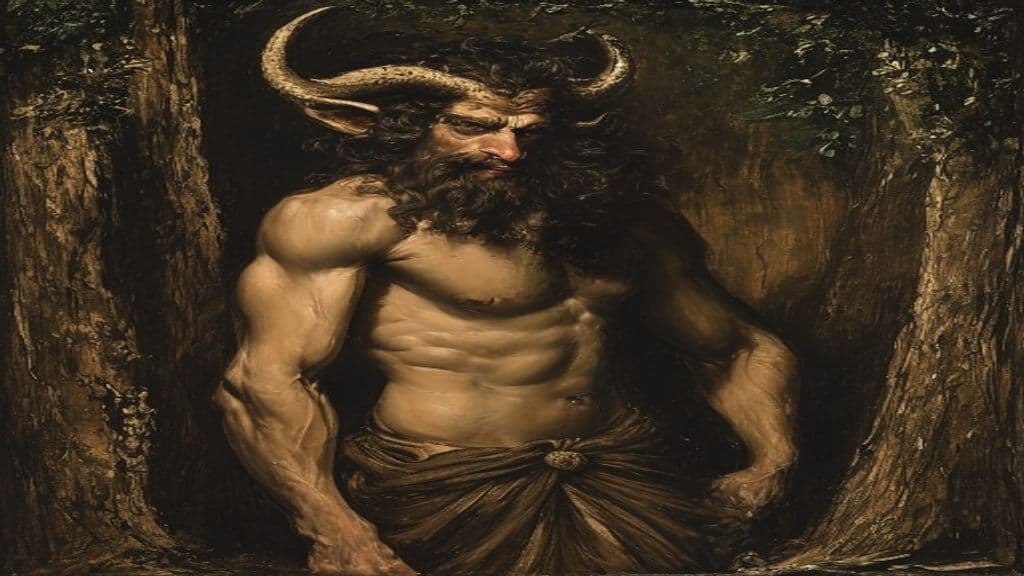
*Péh₂usōn (reconstructed)
Péh₂usōn is a hypothetical Proto‑Indo‑European pastoral guardian reconstructed by comparative scholars from parallels in Greek and Vedic traditions. Proposed as a Graeco‑Aryan ancestor‑figure, the reconstruction describes a protector of flocks, roads, and travellers rather than an attested historical cultic personality.
Aba (disambiguation / name-form)
Aba is a polyvalent name-form attested across many unrelated contexts (place names, personal names, animal names, and brief mythological listings). The provided sources do not support a single, coherent supernatural entity called "Aba" and offer no descriptive or ritual material for such a being.
Abaddon
In Hebrew scripture Abaddon is primarily a noun meaning 'destruction' or a section/condition of the underworld paired with Sheol; in the New Testament Book of Revelation Abaddon is personified as an angelic figure (Greek Apollyon) described as the king of an army of locusts released from the abyss during the apocalypse.
Abadir
Abadir is a polysemous name attested in distinct cultural contexts: a legendary founding saint and clan ancestor in eastern Ethiopia (Sheikh Abadir Umar Al‑Rida / Aw Abadir), a term applied to cone‑shaped cult stones in Phoenician religious description, and a personal name of a martyr (Abadir/Apater) in the Coptic Synaxarium. The attestations are independent usages of the same name rather than a single supernatural being.
Abadiu of Antinoe
Abadiu of Antinoe was a fourth‑century bishop of Antinoe (Antinoopolis, in Roman Egypt) commemorated as a martyr and saint in the Coptic Orthodox Church, with a feast day on 26 December. Sources record that he was killed during a theological dispute with Arian opponents and reference him in collections of Egyptian martyrs.
Abagtha
Abagtha (Hebrew: אבגתא, ’Ǎḇaḡṯā) is a named human court official in the Hebrew Bible’s Book of Esther, listed among seven chamberlains who ministered before King Ahasuerus and were commanded to bring Queen Vashti before the king. He is attested only in Esther 1:10 and is presented as an institutional palace attendant rather than a supernatural being.
Abandinus
Abandinus is a locally attested Romano‑Celtic theonym known from a single inscribed bronze feather (votive object) dedicated at Godmanchester (the Roman fort Durovigutum) in Cambridgeshire. Scholars interpret him as a local god or male spirit tied to a specific place and possibly associated with a nearby spring or stream; this association is tentative and based on etymological readings of the name.
Abanoub
Abanoub is a 4th‑century Egyptian Christian child martyr venerated in the Coptic tradition. Remembered for his public confession of Christ, miraculous healings associated with his passion, and the translation and veneration of his relics, his feast is observed on July 31 (Epip 24) and his cult centers include Nehisa and Samanoud.
Abarbarea
Abarbarea is a name attested in classical Greek and Roman sources for freshwater nymphs (naiads). The name appears for at least two individual mythic figures — a naiad wife of Bucolion and a naiad counted among ancestors of the Tyrians — and Hesychius records plural forms that may indicate the name was also used as a class-name (Abarbareai / Abarbalaiai).
Abas
Abas (Ancient Greek: Ἄβας, gen.: Ἄβαντος) is not a single mythic being but a recurring personal name borne by multiple mortals and minor mythic figures in Greek epic and genealogical traditions — kings, founders, seers, warriors, attendants, a centaur, and a youth transformed by a goddess. The name is glossed in the sources as 'guileless' or 'good-hearted' and appears across Argive, Theban, Trojan, Euboean, and other local cycles.
Abaskhiron the Soldier
A Coptic Orthodox martyr venerated for refusing imperial idolatry during the Diocletian persecution; reputedly healed by the Archangel Michael, preserved in monastery relics, and commemorated on 14 June (7 Paoni).
Abdel Messih El-Makari
Abdel Messih El-Makari (1892–1963) was a Coptic Orthodox monk and priest venerated as a 20th‑century Coptic saint. Associated with the Monastery of Saint Samuel the Confessor and the Monastery of Saint Macarius (Scetes/Wadi El‑Natrun), he is remembered for humility, asceticism, charity, and reported spiritual gifts such as prescience, discerning of spirits, and healing.
Community Record
- [1]Aegipan — Wikipedia. Wikipedia: 'Aegipan' (entries on name, mythology, literature)wiki
- [2]AEGIPAN (Aigipan) — Theoi Greek Mythology. Theoi Project: summary of Aegipan as goat‑legged figure and association with Capricornusliterary
- [3]The Gigantomachy (LP0026) — archive items referencing mythic scenes. Archive: visual/compilation materials linked to Gigantomachy and related mythic iconographyother
- [4]Wikidata: Aegipan (Q3088918). Wikidata entry summarizing variant parentages and transferral to the starsother
- [5]Pliny & medieval bestiary tradition (as summarized in modern sources). Wikipedia summary of Pliny the Elder's usage of 'Aegipanes/Oegipans' and continuation in medieval bestiarieswiki