
Agrat bat Mahlat appears in rabbinic and midrashic texts as a named daughter of Mahlat and a powerful night spirit; Talmudic anecdotes (as preserved in Pesachim and related rabbinic discussions) portray her as one of the demons who 'go out' at night and as subject to restriction by holy sages (e.g., Ḥanina ben Dosa and Abaye). Later Zoharic and Kabbalistic materials expand her role, listing her among the quartet of female consorts/"mothers" associated with Samael and depicting her as a queen of unclean spirits whose existence continues until an eschatological eradication of uncleanness. These layers—rabbinic anecdote, midrashic citation, and Kabbalistic systematization—constitute the primary attested origin and development of her figure in the supplied corpus.
Primary rabbinic and Kabbalistic sources cited in the provided material supply little sustained physical description; the tradition emphasizes her role, lineage, and retinue rather than fixed corporeal features. Some later popular and modern sources portray her in succubus‑like or sexualized terms, but such portrayals are receptions and expansions beyond the sparse physical portrait present in the original rabbinic and Zoharic excerpts.
In the Talmudic tradition Agrat is associated with nocturnal activity and the leadership or accompaniment of many destructive spirits (a cited rabbinic line reports that 'she and 180,000 angels of destruction go out' on certain nights, each with permission to destroy). She is presented as capable of threatening humans at night but also as subject to restriction by pious sages—stories record Ḥanina ben Dosa and Abaye decreeing limits on her passing through inhabited places. In later Kabbalistic texts she is named among the principal female consorts of Samael and counted among the 'mothers' or queens of demonic/unlean spirits, and Zoharic passages add named minions (e.g., a chief minion Joseph). Some traditions also represent her as a transmitter of occult lore (for example, accounts that she taught or communicated secret knowledge to sages), a role attested in secondary/receiving traditions within the supplied materials.
Weaknesses
- ritualRestriction/Decree by a holy sage (e.g., Ḥanina ben Dosa, Abaye)
- mantraScriptural protection (Psalm 91:5) and the 'ineffable Name' as cited in midrashic tradition
Wards
- ritualAvoid going out alone at night (communal/rabbinic admonition)
- symbolInscription of divine/ineffable Name or Psalmic verse on a weapon or amulet (midrashic implication)
- ritualAppeal to the authority of a pious sage or Torah-sanctioned intervention

Lilith
Lilith is a feminine night‑spirit in Jewish mythic, magical, and folkloric traditions associated with harmful nocturnal activity, especially threats to sleeping people and infants. The figure appears both as a class of night‑spirits (lilit/lilītu) in Near Eastern demonologies and as an individualized dangerous woman in later medieval Jewish narratives and amulets.

Naamah
Naamah is a name attested in the Hebrew Bible for several mortal women and later reworked in Jewish mystical and folkloric literature as a feminine supernatural figure associated in Zoharic material with the archangel Samael and with erotic/nocturnal motifs; in some later traditions she is linked with unions to angelic or fallen figures that produce classes of spirits (shedim/sedim).

Eisheth Zenunim
A feminine personification from Zoharic Kabbalah identified with sexual immorality and named among a quartet of female partners of Samael. Later Western esoteric and popular sources reinterpret her as a Qliphothic princess or succubus-like 'queen' of demons.
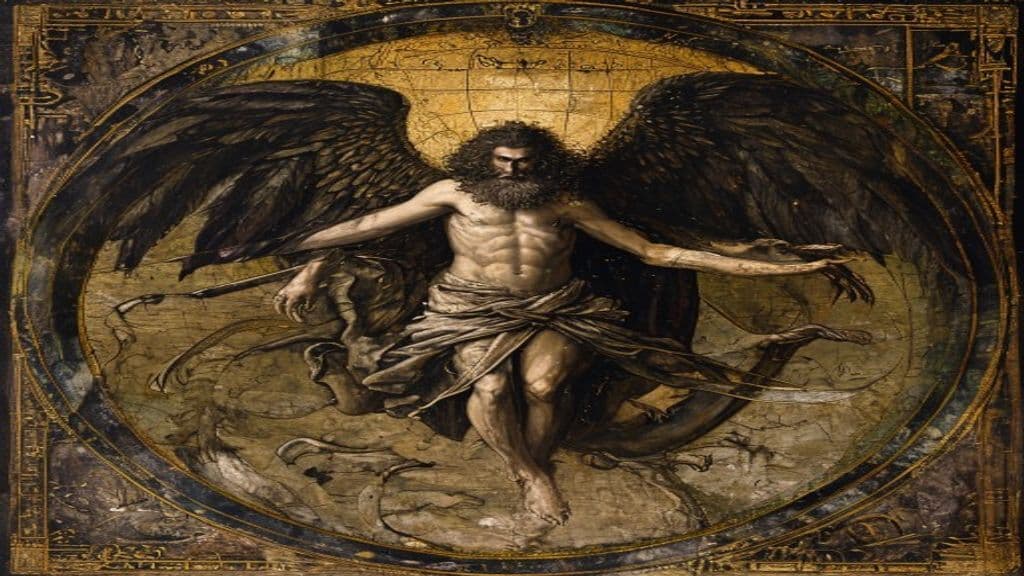
Samael
An angelic figure in Jewish textual traditions whose roles include accuser/adapter (Satanic function), tempter, destroyer/angel of death, and, in later mystical texts, leader of demonic or qlippothic forces. Samael is presented variously across Second Temple literature, midrashim, and Kabbalah; his destructive functions are often framed as serving divine purposes rather than as an independent absolute evil.
*Perkʷūnos
*Perkʷūnos is the reconstructed Proto-Indo-European thunder‑god hypothesized by comparative linguistics and mythology. Scholarly reconstructions portray him as a storm or thunder figure associated with fructifying rain and as the combatant who fights a multi‑headed water‑serpent to release life‑giving waters; no direct attestations from the Proto‑Indo‑European period survive and the figure is inferred from later Indo‑European traditions.
*Péh₂usōn (reconstructed)
Péh₂usōn is a hypothetical Proto‑Indo‑European pastoral guardian reconstructed by comparative scholars from parallels in Greek and Vedic traditions. Proposed as a Graeco‑Aryan ancestor‑figure, the reconstruction describes a protector of flocks, roads, and travellers rather than an attested historical cultic personality.
57 Mnemosyne
57 Mnemosyne is a large main-belt asteroid (S-type) discovered in 1859 and named after the Greek Titaness Mnemosyne. It is a non-sentient astronomical body studied for its orbital and rotational properties and has been used in dynamical measurements related to Jupiter.
Aaron
Aaron is a central human figure in Israelite sacred literature: the elder brother of Moses, the first high priest (progenitor of the Aaronide priesthood), and a spokesman/prophet who mediates between Israel and God in Exodus–Deuteronomy narratives. His role in the texts establishes hereditary priestly authority, ritual functions (sacrifices, blessing, use of Urim and Thummim), and institutional norms for Israelite cultic life.
Abaddon
In Hebrew scripture Abaddon is primarily a noun meaning 'destruction' or a section/condition of the underworld paired with Sheol; in the New Testament Book of Revelation Abaddon is personified as an angelic figure (Greek Apollyon) described as the king of an army of locusts released from the abyss during the apocalypse.
Abagtha
Abagtha (Hebrew: אבגתא, ’Ǎḇaḡṯā) is a named human court official in the Hebrew Bible’s Book of Esther, listed among seven chamberlains who ministered before King Ahasuerus and were commanded to bring Queen Vashti before the king. He is attested only in Esther 1:10 and is presented as an institutional palace attendant rather than a supernatural being.
Aban Yasht
The Aban Yasht is a hymn from the Persian tradition that praises Anahita, a goddess associated with water, fertility, and wisdom. It consists of 132 stanzas and is part of the 21 Yashts collection. (Note: - Power tier should be "Primordial" or possibly "Cosmic", given that it's a hymn of great spiritual significance and associated with a goddess. - The article incorrectly states that Anahita is associa)
Abath
No corroborated folkloric entity named "Abath" is documented in the provided sources. The string appears in the supplied material only as a surname/personal name in Aruban/Dutch-Caribbean archival records and as an unrelated taxonomic or encyclopedic hit; no mythic attributes, origin stories, rituals, or apotropaic practices for an entity called Abath are present in the documents reviewed.
Abatur
Abatur is an uthra (celestial emanation) in Mandaeism described as the 'father of the Uthras' and called the Ancient (ʿattīqā). He resides on the boundary between the World of Light and lower regions, functions as a judge who weighs souls (Abatur Muzania), and supplies instructions and materials to the demiurgic uthra Ptahil in accounts from the Diwan (Scroll) of Abatur.
Abatwa (Twa / Batwa)
Abatwa (also recorded as Twa, Batwa, Mutwa; singular forms Barhwa or Murhwa in some transcriptions) are indigenous hunter‑gatherer peoples of the Great Lakes region of Central Africa, historically identified as some of the earliest inhabitants of the area. The available sources treat them as human ethnic groups whose livelihoods, lands, and populations have been severely affected by conservation policies and modern violence.
Abdiel
Abdiel (Hebrew עֲבְדִּיאֵל) is primarily a theophoric Hebrew personal name meaning "servant of El/servant of God," attested once in the Hebrew Bible (1 Chronicles 5:15). In later literature—most notably John Milton's Paradise Lost—Abdiel is reimagined as a faithful seraph who opposes Satan's revolt. The provided sources do not treat Abdiel as an autonomous folkloric spirit type or record rituals or wards associated with the name.
Abel
Abel is the second son of Adam and Eve in the Genesis narrative, a shepherd whose accepted offering and subsequent murder by his brother Cain form the biblical account of the first death. Later interpretive traditions expand his role, treating him as an archetypal righteous victim, a postmortem avenging or adjudicating figure, and in some systems (notably Mandaean) identifying him with an angelic lightbeing.
Community Record
- [1]Agrat bat Mahlat — Wikipedia. Wikipedia article 'Agrat bat Mahlat' (summary of rabbinic and Kabbalistic traditions)wiki
- [2]Wikidata entry for Agrat bat Mahlat. Wikidata item Q2913206other
- [3]Archive: Agrat Bat Mahlat.. Archive item referenced in the research notes (modern/derivative reception)other
- [4]Archive: Demon Girl succubus NSFW (3695755). Archive item listed among modern receptions/reinterpretationsother
- [5]Succubi Thoughts — Agrat bat Mahlat. Modern blog discussing Agrat's reception as succubus (used in notes to indicate later portrayals)folk