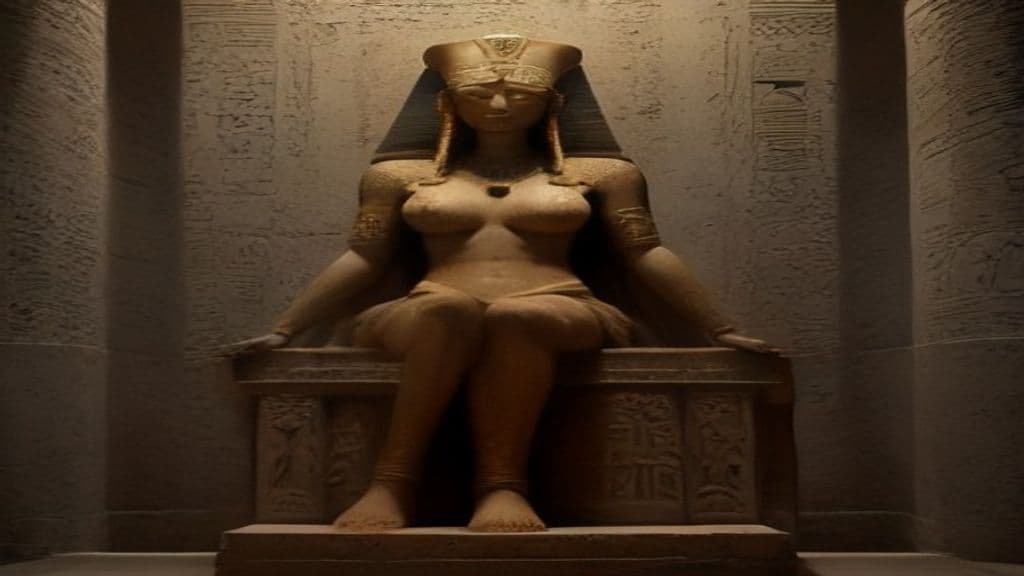
Ahmose‑Nefertari is first attested as a historical royal person: daughter of Seqenenre Tao and Ahhotep I and principal queen (great royal wife) of Ahmose I in the late Seventeenth and early Eighteenth Dynasties. She lived into the early reign of Thutmose I; sources estimate her death approximately in the fifth or sixth year of Thutmose I. After her death she was deified within New Kingdom religious practice and received an institutional cult with endowments and priestly offices attached to her name. Later records and modern summaries describe her posthumous status using cultic epithets — 'Goddess of Resurrection', 'Mistress of the Sky', and 'Lady of the West' — situating her among honored royal dead who functioned as protective and funerary intercessors in the Theban religious landscape.
The supplied sources do not provide a single standardized descriptive inventory of Ahmose‑Nefertari's appearance, but attest to her surviving visual representation in stone and relief. Attestations include a large seated statue at Karnak (described as one of the last statues created in her honor before she died), fragmentary reliefs that show her in the company of Amun and her son Amenhotep I, and reliefs associating her with royal processions in Nubia. These archaeological and museum pieces (statuary, relief fragments) are the basis for her iconographic presence in the record, though the provided materials do not quote detailed contemporaneous descriptions of dress, coloration, or specific regalia.
As a living royal Ahmose‑Nefertari bore a suite of royal and priestly titles (hereditary princess, great royal wife, king's mother, king's sister, God's Wife) that placed her at the intersection of dynastic authority and temple administration; later-era records indicate that the office attached to her cult (Divine Adoratrix / God's Wife of Amun) entailed responsibility for temple property, estates, workshops, treasuries and associated staff, implying significant administrative power vested in her and her descendants. In death she was the focus of organized cultic veneration: endowed priesthoods and land grants sustained her commemorative rites, she was commemorated locally (an annual cult holiday at Deir el‑Medina, II Shemu 14, is recorded in the literature), and she was invoked by epithets linking her to resurrection and western/sky domains. The provided sources do not attribute individual miraculous narratives or hostile supernatural acts to her; instead they present her efficacy in terms of institutionalized veneration, funerary protection, and ancestral-deified status.
Aani
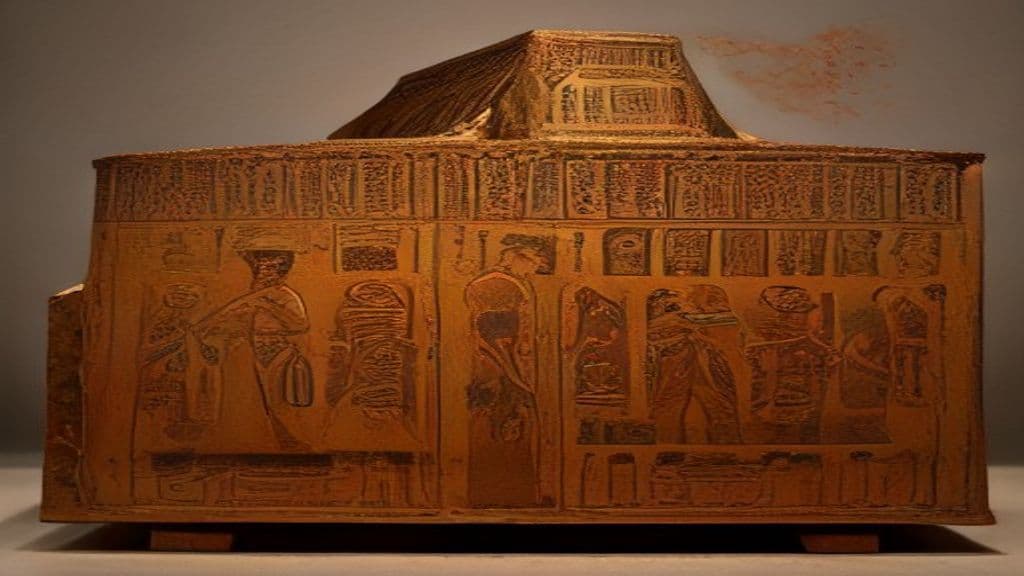
Aani (ancient Egyptian jꜥnr) is the lexical term for the baboon in ancient Egyptian language and functions in religious contexts as an animal icon and theophoric epithet. Attested repeatedly in Egyptian texts and images, the baboon image is used to represent or denote aspects of gods such as Thoth, Hapy, Khonsu, and Osiris rather than implying the animal itself is an independent deity.
Aati
Aati (also rendered Ati) is one of the 42 judges of the dead in ancient Egyptian funerary literature, attested in the Book of the Dead tradition (notably the Papyrus of Nebsemy). Described as originating 'from Heliopolis', Aati's documented function is to question the deceased about a specific moral accusation during the Duat judgment; the funerary texts supply a formulaic denial the soul must recite.
Abadiu of Antinoe
Abadiu of Antinoe was a fourth‑century bishop of Antinoe (Antinoopolis, in Roman Egypt) commemorated as a martyr and saint in the Coptic Orthodox Church, with a feast day on 26 December. Sources record that he was killed during a theological dispute with Arian opponents and reference him in collections of Egyptian martyrs.
Abaset
Abaset is a localized ancient Egyptian goddess attested in tomb decoration at El‑Bawiti in the Bahariya Oasis during the 26th Dynasty. She is depicted anthropomorphically with a hedgehog motif incorporated into her headdress and appears on the walls of Qarat Qasr Salim, including twice in the Tomb of Bannentiu. No cult texts, myth narratives, or ritual prescriptions for her are recorded in the cited corpus.
Abib and Apollo
Abib and Apollo are Christian ascetics and hagiographic saints of Akhmim (Upper Egypt) attested in Coptic sources and the Historia Monachorum. Remembered for extreme asceticism, monastic leadership, angelic encounters, and inclusion in the Coptic Synaxarion (feast day November 4).
Abyzou
Abyzou is a female malignant supernatural figure in Near Eastern and medieval European magico-medical and demonological traditions, blamed especially for miscarriages, stillbirths, and infant mortality. She appears in literary sources (notably the Testament of Solomon) and on Byzantine and medieval amulets where her flight or subjugation is commanded by names, images, and saints/archangels.
Abāmūn of Tarnūt
A fourth‑century Coptic Christian presented in later hagiography as a martyr from the city of Tarnūt (Therenuti). Known primarily from a single late medieval Synaxarion notice, he is commemorated liturgically for his voluntary confession and violent martyrdom.
Adder Stone (Egyptian Tradition)
A type of stone with specific physical characteristics, typically glassy and containing a naturally occurring hole, primarily made of flint. Not considered supernatural in Egyptian tradition. (Note: - Remove "primarily made of flint" from Appearance section, as it is not a characteristic unique to Adder stones. - Power tier should be "None" based on the source material, but clarify that this refe)
Adim (Egyptian Mythology)
In Egyptian mythology, Adim is a king and son of Budasheer who appears after the Great Flood. He has problem-solving skills and consults with his father's ghost for guidance. (Note: 1. The power tier should be Lesser (local spirit) as Adim is described as a king of Egypt, but not as having deity-level abilities. 2. Add sensory cues such as "consulting his father's ghost" and poss)
Agathos Daimon (Agathodaemon)
A beneficent household and civic daemon attested in classical Greek and Graeco‑Egyptian religion. In domestic Greece it is a household spirit honored with post‑meal libations; in Ptolemaic Alexandria it appears prominently in serpentine civic and household forms and is syncretised with various Egyptian protective and fate deities in late antiquity.
Ahmed al-Badawī
Ahmed al-Badawī (Aḥmad al-Badawī, al-Sayyid al-Badawī) was a 13th-century Arab Sufi mystic and founder of the Badawiyyah order. Born in Fes to a Bedouin tribe and later settled in Tanta, Egypt, his tomb remains a major site of visitation and he is regarded as one of the most popular Sufi saints in Egypt (sources emphasize his historical sainthood and pilgrimage cult rather than detailed folkloric attributes).
Aker
Aker is an ancient Egyptian personification of the horizon and an earth and underworld deity who is described in surviving summaries as guardian of the eastern (Bakhu) and western (Manu) horizons, marking liminal boundaries between day and night and between the living world and the netherworld.
Community Record
- [1]Ahmose-Nefertari (Wikipedia). Wikipedia article 'Ahmose-Nefertari'wiki
- [2]Wikidata: Ahmose-Nefertari. Wikidata entry Q239626other
- [3]Statuette of Arsinoe II for her posthumous cult (archive). Archive: statuette of Arsinoe II (comparative note on rare queen cults)other
- [4]Representation of Amun, Ahmes‑Nefertari and King Amunhotep I (Brooklyn fragment). Museum fragment image/description of a relief showing Amun, Ahmes‑Nefertari and Amenhotep Iother
- [5]Ancient Egypt Online — Ahmose‑Nefertari. Overview and notes on cult and mortuary aspectsother