
In the Dindsenchas tradition Boann is a daughter of Delbáeth and sister of Befind, placed among the older mythic population (the Tuatha Dé Danann). Two principal origin episodes are preserved in the narrative corpus. In one, Boann approaches Nechtan's forbidden Well of Segais and, having 'walked around it tuathal' (a ritualized contrarian movement), causes the well to burst forth; the waters surge to the sea and create the River Boyne. In the Dindsenchas version this flood consumes her, and she is said to have lost an arm, a leg and an eye in the catastrophe; variant accounts simply relate that she drowns when she approaches the well. In a related birth-tale, Boann lives at Brú na Bóinne with Elcmar and conceives Aengus by the Dagda after the Dagda sends Elcmar away and magically keeps the sun stationary so nine months pass undetected; Boann then gives birth to Aengus. These episodes present her both as an etiological figure for the Boyne and as the generative mother in a solstitial/seasonal motif.
The sources give no sustained iconographic or clothing description of Boann. Narratively she is portrayed as a named woman of genealogical placement rather than through a fixed visual portrait. Specific physical details in the texts are limited to outcomes of the well-origin tale (narrative mutilation in one version: loss of an arm, leg and eye) and incidental items associated with her household in other stories (for example, a lapdog named Dabilla is mentioned in the wider corpus). The supplied material does not record a consistent habitual appearance.
Boann's agency in the tradition is primarily mythic and etiological: by approaching and ritually encircling the Well of Segais she catalyzes a landscape-creating flood that forms the River Boyne. She exercises sexual and creative agency in conceiving Aengus by the Dagda; that birth-episode is linked in the sources and scholarship to a seasonal/solar motif (the sun kept standing still while nine months pass). In the Táin Bó Fraích she functions as a patronal benefactor: she furnishes her nephew Fráech with an extraordinary suite of gifts—fifty worked mantles and tunics, fifty jeweled spears, fifty horses, fifty swords, seven hounds, seven trumpeters, three jesters and three harpists—enabling him to appear with prestige before rulers. The texts also portray vulnerability: interactions with the sacred well lead to drowning or bodily loss in variant accounts, so her narratives combine creative potency with mortal risk when confronting forbidden waters.
Weaknesses
- conditionviolating prohibition / approaching a forbidden well
- conditionperforming a tuathal (contrary) circumambulation around the well
Wards
- conditionobedience to prohibition (do not approach Nechtan's/Segais well)
- conditionavoid ritual contrarian movement (do not walk tuathal around the well)
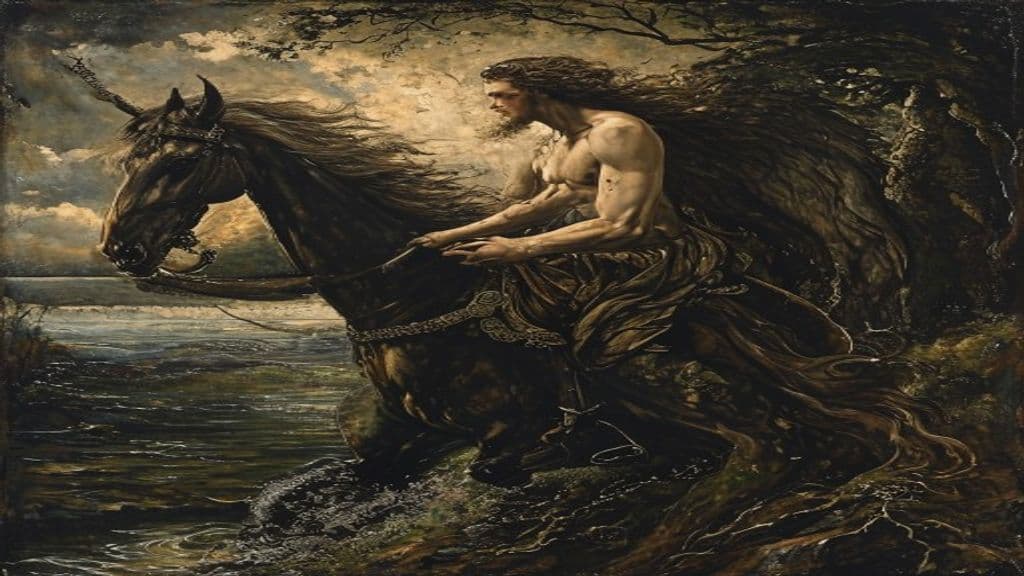
Aengus
Aengus (Óengus, Aonghus) is a member of the Tuatha Dé Danann in Irish myth, portrayed as a youthful, attractive figure associated with love, youth, poetic inspiration and seasonal/solar symbolism; he is linked to Brú na Bóinne (Newgrange) and appears as fosterer, protector, enchanter and avenger in multiple tales.
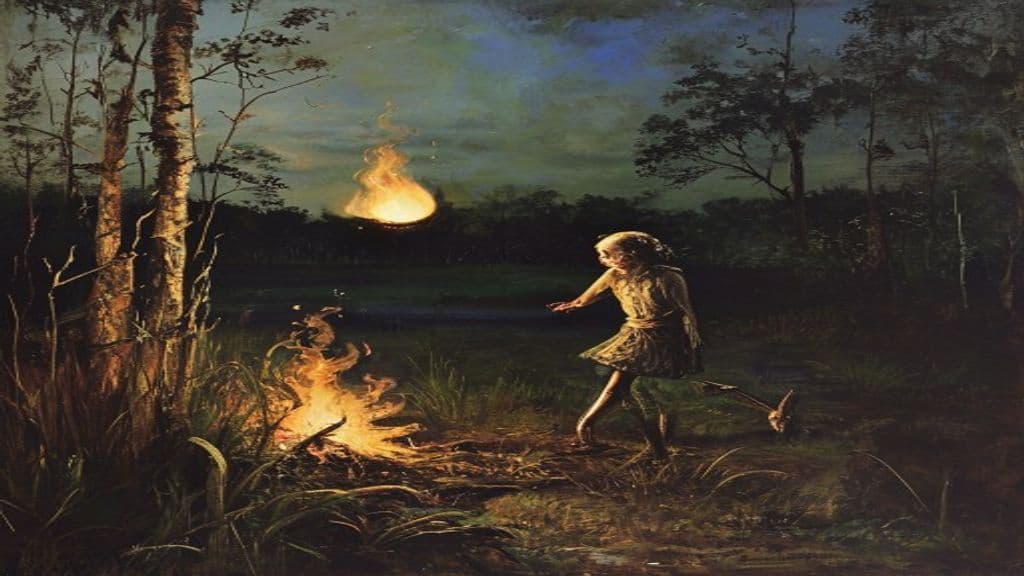
Will-o'-the-wisp
An atmospheric 'ghost light' — a small, mobile, lamp-like light seen at night over marshes, bogs, wet ground, or graveyards. In many cultures the phenomenon is interpreted as a supernatural being or manifestation (wandering nature-spirit, soul of the dead, transformed witch, or treasure-indicator); modern science offers chemiluminescent explanations for some occurrences.
Abandinus
Abandinus is a locally attested Romano‑Celtic theonym known from a single inscribed bronze feather (votive object) dedicated at Godmanchester (the Roman fort Durovigutum) in Cambridgeshire. Scholars interpret him as a local god or male spirit tied to a specific place and possibly associated with a nearby spring or stream; this association is tentative and based on etymological readings of the name.
Abarta (Ábartach)
Abarta (also Ábartach) is a figure of Irish myth who, in surviving accounts, tricks Fionn mac Cumhaill's warriors by giving them a supernatural grey horse that bears them into the Otherworld. Sources variably identify him as a member of the Tuatha Dé Danann or as a Fomorian; after the incident he is compelled to release the captured warriors and is refused entry to the Fianna.
Abcán (Abhcán)
Abcán (modern spelling Abhcán) is a named dwarf poet and musician of the Tuatha Dé Danann in Irish myth. He appears in a small number of narratives as a musician whose art has soporific power and as the ferryman who brings the goddess Ruad from the Otherworld to the human world.
Abhean
Abhean is a named poet of the Tuatha Dé Danann in medieval Irish literature, described as a poet in particular of Lugh and recorded as having been killed by Óengus before Midir in a poem by Fland Mainistreach preserved in the Lebor Gabála Érenn.
Abnoba
Abnoba is a Gaulish theonym and toponym attested in Roman-era sources and inscriptions: a localized deity associated with woods, springs and the sources of rivers (notably the Danube) and simultaneously the name applied to a mountain or mountain range in the Black Forest/Baar/Odenwald region. Roman altars equate her with Diana, reflecting syncretic cult practice in frontier provinces.
Accolon
Accolon is a mortal knight of the Arthurian court, presented in the Post-Vulgate Merlin tradition and Malory's Le Morte d'Arthur as Morgan le Fay's paramour and instrument in a plot to supplant King Arthur; his tale centers on enchanted weapons (Excalibur and its scabbard), love-manipulation, and a tragic duel with Arthur.
Achall
Achall is an eponymous mortal woman in the Ulster Cycle of early Irish literature whose grief-induced death is given as the origin of the hill-name Achall (identified with the modern Hill of Skryne). She appears as a genealogical and etiological figure tied to Tara and later legendary events at the hill, rather than as a recurring supernatural agent.
Achtland
Achtland is a figure from Irish tradition who, according to the surviving account, was a mortal woman famed for rejecting mortal suitors who married a member of the Tuatha Dé Danann and crossed into the síde to become immortal as his wife.
Adar Llwch Gwin
Legendary large, intelligent birds from Welsh tradition said to understand human speech and obey their master's commands; best known for tearing their master Drudwas ap Tryffin to pieces when bound by a literal order in an Arthurian battle narrative. The term later came to be applied to raptors and metaphorically to brave men in medieval Welsh poetry.
Adar Rhiannon
Adar Rhiannon ('birds of Rhiannon') are a set of three magical birds in medieval Welsh narrative (the Mabinogi) whose song can 'wake the dead and lull the living to sleep.' They appear as otherworldly song‑beings tied to the figure Rhiannon and function within tales as providers of enchanted music that sustains and consoles characters.
Aderyn y Corff
Aderyn y Corff (literally 'bird of the corpse') is a bird-like death-porter in Welsh folklore said to call outside the door of a person about to die. Described as an avian portent that may lack feathers or wings and as existing on another plane when not manifesting, it is treated in Welsh ghost lore and sometimes naturalized as a screech owl in modern accounts.
Adhene
A class of Manx fairies (Cloan ny moyrn) described in Isle of Man tradition as a social people of beings said to be "fallen angels cast from heaven but too good for hell," who interact with human livelihoods and families, sometimes benevolent but often mischievous.
Community Record
- [1]Boann. Wikipedia, article 'Boann'wiki
- [2]Boann (Wikidata). Wikidata entry for Boannother
- [3]Thingiverse / Celtic art archive item (contextual file). Archive item referenced in research notes (non-primary to the myths)other
- [4]CIA Reading Room document (archival note). Archive item referenced in research notes (not relevant to primary tradition)other