
No narrative myth or biographical tale is preserved in the surviving evidence. Linguistically the theonym derives from Gaulish Boruō meaning "hot spring" or "warm source", itself from Proto‑Celtic berw‑ ‘boil, brew’ (ultimately Proto‑Indo‑European *bʰerw‑). The name therefore encodes the thermal quality of certain springs and reflects the common ancient practice of personifying important natural resources; numerous place‑names and spa toponyms throughout Gaul and beyond (e.g., Bourbon, Bourbonne, La Bourboule) preserve the deity's name and attest to the longue durée of his local cultic significance.
No standard anthropomorphic biography is preserved beyond iconographic reliefs. Two Roman‑period reliefs are cited: a relief from Entrains depicting the deity with a goblet, a money bag and a plate of fruit (interpreted as markers of abundance and votive economy), and a relief from Vichy showing him seated naked on a rock holding a cup from which liquid bubbles over, visually linking him to bubbling thermal water. No cult costume, priestly regalia or narrative portrait is recorded in the supplied material.
Borvo's primary function is as the divine personification of warm, welling thermal springs held to be curative: worshippers set up votive altars at spa sites to request or thank the deity for healing. Under interpretatio romana he is commonly equated with Apollo in a healing aspect (and once with Hercules), indicating his role as a local source of therapeutic power. Iconographic attributes on some reliefs have been interpreted (scholarly inference) to indicate associations with abundance and prosperity in addition to health.
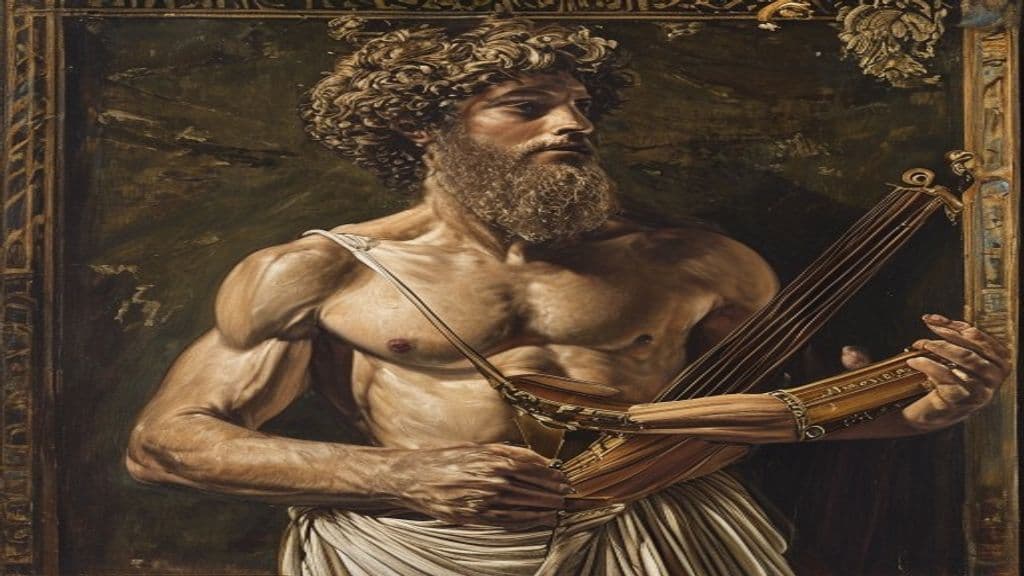
Apollo
Olympian deity of ancient Greek religion associated with prophecy, healing, music, archery, purification, and civic order. Principal patron of the Delphic oracle, protector of youth and flocks, and ambivalently both healer and bringer of plague.

Hercules
Hercules (Latin: Hercules) is the Roman reception of the Greek divine hero Heracles: a semi-divine, divinized heroic figure son of Jupiter and the mortal Alcmena who was widely venerated across Italy. Represented in cult, votive art, and literature, he functions as a protector and martial champion whose identity was adapted through Etruscan and local Italic contexts.
*Péh₂usōn (reconstructed)
Péh₂usōn is a hypothetical Proto‑Indo‑European pastoral guardian reconstructed by comparative scholars from parallels in Greek and Vedic traditions. Proposed as a Graeco‑Aryan ancestor‑figure, the reconstruction describes a protector of flocks, roads, and travellers rather than an attested historical cultic personality.
Aba (disambiguation / name-form)
Aba is a polyvalent name-form attested across many unrelated contexts (place names, personal names, animal names, and brief mythological listings). The provided sources do not support a single, coherent supernatural entity called "Aba" and offer no descriptive or ritual material for such a being.
Abandinus
Abandinus is a locally attested Romano‑Celtic theonym known from a single inscribed bronze feather (votive object) dedicated at Godmanchester (the Roman fort Durovigutum) in Cambridgeshire. Scholars interpret him as a local god or male spirit tied to a specific place and possibly associated with a nearby spring or stream; this association is tentative and based on etymological readings of the name.
Abarbarea
Abarbarea is a name attested in classical Greek and Roman sources for freshwater nymphs (naiads). The name appears for at least two individual mythic figures — a naiad wife of Bucolion and a naiad counted among ancestors of the Tyrians — and Hesychius records plural forms that may indicate the name was also used as a class-name (Abarbareai / Abarbalaiai).
Abarta (Ábartach)
Abarta (also Ábartach) is a figure of Irish myth who, in surviving accounts, tricks Fionn mac Cumhaill's warriors by giving them a supernatural grey horse that bears them into the Otherworld. Sources variably identify him as a member of the Tuatha Dé Danann or as a Fomorian; after the incident he is compelled to release the captured warriors and is refused entry to the Fianna.
Abas
Abas (Ancient Greek: Ἄβας, gen.: Ἄβαντος) is not a single mythic being but a recurring personal name borne by multiple mortals and minor mythic figures in Greek epic and genealogical traditions — kings, founders, seers, warriors, attendants, a centaur, and a youth transformed by a goddess. The name is glossed in the sources as 'guileless' or 'good-hearted' and appears across Argive, Theban, Trojan, Euboean, and other local cycles.
Abcán (Abhcán)
Abcán (modern spelling Abhcán) is a named dwarf poet and musician of the Tuatha Dé Danann in Irish myth. He appears in a small number of narratives as a musician whose art has soporific power and as the ferryman who brings the goddess Ruad from the Otherworld to the human world.
Abderus
Abderus (Ancient Greek: Ἄβδηρος, romanized Ábdēros) is a mortal heroic figure in Greek myth closely associated with Heracles, remembered as the youth left in charge of the Mares of Diomedes who was killed by them. He functions as an eponymous local/divine-hero ancestor for the city of Abdera and received funerary commemoration and athletic agones at his tomb.
Abellio
Abellio is a theonym attested in Roman‑period inscriptions from the Comminges area of the Pyrenees and reported as worshipped in the Garonne Valley of ancient Gallia Aquitania. Surviving evidence is limited to a small number of inscriptions; scholars have variously hypothesized solar or arboreal associations and compared the name to forms of Apollo or to Celtic Belenus, but the deity's precise role in local cosmology remains uncertain.
Abhean
Abhean is a named poet of the Tuatha Dé Danann in medieval Irish literature, described as a poet in particular of Lugh and recorded as having been killed by Óengus before Midir in a poem by Fland Mainistreach preserved in the Lebor Gabála Érenn.
Abnoba
Abnoba is a Gaulish theonym and toponym attested in Roman-era sources and inscriptions: a localized deity associated with woods, springs and the sources of rivers (notably the Danube) and simultaneously the name applied to a mountain or mountain range in the Black Forest/Baar/Odenwald region. Roman altars equate her with Diana, reflecting syncretic cult practice in frontier provinces.
Abomination of Desolation
An apocalyptic prophetic phrase originating in the Book of Daniel designating a profaning thing or act that renders the Jerusalem Temple cult desolate; later reused in the Synoptic Gospels as an eschatological sign prompting urgent flight. The term denotes ritual/cultic impurity (Hebrew shiqquts) and is variously interpreted as pagan offerings or altar, a foreign cult statue, or (in some New Testament readings) an acting agent.
Community Record
- [1]Borvo — Wikipedia. Wikipedia, 'Borvo'wiki
- [2]Borvo — Wikidata. Wikidata entry Q41891341other
- [3]Archive (contextual reference). Archive.org (reference included in research notes)other