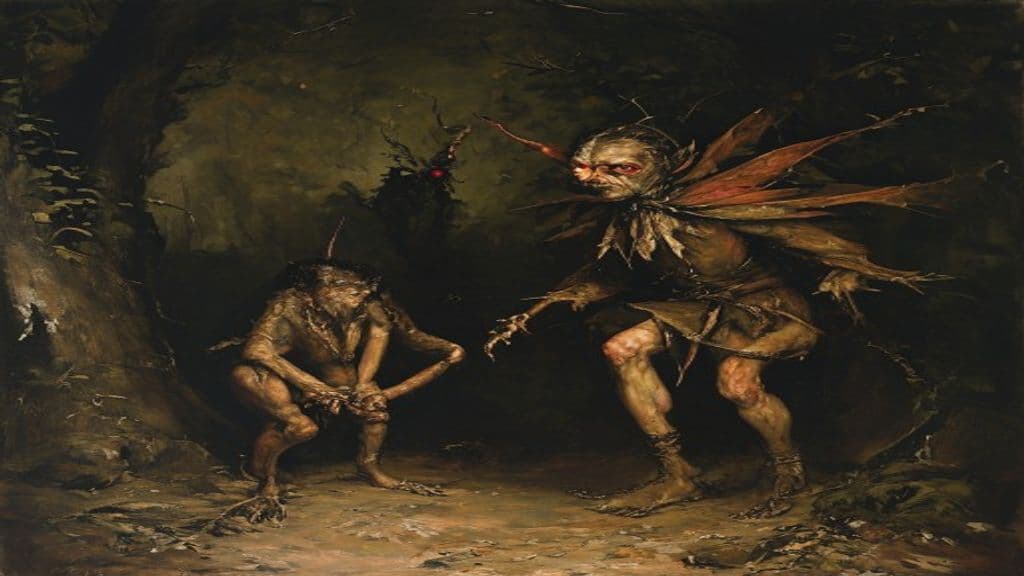
No fully developed mythic origin for the Bugul Noz is preserved in the cited summaries. The available attestations place the being within the vernacular cosmology of Morbihan in Brittany as a night-associated figure rather than as the child of a particular cosmogony or divine genealogy. Functionally, the Bugul Noz occupies the social role of a nocturnal enforcer or cautionary presence: linked by name and by recurrent tales to shepherds and to those who work or loiter outdoors after sunset. Over time collectors and informants reported divergent characterizations—from threatening, clawed little men reported by Émilie Carpentier to a tall, foreboding twilight figure reported to Anatole Le Braz—indicating a flexible folk category used locally to explain or dissuade risky nighttime behavior rather than to narrate an originating mythic event.
Descriptions in the sources disagree. One common description (summarized in modern references) likens the Bugul Noz to a 'little man, goblin or kobold.' Émilie Carpentier's informant(s) described it specifically as a small man with claws, fiery eyes, and a whistling voice. By contrast, Anatole Le Braz recorded an account in which the Bugul Noz appears as a tall, foreboding figure at twilight. Another source summarized in secondary material mentioned an account that characterized it as an undead-like presence; that label is reported as an alternative attestation rather than an established definitive form.
Reported behaviors and capacities vary by account. Several tellings present the Bugul Noz as threatening those who linger outdoors after dark, particularly shepherds and nighttime workers. One motif records the Bugul Noz 'riding at night' but turning back at the sight of crossroads in order to avoid the shape of the cross. In some narratives the being can take a person prisoner; a version summarized in secondary sources states that if he takes someone prisoner he will drown them 'as soon as the cock crows.' Other informants framed the Bugul Noz more benignly as a spirit whose influence is to dissuade people from staying outside where it is not safe after dark. The range of reports indicates variable attributions rather than a consistent catalogue of powers.
Weaknesses
- symbolChristian cross / shape of the cross (reported motif of turning back at crossroads to avoid it)
Wards
- conditionavoidance of lingering outdoors after dark (social preventive practice)
- symbolcross / crossroads (attested motif that causes it to turn back in one account)
Abandinus
Abandinus is a locally attested Romano‑Celtic theonym known from a single inscribed bronze feather (votive object) dedicated at Godmanchester (the Roman fort Durovigutum) in Cambridgeshire. Scholars interpret him as a local god or male spirit tied to a specific place and possibly associated with a nearby spring or stream; this association is tentative and based on etymological readings of the name.
Abarta (Ábartach)
Abarta (also Ábartach) is a figure of Irish myth who, in surviving accounts, tricks Fionn mac Cumhaill's warriors by giving them a supernatural grey horse that bears them into the Otherworld. Sources variably identify him as a member of the Tuatha Dé Danann or as a Fomorian; after the incident he is compelled to release the captured warriors and is refused entry to the Fianna.
Abcán (Abhcán)
Abcán (modern spelling Abhcán) is a named dwarf poet and musician of the Tuatha Dé Danann in Irish myth. He appears in a small number of narratives as a musician whose art has soporific power and as the ferryman who brings the goddess Ruad from the Otherworld to the human world.
Abhean
Abhean is a named poet of the Tuatha Dé Danann in medieval Irish literature, described as a poet in particular of Lugh and recorded as having been killed by Óengus before Midir in a poem by Fland Mainistreach preserved in the Lebor Gabála Érenn.
Abnoba
Abnoba is a Gaulish theonym and toponym attested in Roman-era sources and inscriptions: a localized deity associated with woods, springs and the sources of rivers (notably the Danube) and simultaneously the name applied to a mountain or mountain range in the Black Forest/Baar/Odenwald region. Roman altars equate her with Diana, reflecting syncretic cult practice in frontier provinces.
Accolon
Accolon is a mortal knight of the Arthurian court, presented in the Post-Vulgate Merlin tradition and Malory's Le Morte d'Arthur as Morgan le Fay's paramour and instrument in a plot to supplant King Arthur; his tale centers on enchanted weapons (Excalibur and its scabbard), love-manipulation, and a tragic duel with Arthur.
Achall
Achall is an eponymous mortal woman in the Ulster Cycle of early Irish literature whose grief-induced death is given as the origin of the hill-name Achall (identified with the modern Hill of Skryne). She appears as a genealogical and etiological figure tied to Tara and later legendary events at the hill, rather than as a recurring supernatural agent.
Achtland
Achtland is a figure from Irish tradition who, according to the surviving account, was a mortal woman famed for rejecting mortal suitors who married a member of the Tuatha Dé Danann and crossed into the síde to become immortal as his wife.
Adar Llwch Gwin
Legendary large, intelligent birds from Welsh tradition said to understand human speech and obey their master's commands; best known for tearing their master Drudwas ap Tryffin to pieces when bound by a literal order in an Arthurian battle narrative. The term later came to be applied to raptors and metaphorically to brave men in medieval Welsh poetry.
Adar Rhiannon
Adar Rhiannon ('birds of Rhiannon') are a set of three magical birds in medieval Welsh narrative (the Mabinogi) whose song can 'wake the dead and lull the living to sleep.' They appear as otherworldly song‑beings tied to the figure Rhiannon and function within tales as providers of enchanted music that sustains and consoles characters.
Aderyn y Corff
Aderyn y Corff (literally 'bird of the corpse') is a bird-like death-porter in Welsh folklore said to call outside the door of a person about to die. Described as an avian portent that may lack feathers or wings and as existing on another plane when not manifesting, it is treated in Welsh ghost lore and sometimes naturalized as a screech owl in modern accounts.
Adhene
A class of Manx fairies (Cloan ny moyrn) described in Isle of Man tradition as a social people of beings said to be "fallen angels cast from heaven but too good for hell," who interact with human livelihoods and families, sometimes benevolent but often mischievous.
Community Record
- [1]Bugul Noz (Wikipedia). Wikipedia contributors, 'Bugul Noz,' Wikipedia, The Free Encyclopedia.wiki
- [2]Bugul Noz (Wikidata Q2698640). Wikidata entry Q2698640, 'Bugul Noz.'wiki
- [3]Ford's Faeries Bestiary (archive listing — no specific additional material cited). Archive listing for 'Ford's Faeries Bestiary' (catalog entry consulted; no additional Bugul Noz detail drawn in these notes).other