
Folklore treats the drekavac not as a single fixed species but as a class of restless dead or revenant phenomena. Sources commonly link its origin to improperly handled deaths: souls of sinful adults, of those who died in irregular circumstances, and especially unbaptised children. In some tales the soul of an unbaptised child rises from its grave and haunts the living until properly baptised; other accounts give origins as undead men, ghosts of soldiers or other disturbed dead.
Descriptions vary widely by locality. Reported forms include an undead man rising from a grave, an unbaptised child's spindly corpse with a large head, a humanoid canine walking on hind legs (Eastern Serbia), ghostly soldiers (Maglaj), vampire-like revenants (Kozarska Dubica), a long-necked long-legged creature with a cat-like head (Arilje), a one-legged humanoid with glowing eyes (Sredačka župa), and animal apparitions such as dappled foals, dogs, cats, or birds (Prijepolje, Lešak, Dragačevo). A localized Banovići report describes an ape-like form with long limbs and a dog-like elongated head. Common motifs across variants are night appearance, unsettling proportions (elongated neck/body, large head), and association with graves or dead children.
Core traditional attributes are vocal: loud, terrifying screeching at night and entreaty when in child form (begging for baptism). The drekavac functions as an omen—child-forms are said to predict human death while animal-forms predict cattle disease—and is believed to cause illness if its shadow falls on a person. It is said to avoid dogs and bright light. Modern role-playing and cryptid sources add mechanics such as fog transformation and disease‑carrier properties, but these are adaptations of folkloric motifs rather than claims from traditional sources.
Weaknesses
- conditionbright light (avoided)
- conditiondogs present (avoided)
- ritualbaptism / proper Christian mortuary rites (preventative and curative for unbaptised-child variants)
Wards
- conditionkeeping bright light / illumination
- conditionpresence of dogs
- ritualensuring baptism and correct burial rites for infants and those who died under problematic circumstances
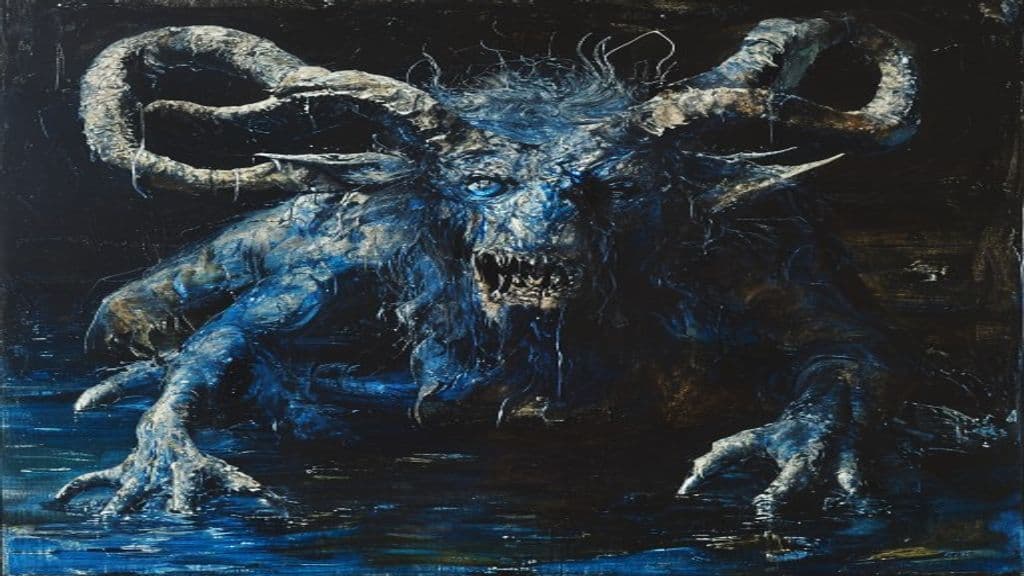
Bukavac
Bukavac is a demonic mythical creature from Slavic (Serbian) popular belief, attested chiefly in Syrmia. Described as an aquatic, nocturnal menace, it was said to emerge from lakes and pools to make loud noises and to jump onto people and animals, strangling them.
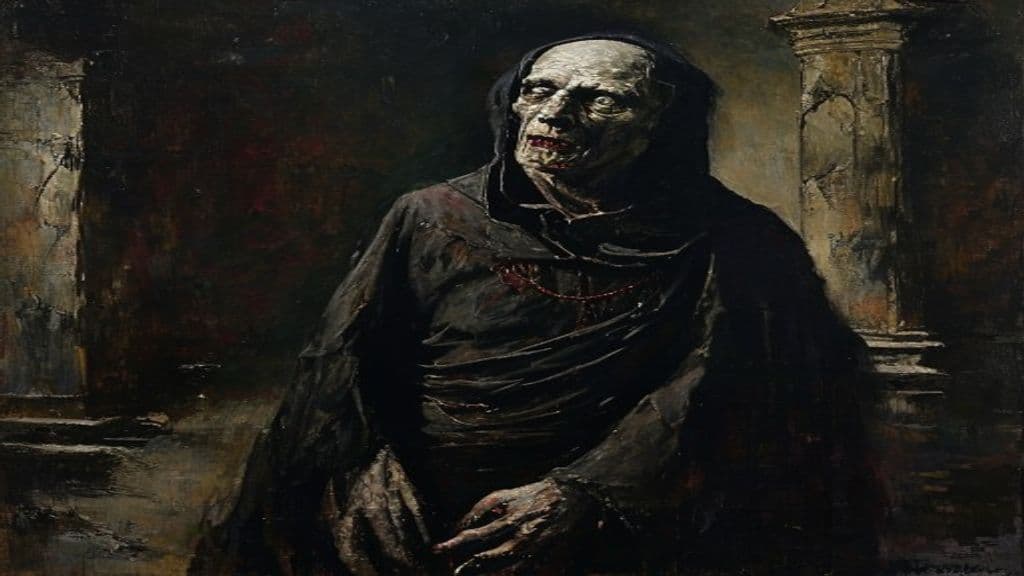
Vampire (tradition)
A class of revenant beings in southeastern and eastern European folk belief that subsist by feeding on the vital essence (generally blood) of the living. Recorded chiefly in early modern to modern oral traditions, these vampires are typically described as reanimated corpses whose presence explains unexplained illness, death, and post-mortem disturbances in their communities.
Abaddon
In Hebrew scripture Abaddon is primarily a noun meaning 'destruction' or a section/condition of the underworld paired with Sheol; in the New Testament Book of Revelation Abaddon is personified as an angelic figure (Greek Apollyon) described as the king of an army of locusts released from the abyss during the apocalypse.
Abadir
Abadir is a polysemous name attested in distinct cultural contexts: a legendary founding saint and clan ancestor in eastern Ethiopia (Sheikh Abadir Umar Al‑Rida / Aw Abadir), a term applied to cone‑shaped cult stones in Phoenician religious description, and a personal name of a martyr (Abadir/Apater) in the Coptic Synaxarium. The attestations are independent usages of the same name rather than a single supernatural being.
Abadiu of Antinoe
Abadiu of Antinoe was a fourth‑century bishop of Antinoe (Antinoopolis, in Roman Egypt) commemorated as a martyr and saint in the Coptic Orthodox Church, with a feast day on 26 December. Sources record that he was killed during a theological dispute with Arian opponents and reference him in collections of Egyptian martyrs.
Abagtha
Abagtha (Hebrew: אבגתא, ’Ǎḇaḡṯā) is a named human court official in the Hebrew Bible’s Book of Esther, listed among seven chamberlains who ministered before King Ahasuerus and were commanded to bring Queen Vashti before the king. He is attested only in Esther 1:10 and is presented as an institutional palace attendant rather than a supernatural being.
Abanoub
Abanoub is a 4th‑century Egyptian Christian child martyr venerated in the Coptic tradition. Remembered for his public confession of Christ, miraculous healings associated with his passion, and the translation and veneration of his relics, his feast is observed on July 31 (Epip 24) and his cult centers include Nehisa and Samanoud.
Abaskhiron the Soldier
A Coptic Orthodox martyr venerated for refusing imperial idolatry during the Diocletian persecution; reputedly healed by the Archangel Michael, preserved in monastery relics, and commemorated on 14 June (7 Paoni).
Abdel Messih El-Makari
Abdel Messih El-Makari (1892–1963) was a Coptic Orthodox monk and priest venerated as a 20th‑century Coptic saint. Associated with the Monastery of Saint Samuel the Confessor and the Monastery of Saint Macarius (Scetes/Wadi El‑Natrun), he is remembered for humility, asceticism, charity, and reported spiritual gifts such as prescience, discerning of spirits, and healing.
Abel
Abel is the second son of Adam and Eve in the Genesis narrative, a shepherd whose accepted offering and subsequent murder by his brother Cain form the biblical account of the first death. Later interpretive traditions expand his role, treating him as an archetypal righteous victim, a postmortem avenging or adjudicating figure, and in some systems (notably Mandaean) identifying him with an angelic lightbeing.
Abib and Apollo
Abib and Apollo are Christian ascetics and hagiographic saints of Akhmim (Upper Egypt) attested in Coptic sources and the Historia Monachorum. Remembered for extreme asceticism, monastic leadership, angelic encounters, and inclusion in the Coptic Synaxarion (feast day November 4).
Abiel
Abiel is attested in the supplied sources only as a male given name — borne by several historical American individuals and listed as two minor biblical figures. The provided materials contain no evidence presenting Abiel as a supernatural, mythological, or folkloric entity.
Abijah of Judah
Abijah (also Abijam or Abiah) is presented in the biblical and later interpretive traditions as a short-reigning human king of Judah from the Davidic line. He is portrayed as a dynastic successor whose military actions (notably the battle at Mount Zemaraim) and moral evaluation in rabbinic literature are interpreted theologically in relation to the Davidic covenant.
Abimelech
Abimelech is a Hebrew personal name and occasionally a regnal title attested in the Hebrew Bible and later traditions. It appears as the name/title of Philistine rulers in the patriarchal narratives (the "king of Gerar" who interacts with Abraham and Isaac) and as the personal name of Abimelech son of Jerubbaal (Gideon) in Judges, a dynastic usurper whose brief rule ends in violent death.
Community Record
- [1]Drekavac (Wikipedia). Wikipedia: 'Drekavac' entry (various paragraphs on names, forms, origins, behaviours, and regional variants).wiki
- [2]Drekavac - PathfinderWiki (adaptation). PathfinderWiki: modern role-playing adaptation describing undead game-stat attributes (not traditional folklore).wiki
- [3]Drekavac - Pathfinder Fandom (adaptation). Pathfinder Fandom: summarizes game/mechanical reinterpretation (fog form, disease mechanics) — modern adaptation.wiki
- [4]Drekavac | Cryptid Wiki | Fandom. Cryptid/modern cultural reinterpretations and reported sightings (modern/cryptid framing).other