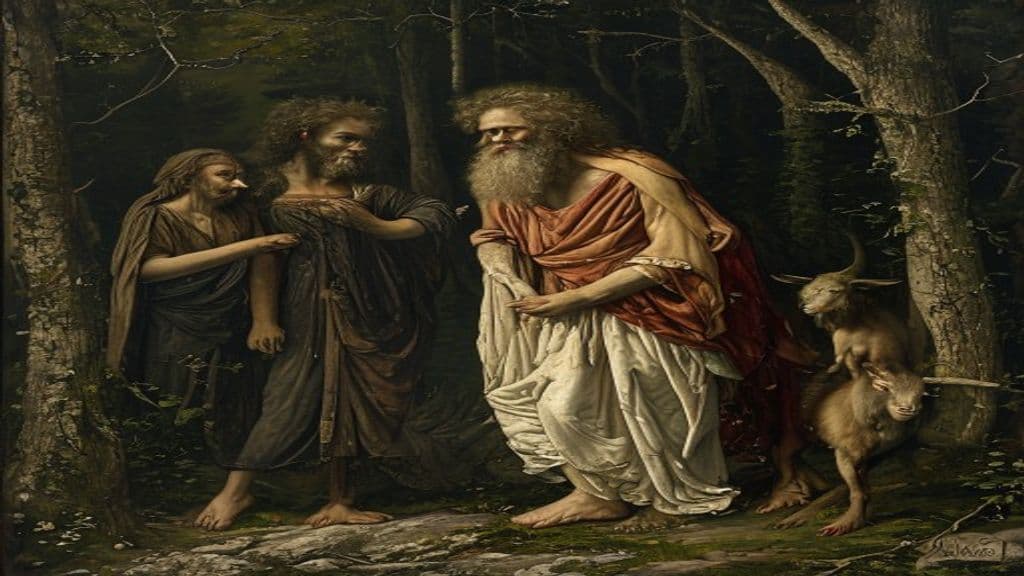
The term dusios (plural dusii/dusioi) appears in late‑antique Latin texts as a Gaulish name for a class of rustic, fertility‑related spirits. Christian authors (notably Augustine and Isidore) identify them with the Greek Pans and Roman Fauni/Inui/Silvani and reinterpret them as incubi or demonic seducers. Medieval hagiographic sources (e.g., the Life of St. Richarius) place beings called dusii or related names among aerial, crop‑raiding powers. Etymological proposals recorded in the sources include Isidore's medieval gloss linking the name to Latin adsidue ('persistently'), and modern scholarly suggestions of cognates with Baltic words for 'spirit/phantom' or 'vapor' (Lithuanian dvãse, dùsas), Breton duz, or links to roots for ecstatic fury; these proposals are discussed in secondary summaries rather than attested origin myths.
Late‑antique descriptions associate dusii by analogy with Pan and Faunus — traditionally hairy, rustic, and goat‑linked — and Isidore explicitly groups them among the 'hairy ones' (pilosi). Augustine reports that such beings have 'often appeared to women as wicked men,' indicating they can assume human male guise. Textual evidence emphasizes ambiguity: they are described as 'aerial in substance' yet capable of taking bodily form, so accounts vary between bestial/Pan‑like imagery and reports of human‑appearing seducers.
Sources attribute to the dusii sexual interaction with humans (notably nocturnal intercourse with women) and with animals (paralleling Faunus/Inuus' power to fertilize livestock). Augustine and Isidore stress persistent seduction and nocturnal visitations (the Christian authors render them as incubi). Hagiography and medieval compilations place them among aerial crop‑raiders that steal or damage orchards and fields (cf. the Life of St. Richarius and Magonian/mane traditions). The fig/faun material (Papias/Pliny summaries) presents an image of 'figgy fauns' and 'ficarii' whose swarming, serial acts of fertilization have been used to interpret dusii as potentially multiple, swarm‑like actors; Augustine's remark that they are 'aerial in substance' and yet can take form underpins accounts of mobility and atmospheric habitation.
Weaknesses
- otherChristian doctrinal/exorcistic response
Wards
- ritualInvocation of Christian authority (prayer/exorcism/saintly intervention)

Faunus
Faunus is an ancient Roman rustic deity and tutelary nature god of forests, plains, and fields, protector of agriculture and cattle. He functions as an oracular and fertility power, head of a plurality of lesser fauni (place-spirits), and was celebrated in festivals such as the Faunalia and associated with the Lupercalia rites.

Incubus (Jewish Tradition)
A male demon that preys on female humans in their dreams, seducing them and leading to physical interactions. (Note: 1. Power tier should be Primordial (cosmic) is too high; a more fitting power tier would be Greater (deity-level), given its ability to manipulate humans' dreams and lead to physical interactions. 2. )

Manes
In ancient Roman religion the Manes (Latin: mānēs) are a collective class of chthonic divine dead — the subterranean spirits of deceased persons — who are propitiated in household, funerary, and civic rites (e.g., Parentalia, Feralia, and foundation rites involving the lapis manalis). They appear in inscriptions (D.M., Dis Manibus) and literary commentary as an institutionalized category of the dead rather than as a single named being.
Abaddon
In Hebrew scripture Abaddon is primarily a noun meaning 'destruction' or a section/condition of the underworld paired with Sheol; in the New Testament Book of Revelation Abaddon is personified as an angelic figure (Greek Apollyon) described as the king of an army of locusts released from the abyss during the apocalypse.
Abadir
Abadir is a polysemous name attested in distinct cultural contexts: a legendary founding saint and clan ancestor in eastern Ethiopia (Sheikh Abadir Umar Al‑Rida / Aw Abadir), a term applied to cone‑shaped cult stones in Phoenician religious description, and a personal name of a martyr (Abadir/Apater) in the Coptic Synaxarium. The attestations are independent usages of the same name rather than a single supernatural being.
Abadiu of Antinoe
Abadiu of Antinoe was a fourth‑century bishop of Antinoe (Antinoopolis, in Roman Egypt) commemorated as a martyr and saint in the Coptic Orthodox Church, with a feast day on 26 December. Sources record that he was killed during a theological dispute with Arian opponents and reference him in collections of Egyptian martyrs.
Abagtha
Abagtha (Hebrew: אבגתא, ’Ǎḇaḡṯā) is a named human court official in the Hebrew Bible’s Book of Esther, listed among seven chamberlains who ministered before King Ahasuerus and were commanded to bring Queen Vashti before the king. He is attested only in Esther 1:10 and is presented as an institutional palace attendant rather than a supernatural being.
Abandinus
Abandinus is a locally attested Romano‑Celtic theonym known from a single inscribed bronze feather (votive object) dedicated at Godmanchester (the Roman fort Durovigutum) in Cambridgeshire. Scholars interpret him as a local god or male spirit tied to a specific place and possibly associated with a nearby spring or stream; this association is tentative and based on etymological readings of the name.
Abanoub
Abanoub is a 4th‑century Egyptian Christian child martyr venerated in the Coptic tradition. Remembered for his public confession of Christ, miraculous healings associated with his passion, and the translation and veneration of his relics, his feast is observed on July 31 (Epip 24) and his cult centers include Nehisa and Samanoud.
Abarbarea
Abarbarea is a name attested in classical Greek and Roman sources for freshwater nymphs (naiads). The name appears for at least two individual mythic figures — a naiad wife of Bucolion and a naiad counted among ancestors of the Tyrians — and Hesychius records plural forms that may indicate the name was also used as a class-name (Abarbareai / Abarbalaiai).
Abarta (Ábartach)
Abarta (also Ábartach) is a figure of Irish myth who, in surviving accounts, tricks Fionn mac Cumhaill's warriors by giving them a supernatural grey horse that bears them into the Otherworld. Sources variably identify him as a member of the Tuatha Dé Danann or as a Fomorian; after the incident he is compelled to release the captured warriors and is refused entry to the Fianna.
Abas
Abas (Ancient Greek: Ἄβας, gen.: Ἄβαντος) is not a single mythic being but a recurring personal name borne by multiple mortals and minor mythic figures in Greek epic and genealogical traditions — kings, founders, seers, warriors, attendants, a centaur, and a youth transformed by a goddess. The name is glossed in the sources as 'guileless' or 'good-hearted' and appears across Argive, Theban, Trojan, Euboean, and other local cycles.
Abaskhiron the Soldier
A Coptic Orthodox martyr venerated for refusing imperial idolatry during the Diocletian persecution; reputedly healed by the Archangel Michael, preserved in monastery relics, and commemorated on 14 June (7 Paoni).
Abcán (Abhcán)
Abcán (modern spelling Abhcán) is a named dwarf poet and musician of the Tuatha Dé Danann in Irish myth. He appears in a small number of narratives as a musician whose art has soporific power and as the ferryman who brings the goddess Ruad from the Otherworld to the human world.
Abdel Messih El-Makari
Abdel Messih El-Makari (1892–1963) was a Coptic Orthodox monk and priest venerated as a 20th‑century Coptic saint. Associated with the Monastery of Saint Samuel the Confessor and the Monastery of Saint Macarius (Scetes/Wadi El‑Natrun), he is remembered for humility, asceticism, charity, and reported spiritual gifts such as prescience, discerning of spirits, and healing.
Community Record
- [1]The Gauls and Their Demons (St. Augustine). Augustine, as cited in provided notes (discussion of Silvani, Pans, incubi; 'aerial in substance' quote).literary
- [2]Isidore (Etymologies) — references in supplied notes. Isidore's gloss grouping 'pilosi' with Pans, Incubi, Inui and reporting the Gaulish name 'Dusii' with etymologizing comment ('they seduce relentlessly'), as summarized on the Wikipedia entry provided.wiki
- [3]Dusios — Wikipedia. Summary article compiling primary quotations and scholarly discussion on dusii, Papias/Pliny fig/faun material, Life of St. Richarius, and etymological proposals (source of synthesized notes).wiki
- [4]Life of St. Richarius (vita) — summary in supplied notes. Eighth‑century hagiographic vita cited in the summary as recording dusii (hemaones/manes in some recensions) stealing crops and damaging orchards.literary
- [5]Papias / Pliny material on fig‑fauns (as summarized). Summarized references to Papias and Pliny connecting 'ficarii' (fig‑flies) and caprificus to 'figgy fauns' and to swarming, serial fertilization used in comparative discussion of dusii.wiki