
Within Swedish and Finland-Swedish popular belief the Easter witch is a seasonal manifestation of persons associated with witchcraft who travel by broom on the Thursday before Easter (Maundy Thursday or the night between Holy Wednesday and Thursday) to a mythic gathering-place called Blåkulla / Blockula / Blå Jungfrun. The motif is embedded in a calendar-based folk cosmology that fused older notions of witch-sabbaths and diabolic meetings with Christian Holy Week. During the 17th century, when witch persecutions occurred in Sweden, these beliefs informed household precautions and juridical responses; over subsequent centuries the figure transformed in popular culture into a largely performative, child-centered custom observed on Maundy Thursday, Holy Saturday or Palm Sunday (in certain Finnish contexts).
Traditional imagery depicts the Easter witch as an old woman (kärring / häxa) who flies on a broom to the meeting-place of Blåkulla; older accounts treat the witches as adults or youths who undertook nocturnal flights. In modern, secularized practice the figure is performed: originally adults and young people donned costume, but over time children most commonly dress as witches, old women or even in old men's clothing. Visual culture (postcards, colouring pages, decorations) preserves an archetypal costume of crone-like dress and broom imagery.
Folklore describes the Easter witch as capable of nocturnal flight on a broom to the sabbath-site of Blåkulla/Blockula/Blå Jungfrun on the Thursday before Easter and returning at Easter. Older accounts associate the gathering with meeting the Devil and with witches exploiting domestic resources while away or en route—households feared that witches might milk livestock or ride animals and might use available tools as travel implements. In contemporary custom the figure lacks the malevolent actions of earlier belief and is primarily performative, involving door-to-door greetings and exchange of cards or treats.
Weaknesses
- conditionlocked or secured doors and dampers
- conditionbarn doors secured/latched
- conditiontools put away (denial of implements usable for travel)
Wards
- ritualsecuring doors and dampers on Maundy Thursday
- ritualputting away tools on Maundy Thursday
- ritualsecuring barn doors to prevent milking or riding of animals

Baba Yaga
Baba Yaga is an ambivalent female figure of East Slavic folktale tradition, depicted variously as a fearsome, child-eating crone or as a helpful, maternal donor. She is associated with the deep forest, a hut described as standing on chicken legs, and the motific accoutrements of a mortar and pestle.
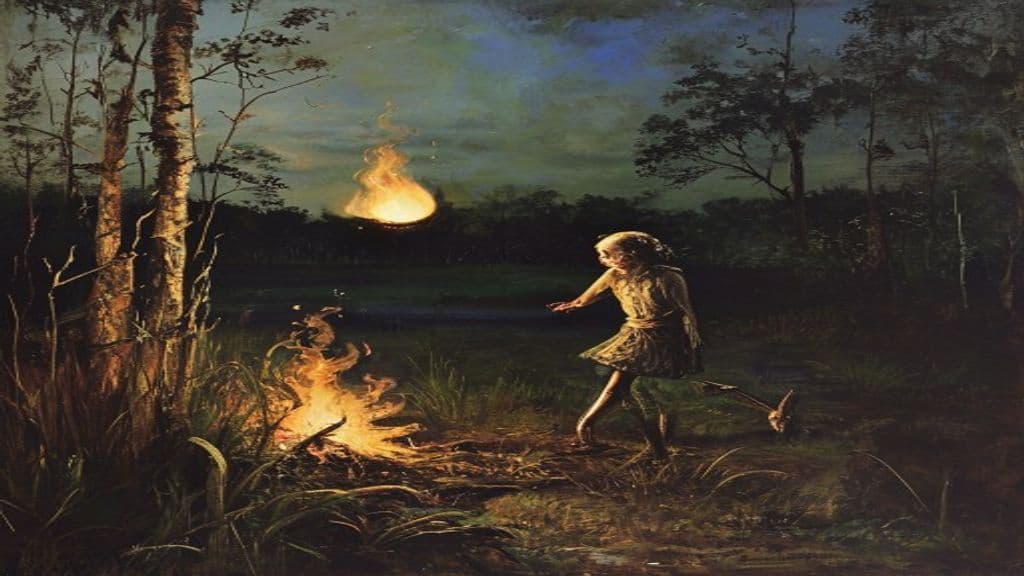
Will-o'-the-wisp
An atmospheric 'ghost light' — a small, mobile, lamp-like light seen at night over marshes, bogs, wet ground, or graveyards. In many cultures the phenomenon is interpreted as a supernatural being or manifestation (wandering nature-spirit, soul of the dead, transformed witch, or treasure-indicator); modern science offers chemiluminescent explanations for some occurrences.
Abaddon
In Hebrew scripture Abaddon is primarily a noun meaning 'destruction' or a section/condition of the underworld paired with Sheol; in the New Testament Book of Revelation Abaddon is personified as an angelic figure (Greek Apollyon) described as the king of an army of locusts released from the abyss during the apocalypse.
Abadir
Abadir is a polysemous name attested in distinct cultural contexts: a legendary founding saint and clan ancestor in eastern Ethiopia (Sheikh Abadir Umar Al‑Rida / Aw Abadir), a term applied to cone‑shaped cult stones in Phoenician religious description, and a personal name of a martyr (Abadir/Apater) in the Coptic Synaxarium. The attestations are independent usages of the same name rather than a single supernatural being.
Abadiu of Antinoe
Abadiu of Antinoe was a fourth‑century bishop of Antinoe (Antinoopolis, in Roman Egypt) commemorated as a martyr and saint in the Coptic Orthodox Church, with a feast day on 26 December. Sources record that he was killed during a theological dispute with Arian opponents and reference him in collections of Egyptian martyrs.
Abagtha
Abagtha (Hebrew: אבגתא, ’Ǎḇaḡṯā) is a named human court official in the Hebrew Bible’s Book of Esther, listed among seven chamberlains who ministered before King Ahasuerus and were commanded to bring Queen Vashti before the king. He is attested only in Esther 1:10 and is presented as an institutional palace attendant rather than a supernatural being.
Abanoub
Abanoub is a 4th‑century Egyptian Christian child martyr venerated in the Coptic tradition. Remembered for his public confession of Christ, miraculous healings associated with his passion, and the translation and veneration of his relics, his feast is observed on July 31 (Epip 24) and his cult centers include Nehisa and Samanoud.
Abaskhiron the Soldier
A Coptic Orthodox martyr venerated for refusing imperial idolatry during the Diocletian persecution; reputedly healed by the Archangel Michael, preserved in monastery relics, and commemorated on 14 June (7 Paoni).
Abdel Messih El-Makari
Abdel Messih El-Makari (1892–1963) was a Coptic Orthodox monk and priest venerated as a 20th‑century Coptic saint. Associated with the Monastery of Saint Samuel the Confessor and the Monastery of Saint Macarius (Scetes/Wadi El‑Natrun), he is remembered for humility, asceticism, charity, and reported spiritual gifts such as prescience, discerning of spirits, and healing.
Abel
Abel is the second son of Adam and Eve in the Genesis narrative, a shepherd whose accepted offering and subsequent murder by his brother Cain form the biblical account of the first death. Later interpretive traditions expand his role, treating him as an archetypal righteous victim, a postmortem avenging or adjudicating figure, and in some systems (notably Mandaean) identifying him with an angelic lightbeing.
Abib and Apollo
Abib and Apollo are Christian ascetics and hagiographic saints of Akhmim (Upper Egypt) attested in Coptic sources and the Historia Monachorum. Remembered for extreme asceticism, monastic leadership, angelic encounters, and inclusion in the Coptic Synaxarion (feast day November 4).
Abiel
Abiel is attested in the supplied sources only as a male given name — borne by several historical American individuals and listed as two minor biblical figures. The provided materials contain no evidence presenting Abiel as a supernatural, mythological, or folkloric entity.
Abijah of Judah
Abijah (also Abijam or Abiah) is presented in the biblical and later interpretive traditions as a short-reigning human king of Judah from the Davidic line. He is portrayed as a dynastic successor whose military actions (notably the battle at Mount Zemaraim) and moral evaluation in rabbinic literature are interpreted theologically in relation to the Davidic covenant.
Abimelech
Abimelech is a Hebrew personal name and occasionally a regnal title attested in the Hebrew Bible and later traditions. It appears as the name/title of Philistine rulers in the patriarchal narratives (the "king of Gerar" who interacts with Abraham and Isaac) and as the personal name of Abimelech son of Jerubbaal (Gideon) in Judges, a dynastic usurper whose brief rule ends in violent death.
Community Record
- [1]Easter witch. Wikipedia, 'Easter witch' entrywiki
- [2]Easter witch (Wikidata Q1516883). Wikidata entry Q1516883wiki
- [3]Blåkulla, Easter Witches (Sweden) | USC Digital Folklore Archives. USC Digital Folklore Archives, 'Blåkulla, Easter Witches (Sweden)'folk
- [4]Archive audio and cultural references (collection). Archive.org collection referenced in research notesother
- [5]Sweden: Easter in Sweden (official site). Official Sweden site: 'Easter in Sweden' (cultural overview)other