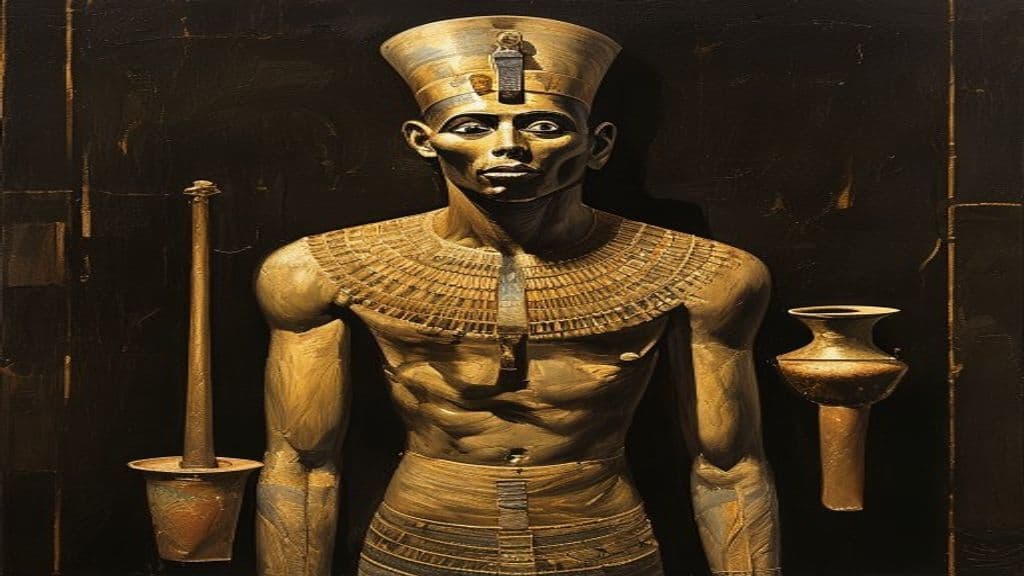
Imsety is attested as one of a quartet called the Four Sons of Horus and is described in funerary tradition as a son of Horus (often Horus the Elder) and an unnamed goddess. Within the Horus/Osiris funerary framework the Four Sons function as named guardians of the internal organs removed during evisceration and embalming, integrated into the mortuary theology that links divine kinship, preservation of the body, and the deceased's successful passage to the afterlife.
Imsety is portrayed in a human form, most commonly as a mummiform human figure (a wrapped human-headed deity). In material culture he appears as the human-headed lid of canopic jars and as small faience amulets; this human-headed iconography for Imsety is consistent from early attestations through the New Kingdom and later periods.
Imsety's primary role is protective and restorative in the funerary domain: he is invoked to guard a specific internal organ removed during mummification (most commonly the liver in many attestations, though organ-to-deity mappings sometimes varied) and to ensure that the deceased's body parts are preserved and may be returned or function in the afterlife. He is named in ritual and funerary spell lists (e.g., Coffin Text/Book of the Dead contexts cited in the sources) and appears as part of sets of protective amulets and canopic equipment.
Weaknesses
None recorded.
Wards
- ritualCanopic practice (evisceration, embalming, storage in canopic jars)
- otherAmulets and funerary spells invoking Imsety

Duamutef
Duamutef is one of the four Sons of Horus in ancient Egyptian funerary religion, a jackal‑headed mummiform guardian whose primary role is to protect the internal organs of the deceased (most commonly the stomach) and to ensure restoration of the body in the afterlife. He appears on canopic jar lids, amulets, and tomb furnishings across a long chronological span from the New Kingdom through the Late Period and beyond.

Qebehsenuef
Qebehsenuef is one of the Four Sons of Horus in ancient Egyptian funerary religion, principally represented as a falcon-headed mummiform deity who protects the intestines of the deceased. He appears on canopic jar lids and amulets and functions as part of the mortuary apparatus intended to preserve bodily integrity for the afterlife.
Aani
Aani (ancient Egyptian jꜥnr) is the lexical term for the baboon in ancient Egyptian language and functions in religious contexts as an animal icon and theophoric epithet. Attested repeatedly in Egyptian texts and images, the baboon image is used to represent or denote aspects of gods such as Thoth, Hapy, Khonsu, and Osiris rather than implying the animal itself is an independent deity.
Aati
Aati (also rendered Ati) is one of the 42 judges of the dead in ancient Egyptian funerary literature, attested in the Book of the Dead tradition (notably the Papyrus of Nebsemy). Described as originating 'from Heliopolis', Aati's documented function is to question the deceased about a specific moral accusation during the Duat judgment; the funerary texts supply a formulaic denial the soul must recite.
Abadiu of Antinoe
Abadiu of Antinoe was a fourth‑century bishop of Antinoe (Antinoopolis, in Roman Egypt) commemorated as a martyr and saint in the Coptic Orthodox Church, with a feast day on 26 December. Sources record that he was killed during a theological dispute with Arian opponents and reference him in collections of Egyptian martyrs.
Abaset
Abaset is a localized ancient Egyptian goddess attested in tomb decoration at El‑Bawiti in the Bahariya Oasis during the 26th Dynasty. She is depicted anthropomorphically with a hedgehog motif incorporated into her headdress and appears on the walls of Qarat Qasr Salim, including twice in the Tomb of Bannentiu. No cult texts, myth narratives, or ritual prescriptions for her are recorded in the cited corpus.
Abib and Apollo
Abib and Apollo are Christian ascetics and hagiographic saints of Akhmim (Upper Egypt) attested in Coptic sources and the Historia Monachorum. Remembered for extreme asceticism, monastic leadership, angelic encounters, and inclusion in the Coptic Synaxarion (feast day November 4).
Abyzou
Abyzou is a female malignant supernatural figure in Near Eastern and medieval European magico-medical and demonological traditions, blamed especially for miscarriages, stillbirths, and infant mortality. She appears in literary sources (notably the Testament of Solomon) and on Byzantine and medieval amulets where her flight or subjugation is commanded by names, images, and saints/archangels.
Abāmūn of Tarnūt
A fourth‑century Coptic Christian presented in later hagiography as a martyr from the city of Tarnūt (Therenuti). Known primarily from a single late medieval Synaxarion notice, he is commemorated liturgically for his voluntary confession and violent martyrdom.
Adder Stone (Egyptian Tradition)
A type of stone with specific physical characteristics, typically glassy and containing a naturally occurring hole, primarily made of flint. Not considered supernatural in Egyptian tradition. (Note: - Remove "primarily made of flint" from Appearance section, as it is not a characteristic unique to Adder stones. - Power tier should be "None" based on the source material, but clarify that this refe)
Adim (Egyptian Mythology)
In Egyptian mythology, Adim is a king and son of Budasheer who appears after the Great Flood. He has problem-solving skills and consults with his father's ghost for guidance. (Note: 1. The power tier should be Lesser (local spirit) as Adim is described as a king of Egypt, but not as having deity-level abilities. 2. Add sensory cues such as "consulting his father's ghost" and poss)
Agathos Daimon (Agathodaemon)
A beneficent household and civic daemon attested in classical Greek and Graeco‑Egyptian religion. In domestic Greece it is a household spirit honored with post‑meal libations; in Ptolemaic Alexandria it appears prominently in serpentine civic and household forms and is syncretised with various Egyptian protective and fate deities in late antiquity.
Ahmed al-Badawī
Ahmed al-Badawī (Aḥmad al-Badawī, al-Sayyid al-Badawī) was a 13th-century Arab Sufi mystic and founder of the Badawiyyah order. Born in Fes to a Bedouin tribe and later settled in Tanta, Egypt, his tomb remains a major site of visitation and he is regarded as one of the most popular Sufi saints in Egypt (sources emphasize his historical sainthood and pilgrimage cult rather than detailed folkloric attributes).
Ahmose‑Nefertari
Ahmose‑Nefertari was an 18th‑Dynasty Egyptian queen who, after her death, received institutionalized cult worship and was venerated in the Theban necropolis and Deir el‑Medina. Sources present her both as a historically attested royal (great royal wife and king's mother) and as a deified figure given epithets such as 'Goddess of Resurrection', 'Mistress of the Sky', and 'Lady of the West'.
Community Record
- [1]Imsety (Wikipedia: Four sons of Horus). Wikipedia, "Four sons of Horus" (Imsety entry)wiki
- [2]Wikidata: Imsety. Wikidata entry for Imsetyother
- [3]Canopic Jar (museum/archive descriptions). Archive description: Canopic Jar with Falcon's Head (museum object context citing canopic practice and four sons association)other
- [4]Canopic Jar with the Head of Imsety – NCMA Learn. North Carolina Museum of Art description of canopic jar with Imsety headother
- [5]Ancient Egypt: the Mythology - Imsety. Overview of Imsety in popular academic summaryother
- [6]Virtual Egyptian - Imsety canopic jar of Osorkon, Dyn. 19. Virtual Egyptian Museum entry on Imsety canopic jarother
- [7]Amuletic Figure of Imsety, Son of Horus, ca. 750-650 BCE (Walters Art Museum). Walters Art Museum object entry for Imsety amulet (Third Intermediate Period)other
- [8]Imsety (summary sources and name variants). Page listing variants and discussion of Imsety/Amsit names and attestationsother
- [9]Museum of Mythology - Imsety. Museum-of-Mythology summary on Imsety and canopic associationsother