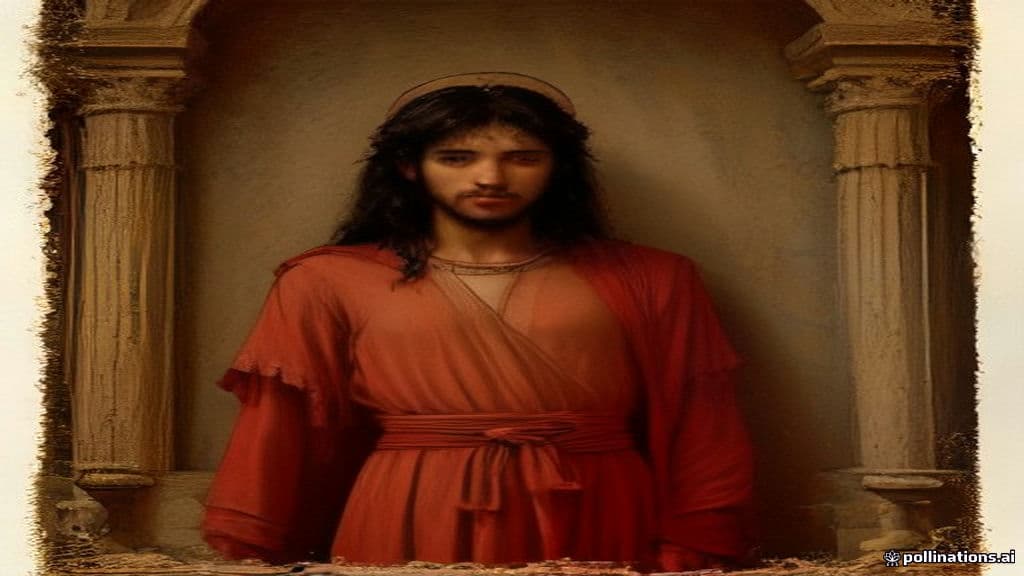
In the primary narrative tradition (2 Kings; 2 Chronicles) Joash (Jehoash) is the surviving heir of the Davidic line concealed from Queen Athaliah and raised within Solomon's Temple under the care and guardianship of the priest Jehoiada and a royal aunt. The priests later proclaim him king inside the Temple, using the sanctuary as refuge and locus of dynastic legitimation. Separately, later lists and some accounts identify a Joash/Yoas as a fourth High Priest in genealogical registers of temple officials; these priestly attestations are fragmentary and cannot be straightforwardly conflated with the kingly narratives without noting uncertainty.
The supplied sources give no physical description of Joash. Narrative and dramatic sources depict him in the roles of child, temple-raised youth, and reigning king, but none of the provided materials record his bodily features, dress, or distinguishing personal appearance.
Sources do not ascribe supernatural powers to Joash; his capacities are political and cultic. As presented in the biblical accounts he exercises royal authority over temple administration, initiates temple repairs while under the guidance of Jehoiada (II Chronicles 24), summons and interacts with priests (2 Kings/2 Chronicles), and later in his reign is portrayed by Chronicles as introducing or tolerating improper cultic innovations (appointing priests to high places and fashioning calves/asherah-like imagery). Josephus and later retellings emphasize his being hidden and raised in the Temple and the priestly mentorship that shaped his early governance.
Weaknesses
- conditionDependence on priestly guidance (Jehoiada)
Wards
None recorded.

Aaron
Aaron is a central human figure in Israelite sacred literature: the elder brother of Moses, the first high priest (progenitor of the Aaronide priesthood), and a spokesman/prophet who mediates between Israel and God in Exodus–Deuteronomy narratives. His role in the texts establishes hereditary priestly authority, ritual functions (sacrifices, blessing, use of Urim and Thummim), and institutional norms for Israelite cultic life.
Abaddon
In Hebrew scripture Abaddon is primarily a noun meaning 'destruction' or a section/condition of the underworld paired with Sheol; in the New Testament Book of Revelation Abaddon is personified as an angelic figure (Greek Apollyon) described as the king of an army of locusts released from the abyss during the apocalypse.
Abadir
Abadir is a polysemous name attested in distinct cultural contexts: a legendary founding saint and clan ancestor in eastern Ethiopia (Sheikh Abadir Umar Al‑Rida / Aw Abadir), a term applied to cone‑shaped cult stones in Phoenician religious description, and a personal name of a martyr (Abadir/Apater) in the Coptic Synaxarium. The attestations are independent usages of the same name rather than a single supernatural being.
Abadiu of Antinoe
Abadiu of Antinoe was a fourth‑century bishop of Antinoe (Antinoopolis, in Roman Egypt) commemorated as a martyr and saint in the Coptic Orthodox Church, with a feast day on 26 December. Sources record that he was killed during a theological dispute with Arian opponents and reference him in collections of Egyptian martyrs.
Abagtha
Abagtha (Hebrew: אבגתא, ’Ǎḇaḡṯā) is a named human court official in the Hebrew Bible’s Book of Esther, listed among seven chamberlains who ministered before King Ahasuerus and were commanded to bring Queen Vashti before the king. He is attested only in Esther 1:10 and is presented as an institutional palace attendant rather than a supernatural being.
Abandinus
Abandinus is a locally attested Romano‑Celtic theonym known from a single inscribed bronze feather (votive object) dedicated at Godmanchester (the Roman fort Durovigutum) in Cambridgeshire. Scholars interpret him as a local god or male spirit tied to a specific place and possibly associated with a nearby spring or stream; this association is tentative and based on etymological readings of the name.
Abanoub
Abanoub is a 4th‑century Egyptian Christian child martyr venerated in the Coptic tradition. Remembered for his public confession of Christ, miraculous healings associated with his passion, and the translation and veneration of his relics, his feast is observed on July 31 (Epip 24) and his cult centers include Nehisa and Samanoud.
Abarbarea
Abarbarea is a name attested in classical Greek and Roman sources for freshwater nymphs (naiads). The name appears for at least two individual mythic figures — a naiad wife of Bucolion and a naiad counted among ancestors of the Tyrians — and Hesychius records plural forms that may indicate the name was also used as a class-name (Abarbareai / Abarbalaiai).
Abas
Abas (Ancient Greek: Ἄβας, gen.: Ἄβαντος) is not a single mythic being but a recurring personal name borne by multiple mortals and minor mythic figures in Greek epic and genealogical traditions — kings, founders, seers, warriors, attendants, a centaur, and a youth transformed by a goddess. The name is glossed in the sources as 'guileless' or 'good-hearted' and appears across Argive, Theban, Trojan, Euboean, and other local cycles.
Abaskhiron the Soldier
A Coptic Orthodox martyr venerated for refusing imperial idolatry during the Diocletian persecution; reputedly healed by the Archangel Michael, preserved in monastery relics, and commemorated on 14 June (7 Paoni).
Abdel Messih El-Makari
Abdel Messih El-Makari (1892–1963) was a Coptic Orthodox monk and priest venerated as a 20th‑century Coptic saint. Associated with the Monastery of Saint Samuel the Confessor and the Monastery of Saint Macarius (Scetes/Wadi El‑Natrun), he is remembered for humility, asceticism, charity, and reported spiritual gifts such as prescience, discerning of spirits, and healing.
Abdiel
Abdiel (Hebrew עֲבְדִּיאֵל) is primarily a theophoric Hebrew personal name meaning "servant of El/servant of God," attested once in the Hebrew Bible (1 Chronicles 5:15). In later literature—most notably John Milton's Paradise Lost—Abdiel is reimagined as a faithful seraph who opposes Satan's revolt. The provided sources do not treat Abdiel as an autonomous folkloric spirit type or record rituals or wards associated with the name.
Community Record
- [1]Joash. Wikipedia, 'Joash'wiki
- [2]Joash (High Priest). Wikipedia, 'Joash (High Priest)'wiki
- [3]II Chronicles 24 (KJV). II Chronicles 24 (KJV) — online textother
- [4]Second Book of Kings. 2 Kings — online textother
- [5]Athalie. Racine's Athalie (dramatic treatment referenced on Wikipedia)literary
- [6]Josephus, Antiquities Book IX. Flavius Josephus, Antiquities of the Jews, Book IXother
- [7]List of Jewish High Priests (Swartzentrover). Swartzentrover — list of high priests (includes Yoas/Joash attestations)other