Kerberos is a monster in Greek folklore, from Greece. Kerberos (Ancient Greek: Κέρβερος; Latinized Cerberus) is the monstrous, typically three-headed canine guardian of the Greek underworld. Serving Hades, he stands at the gates of Hades to admit the souls of the dead and to prevent the living from entering, and he appears in mythic narratives when heroes (notably Heracles) descend into or remove him briefly from the underworld.
In the mythic corpus represented in the supplied sources, Kerberos is a chthonic guard attached to Hades' household who functions as the sentinel of the underworld. Some modern summaries in the set attribute monstrous parentage (for example naming Echidna and Typhon) in extended mythic genealogies, but primary classical citations for parentage are not present in the provided materials; the core origin in these sources is as the named guardian-hound of Hades rather than a detailed cosmogonic birth narrative.
Across the available sources Kerberos is consistently described as a gigantic, fierce hound most commonly specified as having three heads. Summaries emphasize monstrous size and ferocity; other iconographic variants (serpentine elements, additional tails, color) are mentioned inconsistently in secondary accounts and are therefore not reconstructed as canonical within this dataset.
Source accounts focus on Kerberos' role rather than a catalogue of supernatural powers: he is the underworld's guardian who allows souls of the dead to enter and prevents the living from entering (and in some accounts prevents the dead from leaving). He is portrayed in mythic narratives as being in the service of Hades; heroes such as Heracles are exceptional figures who may be permitted (with divine aid) to bypass or remove him temporarily as part of a heroic descent. Descriptors like 'gigantic' and 'ferocious' imply formidable physical danger, but specific supernatural attacks or powers beyond his sentinel function are not enumerated in the supplied sources.
Weaknesses
- conditionNo specific weaknesses attested in supplied sources
- otherExceptional divine authorization or heroic intervention: sources record that gods (e.g., Hermes, Athena in summaries) or heroic agency allow passage or temporary removal, but no human-scale vulnerability or material weakness is documented in the provided materials
Wards
- otherNo documented folk wards or protective practices against Kerberos in the supplied sources

Hades
In ancient Greek religion and mythology, Hades is the god who rules the subterranean realm of the dead and presides over all things beneath the earth, including subterranean riches. He is a son of Cronus and Rhea and one of the generation of Olympian gods, allotted the underworld after the Titanomachy.
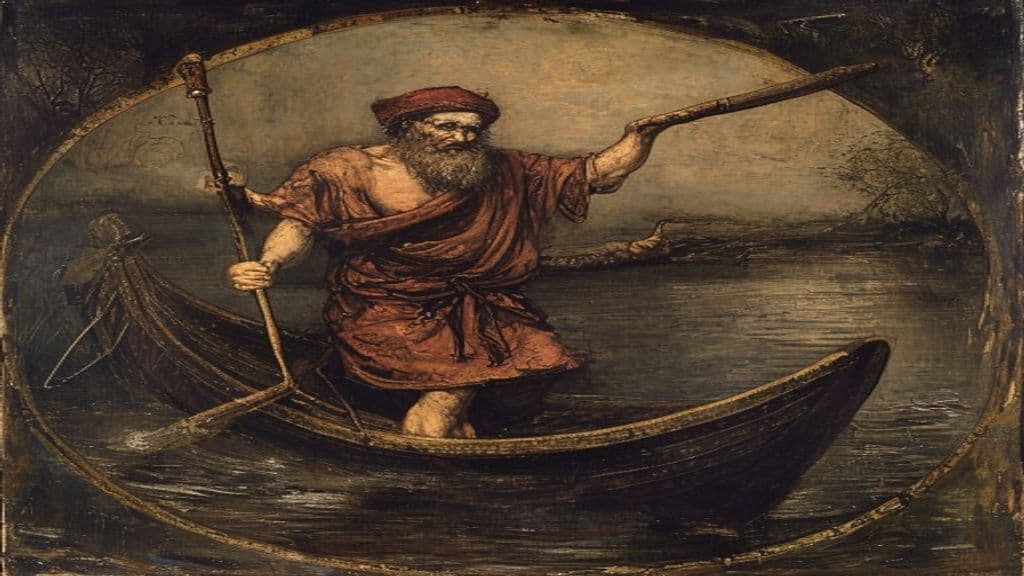
Charon
Charon (Χάρων) is the ferryman of the Greek underworld who conveys the souls of the dead across the boundary river (variously Acheron or Styx). He functions as an underworld attendant and psychopomp whose service typically requires funeral rites and payment (Charon's obol).

Echidna
The 'Mother of Monsters' — half beautiful woman, half enormous serpent — who with Typhon gave birth to nearly every great monster of Greek mythology.

Typhon
The last great monster of Greek mythology — a vast, fire-breathing giant whose shoulders sprouted a hundred serpent heads, nearly toppling Zeus from Olympus.
*Péh₂usōn (reconstructed)
Péh₂usōn is a hypothetical Proto‑Indo‑European pastoral guardian reconstructed by comparative scholars from parallels in Greek and Vedic traditions. Proposed as a Graeco‑Aryan ancestor‑figure, the reconstruction describes a protector of flocks, roads, and travellers rather than an attested historical cultic personality.
3-D Man
3-D Man is a Marvel Comics superhero identity associated with a 1950s-era origin in which the body of Chuck Chandler can materialize in three-dimensional existence when activated by his brother Hal via a pair of glasses. The mantle was later assumed by Delroy Garrett (formerly Triathlon) in modern continuity.
5 Ronin
5 Ronin is a 2011 Marvel Comics five-issue limited series that reimagines five Marvel superhero archetypes as rōnin (masterless samurai) in a fictionalized post‑Sekigahara feudal Japan. The work places Wolverine, Hulk, Punisher, Psylocke, and Deadpool analogues into period roles to explore displacement, revenge, and identity in an era of political upheaval.
A Elbereth Gilthoniel
An Elvish hymn in Sindarin addressed to Elbereth (Varda) from J. R. R. Tolkien's legendarium. Presented in The Lord of the Rings and later musical and dramatic adaptations, the hymn functions as devotional poetic language that evokes Elvish reverence for the star-kindler rather than an independent supernatural agent.
A.R.G.U.S.
A.R.G.U.S. is a fictional clandestine United States government agency in the DC Comics universe that investigates, contains, and manages superhuman, meta-human, and supernatural incidents and assets. Introduced in The New 52 continuity, it functions as an institutional actor providing intelligence, logistical support, covert task forces (notably Task Force X / the Suicide Squad), and a dedicated magic division across comics and media adaptations.
Aba (disambiguation / name-form)
Aba is a polyvalent name-form attested across many unrelated contexts (place names, personal names, animal names, and brief mythological listings). The provided sources do not support a single, coherent supernatural entity called "Aba" and offer no descriptive or ritual material for such a being.
Abandinus
Abandinus is a locally attested Romano‑Celtic theonym known from a single inscribed bronze feather (votive object) dedicated at Godmanchester (the Roman fort Durovigutum) in Cambridgeshire. Scholars interpret him as a local god or male spirit tied to a specific place and possibly associated with a nearby spring or stream; this association is tentative and based on etymological readings of the name.
Abarbarea
Abarbarea is a name attested in classical Greek and Roman sources for freshwater nymphs (naiads). The name appears for at least two individual mythic figures — a naiad wife of Bucolion and a naiad counted among ancestors of the Tyrians — and Hesychius records plural forms that may indicate the name was also used as a class-name (Abarbareai / Abarbalaiai).
Abaris the Hyperborean
Abaris the Hyperborean is a semi-legendary Hyperborean sage, healer, seer, and priestly envoy of Apollo in Greek tradition, famed for traveling with a magical arrow/dart, expelling pestilence, and transmitting ritual and prophetic knowledge to Greece.
Abas
Abas (Ancient Greek: Ἄβας, gen.: Ἄβαντος) is not a single mythic being but a recurring personal name borne by multiple mortals and minor mythic figures in Greek epic and genealogical traditions — kings, founders, seers, warriors, attendants, a centaur, and a youth transformed by a goddess. The name is glossed in the sources as 'guileless' or 'good-hearted' and appears across Argive, Theban, Trojan, Euboean, and other local cycles.
Abderus
Abderus (Ancient Greek: Ἄβδηρος, romanized Ábdēros) is a mortal heroic figure in Greek myth closely associated with Heracles, remembered as the youth left in charge of the Mares of Diomedes who was killed by them. He functions as an eponymous local/divine-hero ancestor for the city of Abdera and received funerary commemoration and athletic agones at his tomb.
Abel Cain
Abel Cain (Abelcaín) is the title character and central figure of Alejandro Jodorowsky's stalled sequel project to his 1970 film El Topo; presented in sources as a fictional post‑apocalyptic narrative about El Topo's sons rather than a folkloric spirit. The project circulated as a film proposal (1990s–2010s) under titles including Los hijos del Topo and Abel Cain and later materialized as a comic‑book miniseries using the Sons of El Topo material.
Community Record
- [1]Cerberus. Wikipedia, Cerberus entrywiki
- [2]KERBEROS (Kerberos) - Three-Headed Hound of Hades of Greek Mythology. Theoi Project, Kerberos summaryother
- [3]Cerberus: Guard Dog of the Underworld in Ancient Greek Mythology. GreekReporter.com, Cerberus summaryother
- [4]Cerberus. World History Encyclopedia, Cerberus entryother
- [5]Cerberus: Legendary Hell Hound of the Underworld. Sarit Yahalomi blog (secondary modern summary; notes a proposed etymology 'spotted')other
- [6]Cerberus - Megami Tensei Wiki. Megami Tensei Wiki (modern summary that includes parentage attribution to Echidna and Typhon)wiki