
Monopods appear across disparate cultural corpora rather than in a single creation tale. In Greco-Roman natural-history and travel literature (via authors such as Ctesias as reported by Pliny) they are presented as a race encountered in distant lands (commonly India or Ethiopia) and incorporated into catalogues of wondrous peoples. Medieval Christian writers and mapmakers (Isidore of Seville; mappae mundi such as the Hereford Mappa Mundi and Beatus maps) continued to place monopods at the margins of the inhabited world. The Norse saga tradition records a one-footed people (einfœtingr) encountered in western voyages (Eiríks saga rauða). In Chinese literature the figure appears in Zhuangzi as an allegorical creature rather than a traveller's report. These attestations indicate a long-standing, cross-cultural motif used to mark 'other' human types on the edges of known geography.
Sources consistently describe a human-like people with a single leg and one very large foot attached centrally to the body. Classical authors note that they lie on their backs and use the large foot as a shade when the heat is extreme (the Greek name σκιάποδες, 'shade-footed ones', derives from this detail). Medieval maps depict them as wondrous inhabitants of remote regions (iconographic detail varies by map). Norse saga accounts simply note a one-footed person encountered in exploration narrative.
Classical and medieval accounts emphasize surprising agility and leaping ability despite the single leg (Pliny, via Ctesias; Isidore of Seville). Thermoregulatory behavior — lying on the back and shading themselves with the foot — is repeatedly reported and underlies their Greek epithet. In Zhuangzi the monopod appears in an allegorical exchange describing its 'hippety-flopping' gait (used for philosophical illustration rather than natural-history claim). The Norse saga Eiríks saga rauða records a one-footed individual capable of armed combat (shooting arrows and fatally wounding a member of an Icelandic party), indicating they can be dangerous in encounter narratives. No sources attribute cosmic or magical world-altering powers to monopods.
Weaknesses
- otherNo specific weaknesses recorded in provided sources
Wards
- otherNo protective measures or rituals directed at monopods are attested in the provided sources

Yuki-onna
The Snow Woman of Japanese folklore — a spirit born of blizzards who appears to travelers lost in snowstorms. Beautiful and lethal, she can show mercy or bring death depending on her mood.

Nuckelavee
The most terrifying creature of Orcadian folklore — a skinless, horse-headed demon of the sea whose breath spreads plague and whose presence causes crops to wither. It cannot cross fresh water.
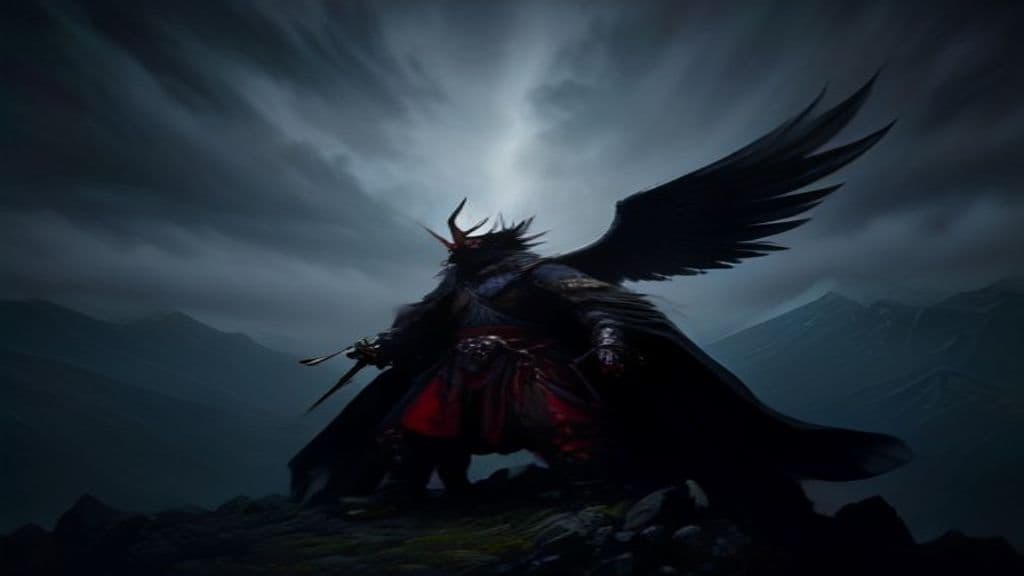
Tengu
Proud, warrior-like mountain spirits of Japan, associated with martial arts, pride, and the wild mountains. Neither fully good nor evil — they test and train warriors and monks, but punish the arrogant.
*Péh₂usōn (reconstructed)
Péh₂usōn is a hypothetical Proto‑Indo‑European pastoral guardian reconstructed by comparative scholars from parallels in Greek and Vedic traditions. Proposed as a Graeco‑Aryan ancestor‑figure, the reconstruction describes a protector of flocks, roads, and travellers rather than an attested historical cultic personality.
Aba (disambiguation / name-form)
Aba is a polyvalent name-form attested across many unrelated contexts (place names, personal names, animal names, and brief mythological listings). The provided sources do not support a single, coherent supernatural entity called "Aba" and offer no descriptive or ritual material for such a being.
Abaddon
In Hebrew scripture Abaddon is primarily a noun meaning 'destruction' or a section/condition of the underworld paired with Sheol; in the New Testament Book of Revelation Abaddon is personified as an angelic figure (Greek Apollyon) described as the king of an army of locusts released from the abyss during the apocalypse.
Abadir
Abadir is a polysemous name attested in distinct cultural contexts: a legendary founding saint and clan ancestor in eastern Ethiopia (Sheikh Abadir Umar Al‑Rida / Aw Abadir), a term applied to cone‑shaped cult stones in Phoenician religious description, and a personal name of a martyr (Abadir/Apater) in the Coptic Synaxarium. The attestations are independent usages of the same name rather than a single supernatural being.
Abadiu of Antinoe
Abadiu of Antinoe was a fourth‑century bishop of Antinoe (Antinoopolis, in Roman Egypt) commemorated as a martyr and saint in the Coptic Orthodox Church, with a feast day on 26 December. Sources record that he was killed during a theological dispute with Arian opponents and reference him in collections of Egyptian martyrs.
Abagtha
Abagtha (Hebrew: אבגתא, ’Ǎḇaḡṯā) is a named human court official in the Hebrew Bible’s Book of Esther, listed among seven chamberlains who ministered before King Ahasuerus and were commanded to bring Queen Vashti before the king. He is attested only in Esther 1:10 and is presented as an institutional palace attendant rather than a supernatural being.
Abandinus
Abandinus is a locally attested Romano‑Celtic theonym known from a single inscribed bronze feather (votive object) dedicated at Godmanchester (the Roman fort Durovigutum) in Cambridgeshire. Scholars interpret him as a local god or male spirit tied to a specific place and possibly associated with a nearby spring or stream; this association is tentative and based on etymological readings of the name.
Abanoub
Abanoub is a 4th‑century Egyptian Christian child martyr venerated in the Coptic tradition. Remembered for his public confession of Christ, miraculous healings associated with his passion, and the translation and veneration of his relics, his feast is observed on July 31 (Epip 24) and his cult centers include Nehisa and Samanoud.
Abarbarea
Abarbarea is a name attested in classical Greek and Roman sources for freshwater nymphs (naiads). The name appears for at least two individual mythic figures — a naiad wife of Bucolion and a naiad counted among ancestors of the Tyrians — and Hesychius records plural forms that may indicate the name was also used as a class-name (Abarbareai / Abarbalaiai).
Abas
Abas (Ancient Greek: Ἄβας, gen.: Ἄβαντος) is not a single mythic being but a recurring personal name borne by multiple mortals and minor mythic figures in Greek epic and genealogical traditions — kings, founders, seers, warriors, attendants, a centaur, and a youth transformed by a goddess. The name is glossed in the sources as 'guileless' or 'good-hearted' and appears across Argive, Theban, Trojan, Euboean, and other local cycles.
Abaskhiron the Soldier
A Coptic Orthodox martyr venerated for refusing imperial idolatry during the Diocletian persecution; reputedly healed by the Archangel Michael, preserved in monastery relics, and commemorated on 14 June (7 Paoni).
Abdel Messih El-Makari
Abdel Messih El-Makari (1892–1963) was a Coptic Orthodox monk and priest venerated as a 20th‑century Coptic saint. Associated with the Monastery of Saint Samuel the Confessor and the Monastery of Saint Macarius (Scetes/Wadi El‑Natrun), he is remembered for humility, asceticism, charity, and reported spiritual gifts such as prescience, discerning of spirits, and healing.
Community Record
- [1]Monopod (creature) — Wikipedia. Wikipedia entry 'Monopod (creature)' summarizing classical, medieval, Chinese, and Norse attestations (Pliny/Ctesias; Isidore; Zhuangzi; Eiríks saga rauða).wiki
- [2]Wikidata: Skiapod. Wikidata entry for Skiapod summarizing variant names and attestations.wiki