
Pylades is presented in the tradition as a Phocian prince, son of Strophius (hence the glosses 'son of Pylas' or related lineage readings). He is childhood companion to Orestes and grows into the role of Orestes' loyal attendant and co-conspirator. The supplied sources do not give a divine or miraculous origin for Pylades; he is treated as a mortal aristocratic figure embedded in the dynastic networks of the House of Atreus.
The provided sources do not supply a sustained physical description; dramatic casting lists and libretti list Pylades as a role implying a conventional young male noble. No specific bodily features, clothing prescriptions beyond conventional noble dress, or distinctive marks are described in the supplied material.
Pylades' 'abilities' are social and practical rather than supernatural: exemplary loyalty and steadfastness in danger; persuasive speech and counsel (notably convincing Orestes to carry out the revenge in Aeschylus' Libation Bearers); practical caregiving, tending Orestes when seized by madness; participation in martial actions alongside Orestes; and collaborative plotting (e.g., schemes to avoid detection or execution and the plot in Tauris to escape with the statue of Artemis). Later Roman-era writers emphasize mutual devotion and willingness to sacrifice for one another.

Orestes
Orestes (Ancient Greek: Ὀρέστης) is a mythic Greek prince and later king, son of Agamemnon and Clytemnestra, whose avenging of his father's murder by killing Aegisthus and Clytemnestra leads to pursuit by the Erinyes and a landmark divine-legal resolution (the trial on the Athenian Acropolis). His narrative explores guilt, divine command, ritual purification, and the transition from private vengeance to civic justice.
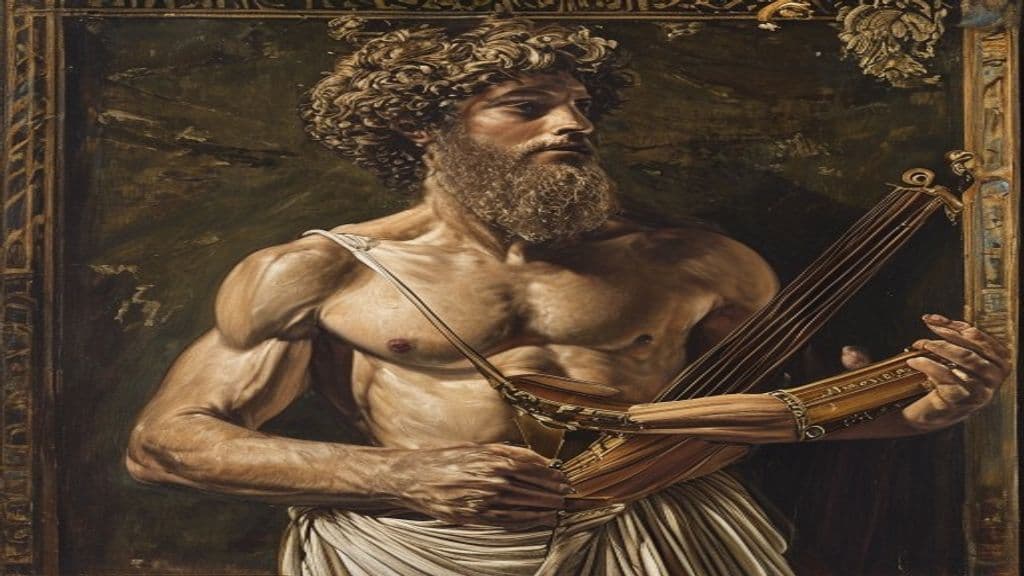
Apollo
Olympian deity of ancient Greek religion associated with prophecy, healing, music, archery, purification, and civic order. Principal patron of the Delphic oracle, protector of youth and flocks, and ambivalently both healer and bringer of plague.

Erinyes
The three avenging Furies of Greek myth — Alecto, Megaera, and Tisiphone — who pursued and tormented those guilty of crimes against blood kin, especially murder of family members.
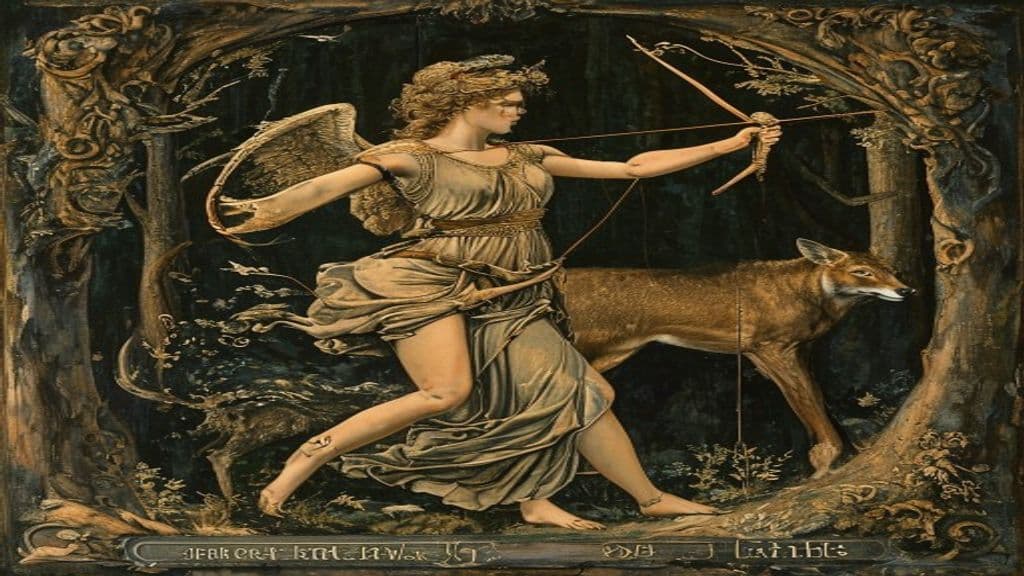
Artemis
Artemis is an ancient Greek goddess of hunting, the wilderness and wild animals, transitions (especially childbirth and puberty), vegetation, and chastity. Twin sister of Apollo and daughter of Zeus and Leto, she functions as a protector of young children and maidens while also capable of inflicting disease or punishment for transgressions against her sacred laws.

Electra
Electra (Ancient Greek: Ἠλέκτρα, Ēléktrā) is a Mycenaean princess in Greek myth and drama, daughter of Agamemnon and Clytemnestra, whose primary role across Aeschylus, Sophocles, and Euripides is as an avenger of her father's murder and a focal figure for questions of filial duty, revenge, and ritual consequence.
*Péh₂usōn (reconstructed)
Péh₂usōn is a hypothetical Proto‑Indo‑European pastoral guardian reconstructed by comparative scholars from parallels in Greek and Vedic traditions. Proposed as a Graeco‑Aryan ancestor‑figure, the reconstruction describes a protector of flocks, roads, and travellers rather than an attested historical cultic personality.
3-D Man
3-D Man is a Marvel Comics superhero identity associated with a 1950s-era origin in which the body of Chuck Chandler can materialize in three-dimensional existence when activated by his brother Hal via a pair of glasses. The mantle was later assumed by Delroy Garrett (formerly Triathlon) in modern continuity.
5 Ronin
5 Ronin is a 2011 Marvel Comics five-issue limited series that reimagines five Marvel superhero archetypes as rōnin (masterless samurai) in a fictionalized post‑Sekigahara feudal Japan. The work places Wolverine, Hulk, Punisher, Psylocke, and Deadpool analogues into period roles to explore displacement, revenge, and identity in an era of political upheaval.
58 Concordia
58 Concordia is a fairly large main-belt asteroid orbiting the Sun, discovered in 1860 and named after the Roman goddess Concordia. Astronomical sources classify it as a C-type (carbonaceous) body with a multi-year orbital period and measurable rotation and pole orientations.
9MOTHER9HORSE9EYES9
An anonymous Reddit screen name and online persona used by the author of the Interface series, a multipart speculative-horror narrative posted in short installments across Reddit in 2016. The name functions as the signature of an authorial identity and as a focal label for a fandom that created archives, a subreddit, and a wiki documenting the story and its fictional phenomena (notably entities called "flesh interfaces").
A.R.G.U.S.
A.R.G.U.S. is a fictional clandestine United States government agency in the DC Comics universe that investigates, contains, and manages superhuman, meta-human, and supernatural incidents and assets. Introduced in The New 52 continuity, it functions as an institutional actor providing intelligence, logistical support, covert task forces (notably Task Force X / the Suicide Squad), and a dedicated magic division across comics and media adaptations.
Aba (disambiguation / name-form)
Aba is a polyvalent name-form attested across many unrelated contexts (place names, personal names, animal names, and brief mythological listings). The provided sources do not support a single, coherent supernatural entity called "Aba" and offer no descriptive or ritual material for such a being.
Abandinus
Abandinus is a locally attested Romano‑Celtic theonym known from a single inscribed bronze feather (votive object) dedicated at Godmanchester (the Roman fort Durovigutum) in Cambridgeshire. Scholars interpret him as a local god or male spirit tied to a specific place and possibly associated with a nearby spring or stream; this association is tentative and based on etymological readings of the name.
Abarbarea
Abarbarea is a name attested in classical Greek and Roman sources for freshwater nymphs (naiads). The name appears for at least two individual mythic figures — a naiad wife of Bucolion and a naiad counted among ancestors of the Tyrians — and Hesychius records plural forms that may indicate the name was also used as a class-name (Abarbareai / Abarbalaiai).
Abas
Abas (Ancient Greek: Ἄβας, gen.: Ἄβαντος) is not a single mythic being but a recurring personal name borne by multiple mortals and minor mythic figures in Greek epic and genealogical traditions — kings, founders, seers, warriors, attendants, a centaur, and a youth transformed by a goddess. The name is glossed in the sources as 'guileless' or 'good-hearted' and appears across Argive, Theban, Trojan, Euboean, and other local cycles.
Abderus
Abderus (Ancient Greek: Ἄβδηρος, romanized Ábdēros) is a mortal heroic figure in Greek myth closely associated with Heracles, remembered as the youth left in charge of the Mares of Diomedes who was killed by them. He functions as an eponymous local/divine-hero ancestor for the city of Abdera and received funerary commemoration and athletic agones at his tomb.
Abellio
Abellio is a theonym attested in Roman‑period inscriptions from the Comminges area of the Pyrenees and reported as worshipped in the Garonne Valley of ancient Gallia Aquitania. Surviving evidence is limited to a small number of inscriptions; scholars have variously hypothesized solar or arboreal associations and compared the name to forms of Apollo or to Celtic Belenus, but the deity's precise role in local cosmology remains uncertain.
Community Record
- [1]Pylades (Wikipedia). Wikipedia, article 'Pylades'.wiki
- [2]Wikidata: Pylades. Wikidata entry Q494886, 'mythical friend of Orestes'.other
- [3]Who's Who in Classical Mythology (archive catalog entry). Archive catalog entry for 'Who's Who in Classical Mythology'.other
- [4]Fata Amicorum (libretto listing, archive). Archive: Fata Amicorum. Dramatis personae and libretti listings referencing Pylades as a role.literary
- [5]Orestes (heroic opera cast lists, archive). Archive: Orestes, heroische Oper — cast lists and theatrical material listing Pylades.literary