
Traditional accounts present Shamharush as an ancient jinn ruler bearing the pre-Islamic epithet Nasrani (Christian) who, after a reputed meeting with the Prophet Muhammad, embraced Islam and was recognized in tradition as a Great Qadi (judge) and an expert in Islamic law. He is named among a set of seven jinn kings and is said in local legend to have lived many centuries before choosing Morocco as his place of eternal rest. From the 16th century onward, Moroccan Islamic scholars campaigned against veneration of jinn figures like him, reducing his public cultic prominence.
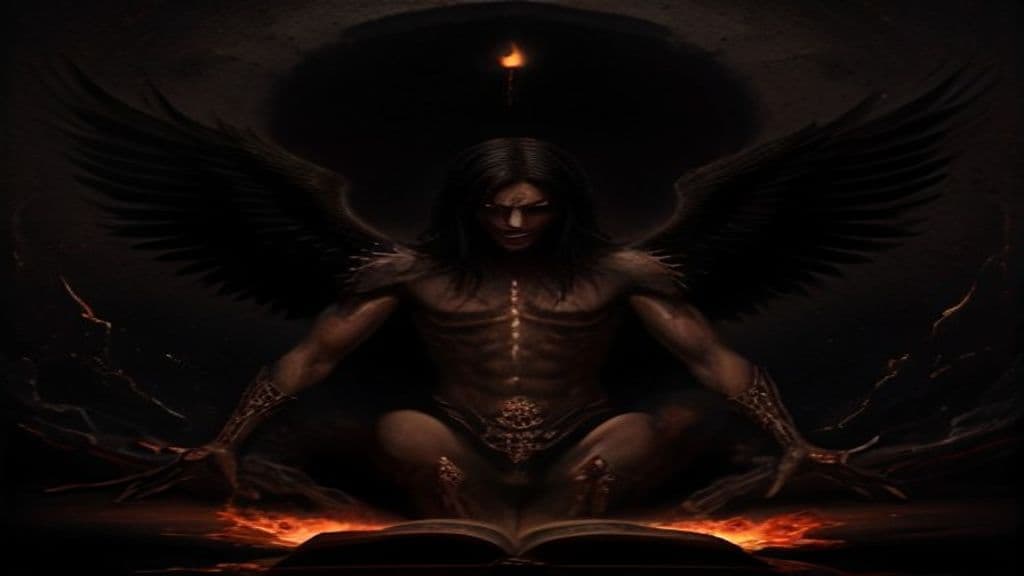
Literary and folkloric accounts rarely supply a detailed anthropomorphic description. Esoteric manuscript imagery (notably Kitab al-Bulhan) depicts him under the epithet Abu al-Walid (Father of the Newborn) holding a naked infant upside down and surrounded by sigils and the Khatam Sulayman (Seal of Solomon) hexagon. Some modern summaries and fandom/esoteric sources also call him al-Tayyar, 'the Flyer,' implying flight in iconography and description.
Shamharush functions as a supreme judicial figure among the jinn, presiding over a tribunal of jinn kings and associated in tradition with law, justice, abundance, and early childhood. He is described as very old, wise, merciful, and as having the authority to offer opportunities for redemption. Tradition links him with the planetary/weekday network (Thursday, Jupiter) and with symbolic attributes such as the color purple and the metal tin. He is said to travel the human world frequently; some sources call him 'the Flyer.' Later folkloric rumors associate him with the lineage of Aicha Kandisha, depicting more morally ambiguous or malign connections, a portrayal that scholars attribute to later demonizing narratives promoted by theologians opposing his cult. Sources associate phenomena such as thunder, lightning, and appearances of shadows with activities at his shrine, which served as a site for resolving human–jinn disputes.
Weaknesses
- otherSources do not list specific vulnerabilities
Wards
- otherShrine visitation and mosque adjacency as local institutional means of addressing disputes (sources record shrine as judicial seat but do not provide explicit ritual ward texts)
57 Mnemosyne
57 Mnemosyne is a large main-belt asteroid (S-type) discovered in 1859 and named after the Greek Titaness Mnemosyne. It is a non-sentient astronomical body studied for its orbital and rotational properties and has been used in dynamical measurements related to Jupiter.
Aamon
Aamon (also Amon) is a named spirit in early modern Western grimoire tradition (Pseudomonarchia Daemonum; the Ars Goetia / Lesser Key of Solomon). He is presented as a high-ranking infernal officer (Marquis/Prince) who governs forty legions and is credited with knowledge of past and future and with affecting human relationships (reconciling or procuring feuds and favor).
Ababil
Ababil (Arabic: أبابيل, romanized abābīl) are miraculous birds mentioned in the Qur'anic account of Surah Al‑Fil. In Islamic tradition they appear as a divinely sent avian host that defended the Kaaba by pelting an invading army with small clay stones; tradition places the event in the year traditionally given as 570 CE.
Abadir
Abadir is a polysemous name attested in distinct cultural contexts: a legendary founding saint and clan ancestor in eastern Ethiopia (Sheikh Abadir Umar Al‑Rida / Aw Abadir), a term applied to cone‑shaped cult stones in Phoenician religious description, and a personal name of a martyr (Abadir/Apater) in the Coptic Synaxarium. The attestations are independent usages of the same name rather than a single supernatural being.
Abdul Qadir Gilani
A historical 11th–12th century Hanbali jurist, preacher, and Sufi shaykh who became the eponym and principal early figure of the Qadiriyya tariqa; venerated in Sunni Sufi traditions as an Awliya (saint) and often given exalted hagiographical ranks such as Muḥi al‑Dīn and Ghawth.
Abel
Abel is the second son of Adam and Eve in the Genesis narrative, a shepherd whose accepted offering and subsequent murder by his brother Cain form the biblical account of the first death. Later interpretive traditions expand his role, treating him as an archetypal righteous victim, a postmortem avenging or adjudicating figure, and in some systems (notably Mandaean) identifying him with an angelic lightbeing.
Abraham (Ibrāhīm) in Islam
Ibrāhīm (Abraham) in Islam is a human prophet and messenger chosen by God, a paradigm of pure monotheism (hanīf), patriarchal ancestor to later peoples and prophets, and traditionally regarded as having helped establish the Kaʿbah with his son Ismāʿīl. He is called Khalīl Allāh ('Friend of God') and is central to rites commemorated in Hajj and Eid al‑Adha.
Abrahel
Abrahel is a demonological entity attested in early modern sources (notably Nicholas Rémy's Demonolatria as summarized in modern reference) portrayed as a female sexual spirit who seduced a man in 1581, induced him to kill his son, then restored the child to life in exchange for worship; the revival produced a diminished, foul-smelling corpse that later died again.
Abraxas
Abraxas (Abrasax) is a late‑antique Gnostic and magical name attested as a high-ranking cosmic power in heresiological summaries and as a potent name engraved on amulets (so-called Abraxas stones) in the Greco‑Roman magical milieu. Heresiologists associate Abraxas with rulership of 365 heavens and note the name's numerological value, while archaeological and papyrological contexts show its use as an amuletic formula.
Abāmūn of Ṭoukh
Abāmūn of Ṭoukh is a Coptic Christian martyr attested in the Synaxarion of Mikhail of Atrib, commemorated with a feast day on 20 July (13 Abib). He is said to have been visited by the archangel Michael, traveled to Ansena where he was tortured and beheaded, was credited with working miracles, and whose body was wrapped by Julius of Aqfahs and returned to Toukh.
Abū Lahab
Abū Lahab (ʿAbd al-ʿUzzā ibn ʿAbd al-Muṭṭalib) is a historical Meccan figure — a paternal uncle of the Prophet Muḥammad and a Quraysh leader who opposed the Prophet; he is singled out and condemned in Qurʾān 111 (Sūrat al-Masad) and functions in Islamic textual memory as an exemplar of divine punishment for opposition.
Achamōth
Achamōth is a feminine emanational figure in certain Gnostic systems, attested as a daughter or subordinate aspect of the divine Wisdom, Sophia. She appears in ophitic/Naassene mythic genealogies where she is named as motherly/filial to lower, problematic figures such as Ilda‑Baoth; beyond this genealogical role the supplied sources record little concrete description or ritual material specific to her.
Community Record
- [1]Shamharush (Wikipedia). Wikipedia: Shamharushwiki
- [2]Friends of Morocco — News in review (Sidi Shamharush reference). Friends of Morocco: 'Sidi Shamharush the Flyer' mentionother
- [3]Kitab al-Bulhan imagery (as summarized in sources). Esoteric manuscript tradition summarized in provided notes (Kitab al-Bulhan depiction: Abu al-Walid holding infant with sigils/Khatam Sulayman)literary
- [4]DjinnUniverse / fandom references (al‑Tayyar; seven jinn kings listings). DjinnUniverse summary; fandom cross-references (djinn wiki / powerlisting fandom) cited in notesfolk
- [5]Zār (Wikipedia) — comparative mention. Wikipedia: Zār (includes brief mention of Shamharush in related spirit-name lists)wiki