
Sources identify shiqq as part of a pre-Islamic layer of Arabian supernatural beings that continued into Bedouin oral tradition after the advent of Islam. The cited summaries classify the shiqq within the broader taxonomy of jinn-types and describe it as a lower-ranked or lesser member of that unseen population. Beyond this placement in older Arabian cosmologies and continuity into Bedouin folklore, the available sources do not provide a detailed creation myth, genealogy, or cosmological origin specific to shiqq.
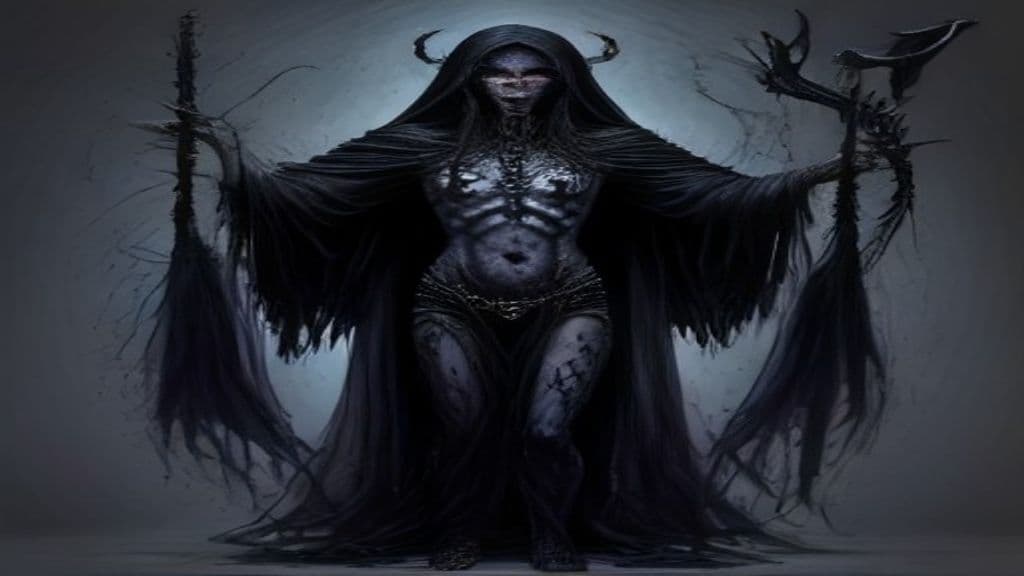
Available descriptions are brief and characterize the shiqq primarily as 'only half-formed,' producing a monstrous appearance. This half-formed descriptor links the shiqq conceptually to other half-bodied motifs in Arabian folklore (for example, the nasnas) but the sources do not supply precise anatomical details for shiqq, so assertions about exact morphology beyond the general 'half-formed' or malformed quality are not attested in the provided material. Modern media usages (animated episodes) reuse the name 'Shiqq' as a character but do not function as traditional descriptive sources.
The supplied sources do not enumerate specific powers, capabilities, or standard behaviors for shiqq beyond their classification as lower-ranked jinn-like or monstrous beings and a noted overlap with the ghoul category in folk summaries. That overlap suggests a conceptual affinity with monstrous or predatory beings in Arabian lore, but the sources do not document particular abilities, modes of attack, or interactions with humans for shiqq. Modern fictional portrayals in the cited animated episodes show narrative actions by a character called Shiqq, but these are not presented as ethnographic evidence of traditional powers.

Nasnas
A half-human djinn creature of Arab folklore — possessing only half a face, one arm, one leg, and half a torso — descended from the union of a shaitan and a human, moving by leaping and highly dangerous to encounter.

Jinn
A class of supernatural beings from pre-Islamic Arabian religion later integrated into Islamic theology; jinn are created, morally accountable entities distinct from humans and angels, often unseen but capable of taking visible forms and interacting with people in varied ways.
Ghoul
A ghoul is a demon-like or monstrous humanoid originating in pre-Islamic Arabian religion, traditionally associated with graveyards and the consumption of human flesh. The concept later entered broader folklore and has been widely reused and transformed in modern fiction and popular culture.
A'ra
No reliable sources in the supplied material establish A'ra as a distinct supernatural entity. The token "A'ra" appears in the dataset as (a) part of general references to pre-Islamic Arabian deities, (b) a modern Korean female given name (A-ra/아라), and (c) an Arabic toponym (A'ra, one village merged into Ar'ara).
Abgal
Abgal (Arabic: أبغال) is a pre‑Islamic local tutelary figure attested in the Palmyrene cultural sphere (c. 154–270 AD), primarily venerated by nomadic Arab groups in the Syrian desert. He appears in inscriptions and reliefs as one of a constellation of armed, mounted protective deities associated with caravan and nomadic protection, though no ritual texts survive in the cited sources.
Al-Abyad
Al-Abyad (Arabic: al‑Abyad, "the White") appears in modern compilations and anecdotal references as a named jinn or epithet within Arabic/Islamic discourse on jinn. The corpus consists mainly of contemporary lists, forum posts, popular articles, and a polemical anecdote; no coherent classical origin myth or primary ritual tradition for Al-Abyad is attested in the supplied materials.
Al-Jānn
Al-Jānn (jann) is a pre-Adamite, ancestral category invoked in Arabic-Islamic exegetical, hadithic, mystical, and folkloric materials to designate an earlier class of sentient beings—progenitors of later jinn—said to be created of fire, to have once inhabited and sometimes ruled the earth, and to stand in a liminal ontological position between angels and humans.
Al-Kuz
Al-Kuz is not attested in the supplied corpus as a supernatural being; the name appears as the designation of an impact crater on Saturn's moon Enceladus and as the name of a literary character (one of the barber’s six brothers) in "The Hunchback's Tale" from The Book of One Thousand and One Nights.
Al-Mi'raj
A mythical creature from medieval Arabic literature, described as a one-horned hare or rabbit. (Note: * Power tier: Given the lack of information on abilities and powers, it's too early to assign a power tier. However, considering its classification as a "mythical creature" in medieval Arabic literatu)
Al-ʻUzzā
Al-ʻUzzā was a principal female deity of pre-Islamic Arabian religion, widely venerated by tribes such as the Quraysh. She formed a triad with al-Lāt and Manāt, had a prominent shrine at Nakhlah (near Mecca) with sacred trees and a stone cube, and was invoked for protection, intercession and oracular consultation in late medieval Islamic sources that record pre-Islamic cult practice.
Aladdin
Aladdin is the human protagonist of a Middle Eastern folktale (ATU 561) who rises from poverty to wealth after acquiring a magical ring and a magical lamp that house spirit-agents. Although widely associated with The Thousand and One Nights, the tale entered that corpus via Antoine Galland from a story told by the Syrian storyteller Hanna Diyab rather than from the earliest Arabic Nights manuscripts.
Alexander the Great in Arabic tradition
Legendary figure with divine authority, expanded empire from Greece to northwestern India. (Note: - Power tier: Change Primordial to Ancient (Alexander is a legendary figure with divine authority, but his abilities are not on a cosmic level) - Abilities: Add that Alexander's ability to inspire loy)
Allah
Allah is the Arabic-language term for the singular monotheistic God of the Abrahamic tradition as used in Islamic theology and by Arabic-speaking Jews and Christians. Linguistically related to other West Semitic divine names, the term in Islamic usage functions as God's unique proper name (Lafẓ al-Jalālah) and denotes the transcendent creator and sovereign of the universe.
Allat (Al-Lat)
Allat (Al-Lat) is a pre-Islamic Arabian goddess attested across the Arabian Peninsula and in wider ancient Near Eastern onomastics. In the supplied sources she is recorded as one of the triad of goddesses worshipped in Arabia (with Al‑Uzza and Manat) and as a cult figure at sites such as al‑Ta'if where her cult-object was a cubic rock.
Amrak
Amrak is not attested in the provided sources as a supernatural being. The lexical string "Amrak" appears across unrelated secular contexts — as a historical regnal name (Amrak Khagan / Ashina Anluo), a Turkish place-name (Çamrak / amrak), titles in modern Arabic-language music, an institutional name/acronym (AMRAK Institute), and as a modern brand/typeface/project name. No folkloric, ritual, or mythological descriptions of an entity called "Amrak" are present in the cited material.
Community Record
- [1]Shiqq. Wikipedia contributors, 'Shiqq,' Wikipedia, The Free Encyclopedia.wiki
- [2]Shiqq (Wikidata). Wikidata entry Q131277817, 'Shiqq'.wiki
- [3]Nasnas. Wikipedia contributors, 'Nasnas,' Wikipedia, The Free Encyclopedia (used for comparative motif of 'half-formed' beings).wiki
- [4]Imago | Shiqq le divin (Épisode 10) | Épisode Complet FR. Archived episode of the animated series Imago featuring a character named 'Shiqq' (modern media usage).other
- [5]Imago | Salamantra (Épisode 9) | Épisode Complet FR. Archived episode of the animated series Imago (modern media usage referencing 'Shiqq').other
- [6]Imago | L'Imago de la lampe - Partie 2 (Épisode 2) | Épisode Complet FR. Archived episode of the animated series Imago (modern media usage referencing 'Shiqq').other
- [7]List of Jinn Types | Cryptid Wiki | Fandom. Cryptid Wiki list of jinn types (includes shiqq among various jinn categories).other