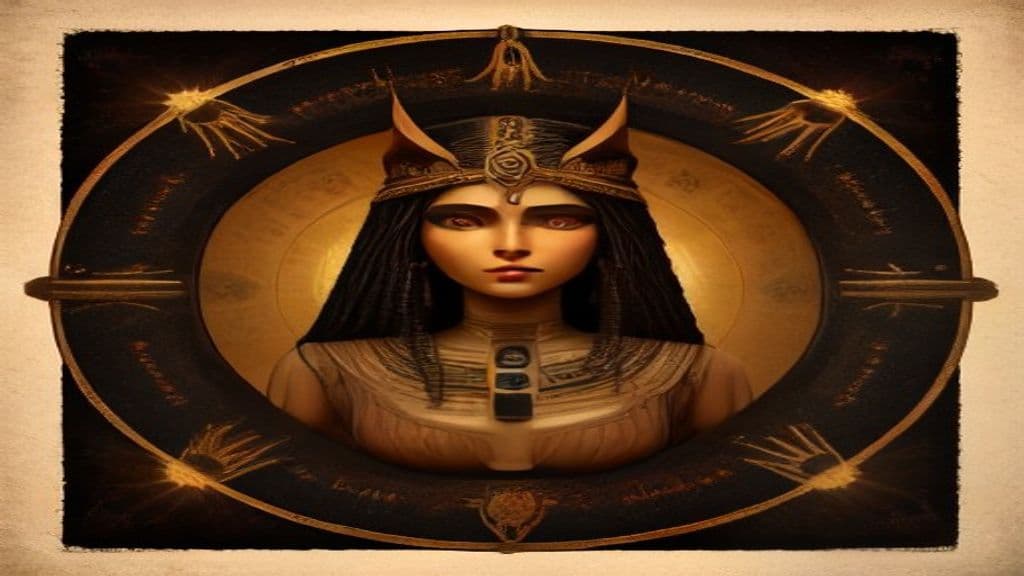
Sources do not record a unified cosmogonic origin or narrative birth for Werethekau. Rather, she emerges in texts and material culture as the personified quality of hekau (magical power); her identity functions both as an independent goddess in some inscriptions and as an epithet or attribute attached to other deities and to royal and protective objects.
Iconography varies and appears to be uncommon; sources describe Werethekau sometimes as a snake or as a lion-headed woman and, when associated with Ra-Horakhty, depicted with his solar disk on her head. At the same time at least one source notes she was seldom depicted in reliefs or papyri, indicating that visual representations are inconsistent and relatively rare.
Werethekau embodies the efficacy of magic (heka) and serves a chiefly protective function. Her name and image are placed on funerary objects and weapons so the deceased can defend themselves in the underworld, on ivory knives as charms to protect pregnant and nursing mothers, and she is described as an inherent power of the Crowns of Egypt and as dwelling in the state sanctuary. She is frequently used as an epithet for goddesses such as Isis, Sekhmet, and Mut, signaling that her power is both an independent divine force and an attribute conferred through other deities.
Weaknesses
- otherSources do not record specific weaknesses or vulnerabilities for Werethekau
Wards
- symbolDepiction/inscription of Werethekau on objects (funerary weapons, ivory knives, crowns) used as talismanic protection

Isis
Isis is a major goddess of ancient Egyptian religion, a member of the Heliopolitan Ennead who functions as sister and consort of Osiris, mother and protector of Horus, a funerary and royal protector, and a locus of potent magic whose cult spread through the Hellenistic and Roman Mediterranean.

Sekhmet
Sekhmet is an ancient Egyptian lioness-headed goddess who functions as the vengeful 'Eye of Ra', a solar agent of divine punishment, and simultaneously as a powerful healing and protective deity invoked against disease. Her mythology and cult deploy the same ambivalent force for destruction and restoration, with ritual practices developed to both propitiate and emulate her pacification.

Mut
Mut is an ancient Egyptian mother goddess associated with the primordial waters (Nu), the Theban Triad, and the Eye of Ra corpus. She functions as a cosmic maternal principle, a local patroness of Thebes with temples and priesthood, and a shifting consort/maternal figure within Amun-centered theology.

Ra-Horakhty
Ra-Horakhty is a syncretic ancient Egyptian deity combining Ra (the principal solar god associated with the noonday sun and rulership) and Horus in his horizon-related aspect. The compound, glossed as "Ra who is Horus of the Two Horizons," expresses the sun's journey across the horizons and the fusion of solar sovereignty with royal/sky symbolism in Egyptian theology.
Aani
Aani (ancient Egyptian jꜥnr) is the lexical term for the baboon in ancient Egyptian language and functions in religious contexts as an animal icon and theophoric epithet. Attested repeatedly in Egyptian texts and images, the baboon image is used to represent or denote aspects of gods such as Thoth, Hapy, Khonsu, and Osiris rather than implying the animal itself is an independent deity.
Aati
Aati (also rendered Ati) is one of the 42 judges of the dead in ancient Egyptian funerary literature, attested in the Book of the Dead tradition (notably the Papyrus of Nebsemy). Described as originating 'from Heliopolis', Aati's documented function is to question the deceased about a specific moral accusation during the Duat judgment; the funerary texts supply a formulaic denial the soul must recite.
Abadiu of Antinoe
Abadiu of Antinoe was a fourth‑century bishop of Antinoe (Antinoopolis, in Roman Egypt) commemorated as a martyr and saint in the Coptic Orthodox Church, with a feast day on 26 December. Sources record that he was killed during a theological dispute with Arian opponents and reference him in collections of Egyptian martyrs.
Abaset
Abaset is a localized ancient Egyptian goddess attested in tomb decoration at El‑Bawiti in the Bahariya Oasis during the 26th Dynasty. She is depicted anthropomorphically with a hedgehog motif incorporated into her headdress and appears on the walls of Qarat Qasr Salim, including twice in the Tomb of Bannentiu. No cult texts, myth narratives, or ritual prescriptions for her are recorded in the cited corpus.
Abib and Apollo
Abib and Apollo are Christian ascetics and hagiographic saints of Akhmim (Upper Egypt) attested in Coptic sources and the Historia Monachorum. Remembered for extreme asceticism, monastic leadership, angelic encounters, and inclusion in the Coptic Synaxarion (feast day November 4).
Abyzou
Abyzou is a female malignant supernatural figure in Near Eastern and medieval European magico-medical and demonological traditions, blamed especially for miscarriages, stillbirths, and infant mortality. She appears in literary sources (notably the Testament of Solomon) and on Byzantine and medieval amulets where her flight or subjugation is commanded by names, images, and saints/archangels.
Abāmūn of Tarnūt
A fourth‑century Coptic Christian presented in later hagiography as a martyr from the city of Tarnūt (Therenuti). Known primarily from a single late medieval Synaxarion notice, he is commemorated liturgically for his voluntary confession and violent martyrdom.
Adder Stone (Egyptian Tradition)
A type of stone with specific physical characteristics, typically glassy and containing a naturally occurring hole, primarily made of flint. Not considered supernatural in Egyptian tradition. (Note: - Remove "primarily made of flint" from Appearance section, as it is not a characteristic unique to Adder stones. - Power tier should be "None" based on the source material, but clarify that this refe)
Adim (Egyptian Mythology)
In Egyptian mythology, Adim is a king and son of Budasheer who appears after the Great Flood. He has problem-solving skills and consults with his father's ghost for guidance. (Note: 1. The power tier should be Lesser (local spirit) as Adim is described as a king of Egypt, but not as having deity-level abilities. 2. Add sensory cues such as "consulting his father's ghost" and poss)
Agathos Daimon (Agathodaemon)
A beneficent household and civic daemon attested in classical Greek and Graeco‑Egyptian religion. In domestic Greece it is a household spirit honored with post‑meal libations; in Ptolemaic Alexandria it appears prominently in serpentine civic and household forms and is syncretised with various Egyptian protective and fate deities in late antiquity.
Ahmed al-Badawī
Ahmed al-Badawī (Aḥmad al-Badawī, al-Sayyid al-Badawī) was a 13th-century Arab Sufi mystic and founder of the Badawiyyah order. Born in Fes to a Bedouin tribe and later settled in Tanta, Egypt, his tomb remains a major site of visitation and he is regarded as one of the most popular Sufi saints in Egypt (sources emphasize his historical sainthood and pilgrimage cult rather than detailed folkloric attributes).
Ahmose‑Nefertari
Ahmose‑Nefertari was an 18th‑Dynasty Egyptian queen who, after her death, received institutionalized cult worship and was venerated in the Theban necropolis and Deir el‑Medina. Sources present her both as a historically attested royal (great royal wife and king's mother) and as a deified figure given epithets such as 'Goddess of Resurrection', 'Mistress of the Sky', and 'Lady of the West'.
Community Record
- [1]Werethekau. Wikipedia, 'Werethekau' article (accessed via provided research notes)wiki
- [2]Werethekau & Isis Great of Magic – Isiopolis. Isiopolis blog quoting Ebers Papyrus and discussing the epithet Weret Hekaufolk
- [3]The Goddess Werethekau & Isis – Isiopolis. Isiopolis blog on Werethekau and her usage as an epithetfolk
- [4]Urthekau, Werethekau (nemo.nu). Nemo.nu summary noting lion-headed depiction and rarity of depictionsother
- [5]werethekau | Ancient Egypt Online. Ancient Egypt Online entry on Werethekau (referenced in research notes)other