
Astarte derives from the Northwest Semitic goddess-name ʿAṯtart and appears in Bronze Age sources from Amorite and Levantine cities such as Ugarit, Emar, Mari, and Ebla. Over time her cult became prominent in Iron Age Phoenician city-states (Sidon, Tyre, Byblos) and spread with Phoenician trade and colonization to Cyprus, parts of the central Mediterranean (including Eryx in Sicily and Carthage), Egypt (as an imported foreign goddess during periods such as the Ramesside era), and the western Mediterranean. In classical antiquity she is Hellenized as Astarte and often syncretized with Greek and Roman goddesses (notably Aphrodite/Venus in some contexts). Scholarly sources emphasize continuity and regional adaptation rather than a single foundational myth recorded in the surviving summaries used here.
Iconography associated with Astarte in the supplied sources includes frequent associations with lions (often prostrate at her feet or beneath her), portrayals of erotic nudity in some Iron Age Phoenician art, and martial imagery such as depictions on horseback or in chariots (the latter are the images most securely identified as Astarte). Additional motifs attested in various contexts include winged representations, headdress elements like a solar disk and crescent, the horse and chariot, the dove on some Bronze Age seals, bees, bull motifs in certain assimilations, standing on the prow of a galley on Sidonian coins, and botanical symbols (palm, lotus). The corpus shows variation by place and period rather than a single uniform appearance.
Astarte's spheres of influence in the available sources are multifaceted: prominently war (symbolized by lions, horses, chariots, and martial iconography), sexuality (naked portrayals and erotic emphasis in Iron Age Phoenicia), royal power and beauty, hunting (noted in Ugarit and Emar), and healing in certain civic contexts (for example shared cult space with the healing deity Eshmun in Sidon). Earlier scholarship often labeled her an astral deity (a deified morning/evening star), but the sources note this astral character is disputed and not clearly attested in all cities. God lists and regional practice also show interchangeability and syncretism with East Semitic Ištar and Hurrian Ishtar‑like goddesses, indicating overlapping divine functions.
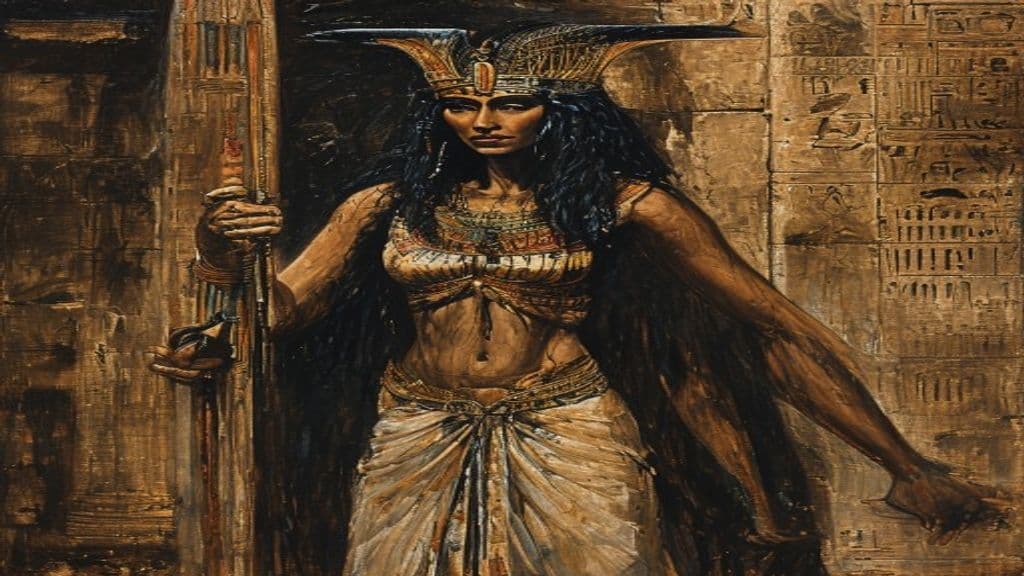
Anat
Anat is a Bronze Age Levantine goddess best known from Ugaritic texts, associated primarily with warfare and hunting. She is a major divine figure in the Ugaritic pantheon who regularly received offerings, appears as an active agent in mythic narratives (notably the Baal Cycle), and was attested across the Levant, into Egypt, Cyprus, Hurrian ritual contexts, and later in Suhum.
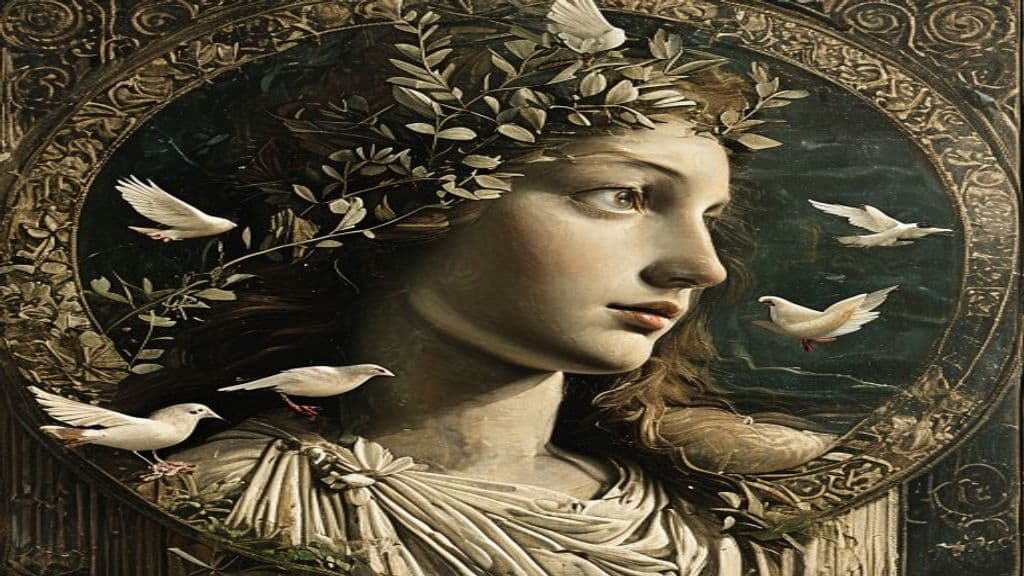
Aphrodite
Aphrodite is a major ancient Greek goddess associated with love, lust, beauty, pleasure, passion, procreation, and related social and cosmic forces. She is counted among the principal Olympian deities with major cult-centers (Cythera, Cyprus, Corinth, Athens), celebrated annually at the Aphrodisia, and syncretized with the Roman Venus.
*Péh₂usōn (reconstructed)
Péh₂usōn is a hypothetical Proto‑Indo‑European pastoral guardian reconstructed by comparative scholars from parallels in Greek and Vedic traditions. Proposed as a Graeco‑Aryan ancestor‑figure, the reconstruction describes a protector of flocks, roads, and travellers rather than an attested historical cultic personality.
Aba (disambiguation / name-form)
Aba is a polyvalent name-form attested across many unrelated contexts (place names, personal names, animal names, and brief mythological listings). The provided sources do not support a single, coherent supernatural entity called "Aba" and offer no descriptive or ritual material for such a being.
Abadir
Abadir is a polysemous name attested in distinct cultural contexts: a legendary founding saint and clan ancestor in eastern Ethiopia (Sheikh Abadir Umar Al‑Rida / Aw Abadir), a term applied to cone‑shaped cult stones in Phoenician religious description, and a personal name of a martyr (Abadir/Apater) in the Coptic Synaxarium. The attestations are independent usages of the same name rather than a single supernatural being.
Abandinus
Abandinus is a locally attested Romano‑Celtic theonym known from a single inscribed bronze feather (votive object) dedicated at Godmanchester (the Roman fort Durovigutum) in Cambridgeshire. Scholars interpret him as a local god or male spirit tied to a specific place and possibly associated with a nearby spring or stream; this association is tentative and based on etymological readings of the name.
Abarbarea
Abarbarea is a name attested in classical Greek and Roman sources for freshwater nymphs (naiads). The name appears for at least two individual mythic figures — a naiad wife of Bucolion and a naiad counted among ancestors of the Tyrians — and Hesychius records plural forms that may indicate the name was also used as a class-name (Abarbareai / Abarbalaiai).
Abas
Abas (Ancient Greek: Ἄβας, gen.: Ἄβαντος) is not a single mythic being but a recurring personal name borne by multiple mortals and minor mythic figures in Greek epic and genealogical traditions — kings, founders, seers, warriors, attendants, a centaur, and a youth transformed by a goddess. The name is glossed in the sources as 'guileless' or 'good-hearted' and appears across Argive, Theban, Trojan, Euboean, and other local cycles.
Abderus
Abderus (Ancient Greek: Ἄβδηρος, romanized Ábdēros) is a mortal heroic figure in Greek myth closely associated with Heracles, remembered as the youth left in charge of the Mares of Diomedes who was killed by them. He functions as an eponymous local/divine-hero ancestor for the city of Abdera and received funerary commemoration and athletic agones at his tomb.
Abellio
Abellio is a theonym attested in Roman‑period inscriptions from the Comminges area of the Pyrenees and reported as worshipped in the Garonne Valley of ancient Gallia Aquitania. Surviving evidence is limited to a small number of inscriptions; scholars have variously hypothesized solar or arboreal associations and compared the name to forms of Apollo or to Celtic Belenus, but the deity's precise role in local cosmology remains uncertain.
Abnoba
Abnoba is a Gaulish theonym and toponym attested in Roman-era sources and inscriptions: a localized deity associated with woods, springs and the sources of rivers (notably the Danube) and simultaneously the name applied to a mountain or mountain range in the Black Forest/Baar/Odenwald region. Roman altars equate her with Diana, reflecting syncretic cult practice in frontier provinces.
Abomination of Desolation
An apocalyptic prophetic phrase originating in the Book of Daniel designating a profaning thing or act that renders the Jerusalem Temple cult desolate; later reused in the Synoptic Gospels as an eschatological sign prompting urgent flight. The term denotes ritual/cultic impurity (Hebrew shiqquts) and is variously interpreted as pagan offerings or altar, a foreign cult statue, or (in some New Testament readings) an acting agent.
Aborigines (mythology)
A mytho-historical label used in Roman and general reference sources to denote the oldest inhabitants of a region (specifically central Italy in the cited Roman context). The term functions as an identity/category for original human populations rather than as a characterized supernatural being in the provided sources.
Absyrtus
Absyrtus (Ancient Greek: Ἄψυρτος) is a Colchian prince in the Greek Argonautic cycle, son of King Aeëtes and brother or half-brother of Medea. He appears in variant traditions either as a companion taken by Medea during her flight with Jason and murdered/dismembered to delay pursuit, or as a pursuer sent by Aeëtes who is overtaken and slain by Jason; his death functions as a key narrative device in the escape from Colchis.
Community Record
- [1]Astarte (Wikipedia). Wikipedia contributors, 'Astarte,' Wikipedia, The Free Encyclopedia, https://en.wikipedia.org/wiki/Astartewiki
- [2]Astarte (Wikidata). Wikidata entry Q3259657, 'Astarte,' http://www.wikidata.org/entity/Q3259657wiki
- [3]Murder Music - Black Metal (Archive listing referencing modern use of the name 'Astarte'). Archive.org, 'Murder Music - Black Metal' (lists a modern musical act named 'Astarte'), https://archive.org/details/youtube-Hrtq_W6fcCUother