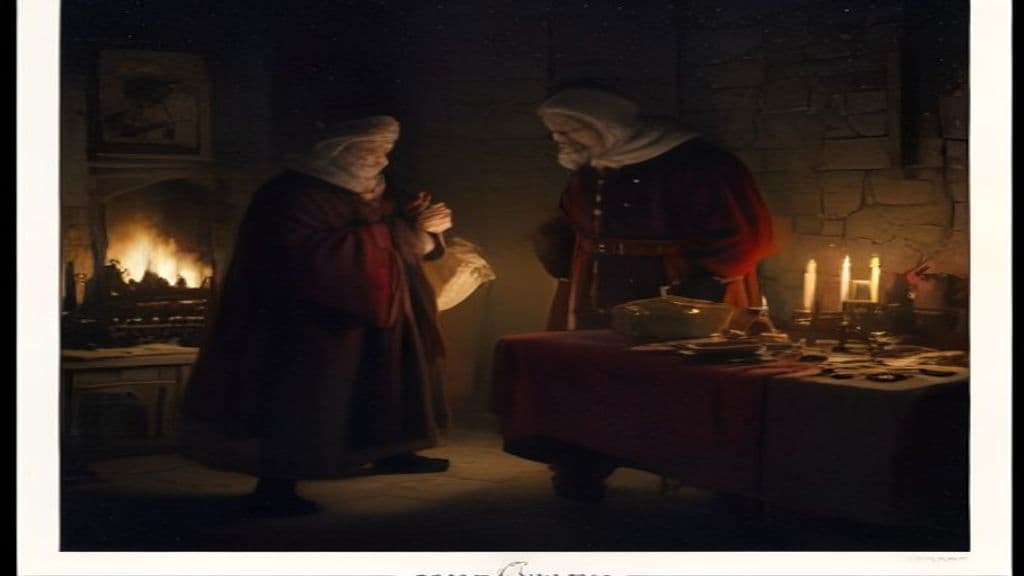
There is no single mythic origin in the sources; rather the gift-bringer role is a mutable office formed by syncretism. In many Christianized regions the role was overlaid onto or associated with the hagiography of Nicholas of Myra (fourth century) because his acts of charity provided a model for seasonal gift-giving. Pre-Christian antecedents include household spirits, Yule personifications, and farmstead guardians (e.g., tomten, kobolds) whose seasonal visibility and association with the winter calendar were reinterpreted in Christian and later secular frames. Nineteenth-century print culture and mass media produced a standardized, secularized North American variant (Santa Claus) that then influenced European forms.
Appearances vary by regional tradition: a bearded old man figure appears widely (e.g., Saint Nicholas, Father Christmas); Scandinavian forms include an elf-like tomten or Yule-associated goat figure in some localities; the Christkind is portrayed as a young child or angelic being in parts of Central Europe; Italian Befana is described as an old woman who rides a broom and brings sweets at Epiphany. The modern North American Santa is a standardized jovial, red-suited, reindeer-and-sleigh chimera formed through nineteenth-century cultural production and mass media.
Primary functional attribute is seasonal gift delivery to children and the poor on culturally specified dates (December 6, Christmas Eve, Epiphany/January 6, or Yule period), often embedded in rituals of petition (letters, offerings) and communal performance (parades, household exchanges). Traditions may pair the gift-bringer with punitive companions (e.g., Krampus, Belsnickel) who embody sanction for misbehavior; scholarly interpretation (Jacob Grimm) traces these punitive figures to Christianized household-spirit motifs. Sources describe cultural and narrative mechanisms for mobility and gift distribution (reindeer + sleigh motif, etc.) as literary and visual conventions rather than uniform supernatural mechanics.
Weaknesses
- conditionNot specified as hostile — no folkloric vulnerabilities recorded for primary gift-bringers
- otherCompanion-based sanction: traditions preserve punitive counterparts (Krampus, Belsnickel) whose presence functions as social threat rather than a vulnerability of the gift-bringer
Wards
- otherNone traditionally specified for the gift-bringer class — sources emphasize celebration and petitioning rather than warding
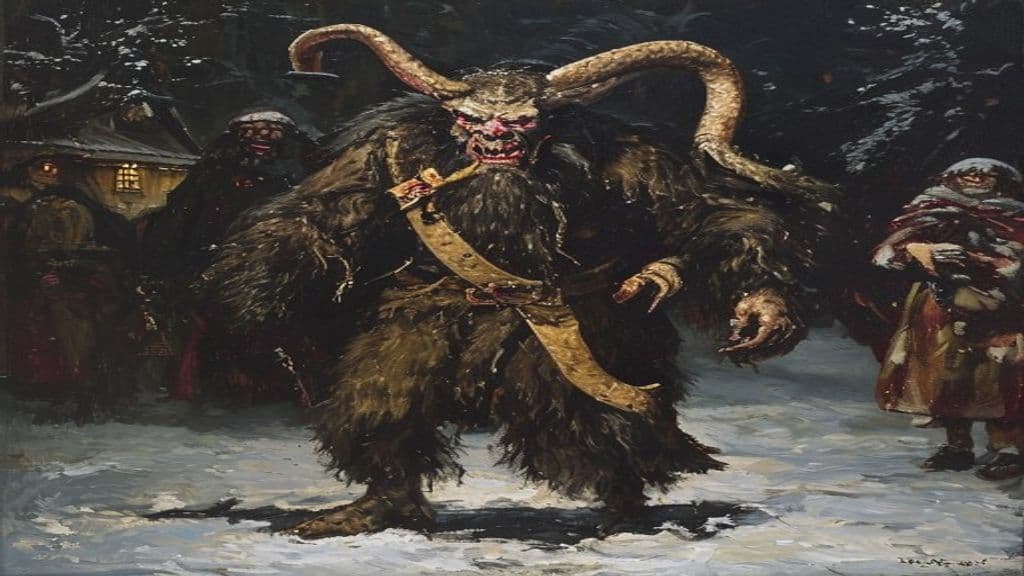
Krampus
Krampus is a horned, hairy, anthropomorphic figure from Central and Eastern Alpine folk practice who serves as the punitive companion to Saint Nicholas during the winter festival cycle; he appears on Krampusnacht (5 December) and in public Krampuslauf/Perchtenlauf processions to threaten or punish badly behaved children.

Belsnickel
Belsnickel is a traditional fur-clad Yuletide visitor from the Palatinate region of southwestern Germany who inspects children's behaviour, disperses sweets to the well-behaved, and threatens or administers punishment (often symbolically) to the naughty. The figure survives in Pennsylvania Dutch and other diaspora communities and appears both as a solitary domestic visitor and as part of boisterous communal processions called 'Belsnickling' or 'Klausentreiben'.

Christkind
The Christkind is a Central European cultural personification of the Christ Child who functions as the traditional bringer of Christmas gifts in many domestic and civic seasonal practices. Originating in Reformation-era promotion of the infant Jesus as focus of Christmas giving, it persists in diverse regional forms (e.g., Ježíšek, Jézuska) and in civic pageantry such as the Nuremberg Christkindlesmarkt.

Befana
In Italian popular and folk culture, the Befana is a witch‑like old woman associated with the Feast of the Epiphany who, on Epiphany Eve (night of January 5), brings sweets to good children and coal to bad children. She is an ambivalent household/seasonal figure involved in domestic and communal Epiphany rituals such as mumming, effigy‑making and bonfires, and her origins are debated between liturgical personification and survivals of older household goddess offerings.

Baba Yaga
Baba Yaga is an ambivalent female figure of East Slavic folktale tradition, depicted variously as a fearsome, child-eating crone or as a helpful, maternal donor. She is associated with the deep forest, a hut described as standing on chicken legs, and the motific accoutrements of a mortar and pestle.
Abaddon
In Hebrew scripture Abaddon is primarily a noun meaning 'destruction' or a section/condition of the underworld paired with Sheol; in the New Testament Book of Revelation Abaddon is personified as an angelic figure (Greek Apollyon) described as the king of an army of locusts released from the abyss during the apocalypse.
Abadir
Abadir is a polysemous name attested in distinct cultural contexts: a legendary founding saint and clan ancestor in eastern Ethiopia (Sheikh Abadir Umar Al‑Rida / Aw Abadir), a term applied to cone‑shaped cult stones in Phoenician religious description, and a personal name of a martyr (Abadir/Apater) in the Coptic Synaxarium. The attestations are independent usages of the same name rather than a single supernatural being.
Abadiu of Antinoe
Abadiu of Antinoe was a fourth‑century bishop of Antinoe (Antinoopolis, in Roman Egypt) commemorated as a martyr and saint in the Coptic Orthodox Church, with a feast day on 26 December. Sources record that he was killed during a theological dispute with Arian opponents and reference him in collections of Egyptian martyrs.
Abagtha
Abagtha (Hebrew: אבגתא, ’Ǎḇaḡṯā) is a named human court official in the Hebrew Bible’s Book of Esther, listed among seven chamberlains who ministered before King Ahasuerus and were commanded to bring Queen Vashti before the king. He is attested only in Esther 1:10 and is presented as an institutional palace attendant rather than a supernatural being.
Abanoub
Abanoub is a 4th‑century Egyptian Christian child martyr venerated in the Coptic tradition. Remembered for his public confession of Christ, miraculous healings associated with his passion, and the translation and veneration of his relics, his feast is observed on July 31 (Epip 24) and his cult centers include Nehisa and Samanoud.
Abaskhiron the Soldier
A Coptic Orthodox martyr venerated for refusing imperial idolatry during the Diocletian persecution; reputedly healed by the Archangel Michael, preserved in monastery relics, and commemorated on 14 June (7 Paoni).
Abdel Messih El-Makari
Abdel Messih El-Makari (1892–1963) was a Coptic Orthodox monk and priest venerated as a 20th‑century Coptic saint. Associated with the Monastery of Saint Samuel the Confessor and the Monastery of Saint Macarius (Scetes/Wadi El‑Natrun), he is remembered for humility, asceticism, charity, and reported spiritual gifts such as prescience, discerning of spirits, and healing.
Abel
Abel is the second son of Adam and Eve in the Genesis narrative, a shepherd whose accepted offering and subsequent murder by his brother Cain form the biblical account of the first death. Later interpretive traditions expand his role, treating him as an archetypal righteous victim, a postmortem avenging or adjudicating figure, and in some systems (notably Mandaean) identifying him with an angelic lightbeing.
Abib and Apollo
Abib and Apollo are Christian ascetics and hagiographic saints of Akhmim (Upper Egypt) attested in Coptic sources and the Historia Monachorum. Remembered for extreme asceticism, monastic leadership, angelic encounters, and inclusion in the Coptic Synaxarion (feast day November 4).
Abiel
Abiel is attested in the supplied sources only as a male given name — borne by several historical American individuals and listed as two minor biblical figures. The provided materials contain no evidence presenting Abiel as a supernatural, mythological, or folkloric entity.
Abijah of Judah
Abijah (also Abijam or Abiah) is presented in the biblical and later interpretive traditions as a short-reigning human king of Judah from the Davidic line. He is portrayed as a dynastic successor whose military actions (notably the battle at Mount Zemaraim) and moral evaluation in rabbinic literature are interpreted theologically in relation to the Davidic covenant.
Abimelech
Abimelech is a Hebrew personal name and occasionally a regnal title attested in the Hebrew Bible and later traditions. It appears as the name/title of Philistine rulers in the patriarchal narratives (the "king of Gerar" who interacts with Abraham and Isaac) and as the personal name of Abimelech son of Jerubbaal (Gideon) in Judges, a dynastic usurper whose brief rule ends in violent death.
Community Record
- [1]Christmas gift-bringer. Wikipedia, 'Christmas gift-bringer' entry (summary of traditions, appearances, dates, and syncretism)wiki
- [2]List of Christmas and winter gift-bringers. Wikipedia, compilation of regional gift-bringers and local nameswiki
- [3]Deutsche Mythologie (interpretation cited). Summary referencing Jacob Grimm's interpretation linking punitive companions (Krampus) to household spirits (via Wikipedia article)folk
- [4]The Santa Mutation: How One Meme Conquered Winter. Archive essay summarizing cultural-evolutionary account of Santa's standardization in the 19th century (Washington Irving, Clement Clarke Moore, Thomas Nast cited as agents)other
- [5]Christine Kringle (archive record). Fictional archive text cited in research notes illustrating modern literary reimaginings; used only as an example of contemporary narrative inventionliterary
- [6]Who is the Christkind? (University of Hamburg). University of Hamburg account describing Christkind as a young-child/angelic gift-bringer in Central Europeother
- [7]Christkind: How this Christmas Gift-Bringer Differs from Santa Claus. Ancient-Origins article contrasting Christkind and Santa Claus and describing regional practicesother
- [8]Spanish Los Reyes Magos practices (summary). Wikipedia summary noting children write to the Wise Men and leave out treats for them and their camels; references to Cabalgata de Reyes and Epiphany dateswiki