Great Gish is a deity in Central Asian folklore, from Bashgul (Nuristan, Afghanistan). Great Gish (Gish; various Nuristani forms Giṣ/Gaviṣ/Giwīṣ/Giwiš/Gīṣ) is the principal war-associated divine figure of the Siah-Posh Nuristani (historically called Kafir) religion in Bashgul. He is a highly attended cult figure—recipient of mass animal sacrifice, seasonal drumming and warrior rites—embedded in a cosmology centered on the creator Imra and adjacent to the prophet-like Moni.
Two strands of origin are reported in the sources. In one tradition (recorded in ethnographic accounts summarized by Robertson and ethnographers) Gish is a created being placed in the cosmological order by the supreme creator Imra and said to have been produced 'by his breath,' ranking next to Moni. In other locally attested narratives (recorded in sources summarized by Čanlū and other informants) Gish is born of his mother Outhiz (Utr) after an extraordinary eighteen-month pregnancy, bursting from her navel; a vast walnut tree grew with eighteen branches in association with his birth. The sources present these variants without a single authoritative resolution.
No stable canonical anthropomorphic description is preserved in the cited sources. Birth-narrative imagery emphasizes prodigious corporeality (eighteen-month gestation; bursting from the mother's navel; a walnut tree grown to the sky) and miraculous bodily repair (he sews his mother's belly with a steel needle and applies medicine). Cult display imagery includes temples that displayed war trophies on corner posts and mythic episodes that depict Gish bellowing like a bullock and dramatic acts (for example, playing polo with a severed head), but no consistent physical statuary-type description is recorded in the provided materials.
The sources report mythic episodes in which Gish effects landscape and material transformations: striking his spear into a rock to raise or block a mountain, striking the ground to cause sweet roots to grow, ordering sacrifices after which a bridge appears, and producing prodigious foodstuffs (the walnut-tree producing large quantities of walnuts used to feed his army). He is presented as a war-god who organizes and sustains martial forces, receives vast male-bull and billy-goat sacrifices, presides over extended ritual drumming and warrior dances, and—according to ethnographers—can be manifested through possession of priests during processions. Certain traditions narrate violent enmity toward Muslim figures (stories of killing a Muslim missionary Sanu and playing polo with his head; some informants link him to the earthly name 'Yazid' and to attacks on famous Muslim personages), reflecting inter-religious boundary narratives recorded in the sources.
Weaknesses
- otherNo clear vulnerabilities attested in provided sources
Wards
- ritualPropitiation by worship (animal sacrifice, drumming, procession)

Imra
Imra (Kati: Imro) is the chief creator deity in pre-Islamic Nuristani religion who was believed to have created the earth and, by his breath, the other main deities of the pantheon; he also functions as guardian of the subterranean gates of the dead, preventing the return of the dead to the living.
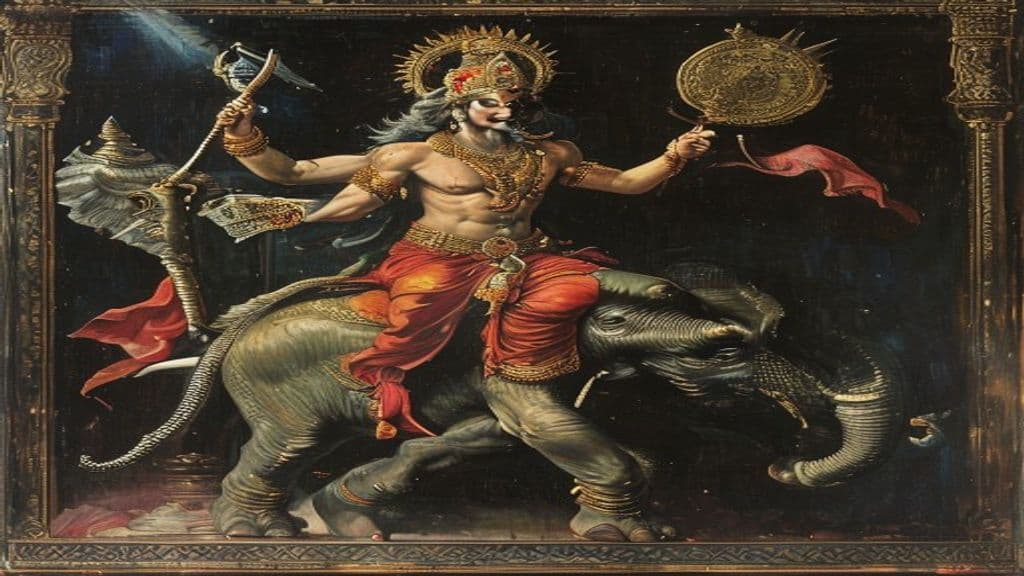
Indra
Indra is a major Vedic deity, king of the devas and lord of Svarga (heaven), associated primarily with the sky, storms, lightning, rain, rivers and martial heroism; he is central in the Rigveda and later appears across Hindu, Buddhist and Jain cosmologies with varying status.
*Perkʷūnos
*Perkʷūnos is the reconstructed Proto-Indo-European thunder‑god hypothesized by comparative linguistics and mythology. Scholarly reconstructions portray him as a storm or thunder figure associated with fructifying rain and as the combatant who fights a multi‑headed water‑serpent to release life‑giving waters; no direct attestations from the Proto‑Indo‑European period survive and the figure is inferred from later Indo‑European traditions.
*Péh₂usōn (reconstructed)
Péh₂usōn is a hypothetical Proto‑Indo‑European pastoral guardian reconstructed by comparative scholars from parallels in Greek and Vedic traditions. Proposed as a Graeco‑Aryan ancestor‑figure, the reconstruction describes a protector of flocks, roads, and travellers rather than an attested historical cultic personality.
57 Mnemosyne
57 Mnemosyne is a large main-belt asteroid (S-type) discovered in 1859 and named after the Greek Titaness Mnemosyne. It is a non-sentient astronomical body studied for its orbital and rotational properties and has been used in dynamical measurements related to Jupiter.
Abaddon
In Hebrew scripture Abaddon is primarily a noun meaning 'destruction' or a section/condition of the underworld paired with Sheol; in the New Testament Book of Revelation Abaddon is personified as an angelic figure (Greek Apollyon) described as the king of an army of locusts released from the abyss during the apocalypse.
Aban Yasht
The Aban Yasht is a hymn from the Persian tradition that praises Anahita, a goddess associated with water, fertility, and wisdom. It consists of 132 stanzas and is part of the 21 Yashts collection. (Note: - Power tier should be "Primordial" or possibly "Cosmic", given that it's a hymn of great spiritual significance and associated with a goddess. - The article incorrectly states that Anahita is associa)
Abath
No corroborated folkloric entity named "Abath" is documented in the provided sources. The string appears in the supplied material only as a surname/personal name in Aruban/Dutch-Caribbean archival records and as an unrelated taxonomic or encyclopedic hit; no mythic attributes, origin stories, rituals, or apotropaic practices for an entity called Abath are present in the documents reviewed.
Abatur
Abatur is an uthra (celestial emanation) in Mandaeism described as the 'father of the Uthras' and called the Ancient (ʿattīqā). He resides on the boundary between the World of Light and lower regions, functions as a judge who weighs souls (Abatur Muzania), and supplies instructions and materials to the demiurgic uthra Ptahil in accounts from the Diwan (Scroll) of Abatur.
Abatwa (Twa / Batwa)
Abatwa (also recorded as Twa, Batwa, Mutwa; singular forms Barhwa or Murhwa in some transcriptions) are indigenous hunter‑gatherer peoples of the Great Lakes region of Central Africa, historically identified as some of the earliest inhabitants of the area. The available sources treat them as human ethnic groups whose livelihoods, lands, and populations have been severely affected by conservation policies and modern violence.
Abellio
Abellio is a theonym attested in Roman‑period inscriptions from the Comminges area of the Pyrenees and reported as worshipped in the Garonne Valley of ancient Gallia Aquitania. Surviving evidence is limited to a small number of inscriptions; scholars have variously hypothesized solar or arboreal associations and compared the name to forms of Apollo or to Celtic Belenus, but the deity's precise role in local cosmology remains uncertain.
Abraham
Abraham (originally Abram) is the foundational patriarchal ancestor in the Hebrew Bible whose life establishes a covenantal relationship between his family/people and God. He functions as an exemplar of faith, the progenitor of promised descendants, and a narrative anchor for claims of land, blessing, and communal identity in later religious traditions.
Abraun
Abraun is an attested name in German-language plant-legend scholarship (Der abraun, ein beitrag zur pflanzensagenkunde, 1916) and a short database entry (Wikidata) labels it as a spirit from German mythology. Surviving accessible documentation is extremely limited: the principal academic treatment is a 1916 contribution to pflanzensagenkunde (plant-saga studies), but the excerpts available here contain only bibliographic metadata and do not record tales, descriptions, or rituals.
Abtin
Abtin (Persian: آبتین), attested also as Athwya, is a mythic ancestral figure in Iranian tradition described in Avestan and later epic literature as one of a small set of formative human-like figures involved in preparing the corporeal world and as the father of the epic hero-king Fereydun in the Shahnama.
Community Record
- [1]Great Gish — Wikipedia. Wikipedia article 'Great Gish' (accessed via supplied research notes)wiki
- [2]Wikidata: Great Gish. Wikidata entry Q1527568 (linked from supplied research notes)wiki
- [3]Archive: CIA reading-room document (reference list). Archive item included in supplied research notes (contextual reference)other
- [4]Secondary ethnographic citations summarized in the article (Robertson, Ibbetson, Strand, Čanlū). Ethnographic material and etymological notes (Robertson; Ibbetson; Richard Strand; Čanlū) as summarized in the Wikipedia entry provided in the research notesacademic