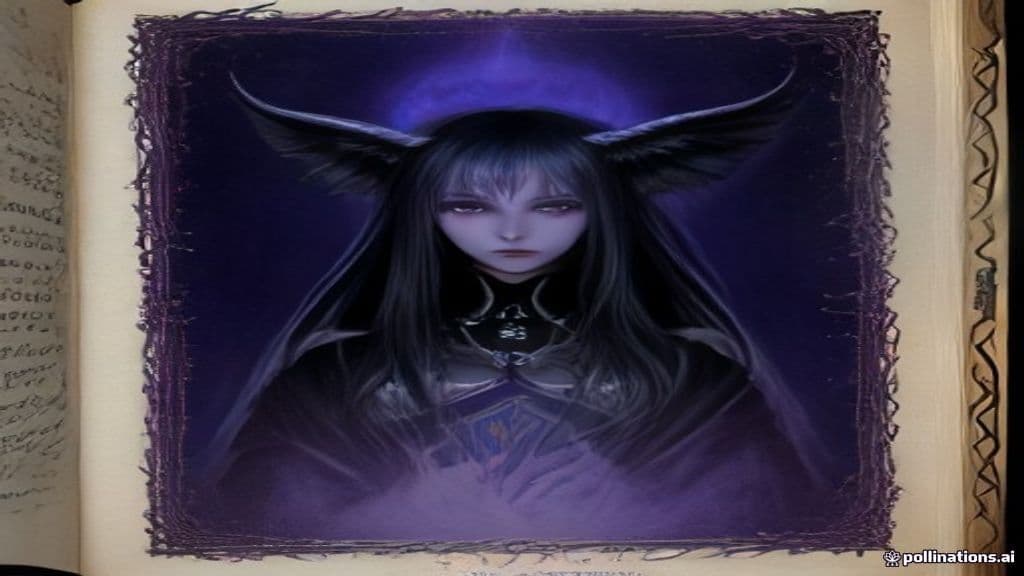
The supplied corpus does not include a narrative origin story for Gremory. What is documented in the provided material is only that the name appears as an entry in the corpus of demonological grimoires as recorded in a modern reference; fuller origin narratives, if they exist, would need to be sought in primary grimoire sources (for example, historical editions of the Goetia, the Lesser Key of Solomon, or related demonological manuscripts), which were not included among the supplied materials.
The provided sources do not supply a description of Gremory's form, visage, or iconography. No textual or visual appearance details are present in the materials given here; descriptions often associated with named grimoire spirits may appear in other primary texts, but such descriptions are outside the scope of the supplied corpus.
Beyond being listed as a demon in demonological grimoires, the supplied materials do not enumerate any specific powers, behaviors, hierarchies, or modes of interaction with humans for Gremory. The dossier contains only the categorical placement within grimoires and offers no attested lists of abilities; investigation of primary grimoire entries would be required to document any traditional attributions.
57 Mnemosyne
57 Mnemosyne is a large main-belt asteroid (S-type) discovered in 1859 and named after the Greek Titaness Mnemosyne. It is a non-sentient astronomical body studied for its orbital and rotational properties and has been used in dynamical measurements related to Jupiter.
Aamon
Aamon (also Amon) is a named spirit in early modern Western grimoire tradition (Pseudomonarchia Daemonum; the Ars Goetia / Lesser Key of Solomon). He is presented as a high-ranking infernal officer (Marquis/Prince) who governs forty legions and is credited with knowledge of past and future and with affecting human relationships (reconciling or procuring feuds and favor).
Abrahel
Abrahel is a demonological entity attested in early modern sources (notably Nicholas Rémy's Demonolatria as summarized in modern reference) portrayed as a female sexual spirit who seduced a man in 1581, induced him to kill his son, then restored the child to life in exchange for worship; the revival produced a diminished, foul-smelling corpse that later died again.
Abraxas
Abraxas (Abrasax) is a late‑antique Gnostic and magical name attested as a high-ranking cosmic power in heresiological summaries and as a potent name engraved on amulets (so-called Abraxas stones) in the Greco‑Roman magical milieu. Heresiologists associate Abraxas with rulership of 365 heavens and note the name's numerological value, while archaeological and papyrological contexts show its use as an amuletic formula.
Achamōth
Achamōth is a feminine emanational figure in certain Gnostic systems, attested as a daughter or subordinate aspect of the divine Wisdom, Sophia. She appears in ophitic/Naassene mythic genealogies where she is named as motherly/filial to lower, problematic figures such as Ilda‑Baoth; beyond this genealogical role the supplied sources record little concrete description or ritual material specific to her.
Adam Kadmon
Adam Kadmon (Hebrew: אָדָם קַדְמוֹן) is the Kabbalistic Primordial Man: a supra‑human, archetypal pattern or persona projected at the first stage of creation after God's contraction (tzimtzum). It is a metaphysical template corresponding to the highest aspect of divine intention and the sefirotic structure rather than a historical, corporeal individual.
Aedesia
Aedesia is a proper name attested in the supplied sources with three distinct referents: a fifth‑century Neoplatonic woman philosopher of Alexandria, a modern botanical genus (Aedesia O.Hoffm.) native to parts of West and Central Tropical Africa, and a reused toponym/moon name in a speculative fiction setting. None of the provided materials portray Aedesia as a supernatural being or attribute spiritlike powers to the name.
Aeon (Gnosticism)
In Gnostic religious systems an Aeon is a divine emanation or hypostasis that issues from the supreme divine source and together with other Aeons composes the Pleroma, the realm or fullness of divine reality. Aeons function as personified principles or powers (e.g., Nous, Sophia) that mediate between the ultimate One and lower levels of existence; their names, numbers, and relationships vary across Gnostic schools (Valentinian, Basilidian, Sethian, etc.).
Agaliarept
A named high-ranking spirit from post-medieval grimoire tradition, presented in the Grimoirium Verum and the Grand Grimoire as a commanding officer in a hierarchical host of spirits; credited with revealing secrets and commanding a legion, and cited in later printed occult imprints and modern fiction.
Agares
Agares is a named, ranked spirit in the European grimoire tradition. Frequently presented as an elderly man associated with the eastern quarter, he is credited in multiple grimoires with teaching languages, stopping or retrieving runaway persons, causing earthquakes, and granting noble titles, and is invoked in evocations and object-binding experiments.
Agathos Daimon (Agathodaemon)
A beneficent household and civic daemon attested in classical Greek and Graeco‑Egyptian religion. In domestic Greece it is a household spirit honored with post‑meal libations; in Ptolemaic Alexandria it appears prominently in serpentine civic and household forms and is syncretised with various Egyptian protective and fate deities in late antiquity.
Agrippa
Agrippa is a polyvalent Latin personal name attested across Roman myth (a legendary king of Alba Longa), multiple historical figures (e.g., Marcus Vipsanius Agrippa, Agrippa Postumus, Herod Agrippa I & II), and a Renaissance occult author (Heinrich/Heinrich Cornelius Agrippa). The supplied sources treat Agrippa primarily as an onomastic label rather than a single, consistent supernatural entity.
Community Record
- [1]Gemory. Wikipedia, entry 'Gemory' (as provided in the research notes).wiki
- [2]Gremory (Wikidata entry — modern name reuse). Wikidata entry noted in the research notes; identified as unrelated modern usage in the supplied materials.other
- [3]Rias Gremory Gaming Favorites (archive — modern/pop-cultural use). Internet Archive item listed in the research notes; used in the notes to illustrate modern/pop-cultural reuse of the name rather than as evidence for the demonological figure.other
- [4]Gremory, the storm returns (fanfiction — modern/pop-cultural use). Internet Archive fanfiction item cited in the research notes; represents fictional reuse of the name and is not documentary evidence about the traditional demonological entry.literary