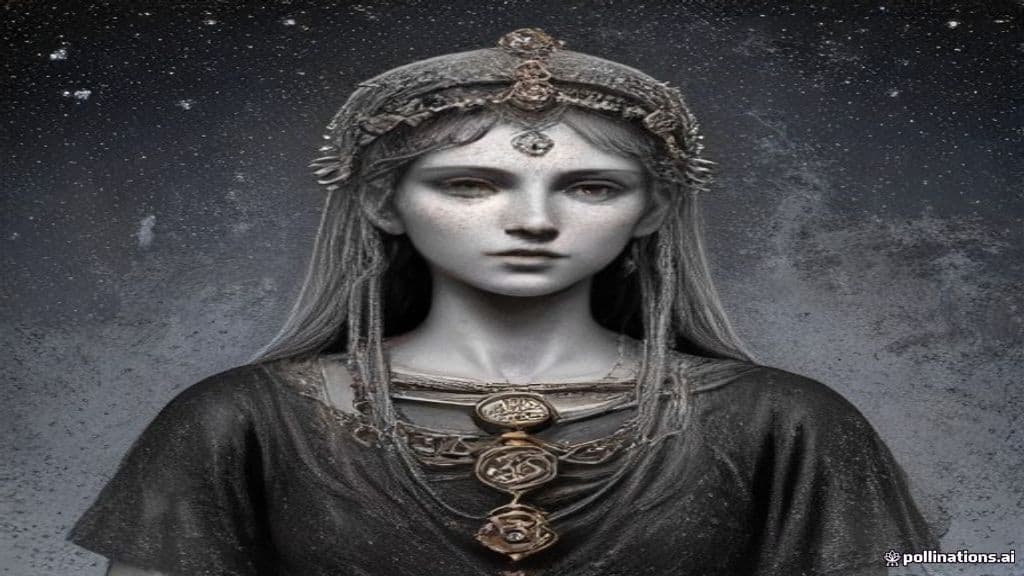
Aeternitas arises in Roman official religion as the personified abstract noun aeternitas, the quality or state of being eternal. Cultic evidence places her among the repertory of deified virtues promoted by the state and attached to the Imperial cult from the Julio-Claudian through Severan periods (1st–3rd centuries AD). Her role as Aeternitas Imperii — the eternity of Roman rule — and her inclusion among deities receiving sacrifices from collegia such as the Arval Brethren (e.g., thanksgiving when Nero survived conspiracy) demonstrate development as a civic-religious institution intended to sacralize imperial continuity. In late-antique literary reception (e.g., Martianus Capella) she is allegorically listed among Jupiter's daughters; in medieval scholastic writing the Latin term is continued as a technical term for divine duration rather than as an object of cult.
Iconography on Roman coinage and in late-antique description presents Aeternitas with cosmological and imperial symbols. Coins of Vespasian (c. 75–79 AD) depict her holding heads representing Sol and Luna; coins of Titus (80–81 AD) show her with a cornucopia, leaning on a scepter, and with one foot on a globe. From the 2nd to mid-3rd century, she is commonly shown with a globe, celestial bodies (stars or sun and moon), and the phoenix (sometimes perched on the globe); Martianus Capella describes her wearing a circular diadem symbolizing eternity.
As an abstract personification, Aeternitas does not act in narrative myth but functions symbolically and cultically. She embodies the enduring quality attributed to a deified emperor and to Roman rule (Aeternitas Imperii). In practice she was honored with sacrifices and temples — attested both in Rome and in the provinces (for example, the temple of Aeternitas Augusta at Tarraco) — and appears in state ritual contexts (e.g., offerings by the Arval Brethren during thanksgiving rites for imperial survival). Her associated imagery (cornucopia, scepter, globe, sun, moon, phoenix) links her symbolically to prosperity, authority, world dominion, and cyclical renewal rather than describing supernatural feats in narrative.
Weaknesses
- otherNo mythic vulnerabilities attested; as an abstract virtue her 'limits' are conceptual and depend on the political-religious standing of the emperor and the state
Wards
- otherNo wards attested; cultic practice consisted of sacrifices and temple maintenance to honor and sustain the virtue rather than magical warding
Abaddon
In Hebrew scripture Abaddon is primarily a noun meaning 'destruction' or a section/condition of the underworld paired with Sheol; in the New Testament Book of Revelation Abaddon is personified as an angelic figure (Greek Apollyon) described as the king of an army of locusts released from the abyss during the apocalypse.
Abadir
Abadir is a polysemous name attested in distinct cultural contexts: a legendary founding saint and clan ancestor in eastern Ethiopia (Sheikh Abadir Umar Al‑Rida / Aw Abadir), a term applied to cone‑shaped cult stones in Phoenician religious description, and a personal name of a martyr (Abadir/Apater) in the Coptic Synaxarium. The attestations are independent usages of the same name rather than a single supernatural being.
Abadiu of Antinoe
Abadiu of Antinoe was a fourth‑century bishop of Antinoe (Antinoopolis, in Roman Egypt) commemorated as a martyr and saint in the Coptic Orthodox Church, with a feast day on 26 December. Sources record that he was killed during a theological dispute with Arian opponents and reference him in collections of Egyptian martyrs.
Abagtha
Abagtha (Hebrew: אבגתא, ’Ǎḇaḡṯā) is a named human court official in the Hebrew Bible’s Book of Esther, listed among seven chamberlains who ministered before King Ahasuerus and were commanded to bring Queen Vashti before the king. He is attested only in Esther 1:10 and is presented as an institutional palace attendant rather than a supernatural being.
Abandinus
Abandinus is a locally attested Romano‑Celtic theonym known from a single inscribed bronze feather (votive object) dedicated at Godmanchester (the Roman fort Durovigutum) in Cambridgeshire. Scholars interpret him as a local god or male spirit tied to a specific place and possibly associated with a nearby spring or stream; this association is tentative and based on etymological readings of the name.
Abanoub
Abanoub is a 4th‑century Egyptian Christian child martyr venerated in the Coptic tradition. Remembered for his public confession of Christ, miraculous healings associated with his passion, and the translation and veneration of his relics, his feast is observed on July 31 (Epip 24) and his cult centers include Nehisa and Samanoud.
Abarbarea
Abarbarea is a name attested in classical Greek and Roman sources for freshwater nymphs (naiads). The name appears for at least two individual mythic figures — a naiad wife of Bucolion and a naiad counted among ancestors of the Tyrians — and Hesychius records plural forms that may indicate the name was also used as a class-name (Abarbareai / Abarbalaiai).
Abas
Abas (Ancient Greek: Ἄβας, gen.: Ἄβαντος) is not a single mythic being but a recurring personal name borne by multiple mortals and minor mythic figures in Greek epic and genealogical traditions — kings, founders, seers, warriors, attendants, a centaur, and a youth transformed by a goddess. The name is glossed in the sources as 'guileless' or 'good-hearted' and appears across Argive, Theban, Trojan, Euboean, and other local cycles.
Abaskhiron the Soldier
A Coptic Orthodox martyr venerated for refusing imperial idolatry during the Diocletian persecution; reputedly healed by the Archangel Michael, preserved in monastery relics, and commemorated on 14 June (7 Paoni).
Abdel Messih El-Makari
Abdel Messih El-Makari (1892–1963) was a Coptic Orthodox monk and priest venerated as a 20th‑century Coptic saint. Associated with the Monastery of Saint Samuel the Confessor and the Monastery of Saint Macarius (Scetes/Wadi El‑Natrun), he is remembered for humility, asceticism, charity, and reported spiritual gifts such as prescience, discerning of spirits, and healing.
Abel
Abel is the second son of Adam and Eve in the Genesis narrative, a shepherd whose accepted offering and subsequent murder by his brother Cain form the biblical account of the first death. Later interpretive traditions expand his role, treating him as an archetypal righteous victim, a postmortem avenging or adjudicating figure, and in some systems (notably Mandaean) identifying him with an angelic lightbeing.
Abellio
Abellio is a theonym attested in Roman‑period inscriptions from the Comminges area of the Pyrenees and reported as worshipped in the Garonne Valley of ancient Gallia Aquitania. Surviving evidence is limited to a small number of inscriptions; scholars have variously hypothesized solar or arboreal associations and compared the name to forms of Apollo or to Celtic Belenus, but the deity's precise role in local cosmology remains uncertain.
Community Record
- [1]Aeternitas (Wikipedia). Wikipedia, 'Aeternitas' article (summary of cult, iconography, coin evidence, Arval Brethren, Martianus Capella, and later reception).wiki
- [2]Albert the Great commemorative essays (summary source). Summary in the supplied material: Albert's taxonomy uses 'Aeternitas' to denote divine duration (late-medieval/scholastic conceptual reception).other
- [3]Wikidata entry: AETERNITAS. Wikidata entry referenced in research notes for modern cultural uses and identifiers.other
- [4]446 Aeternitas (asteroid — modern namesake). Modern astronomical naming showing persistence of the term 'Aeternitas' in later cultural contexts (provided in research notes).wiki