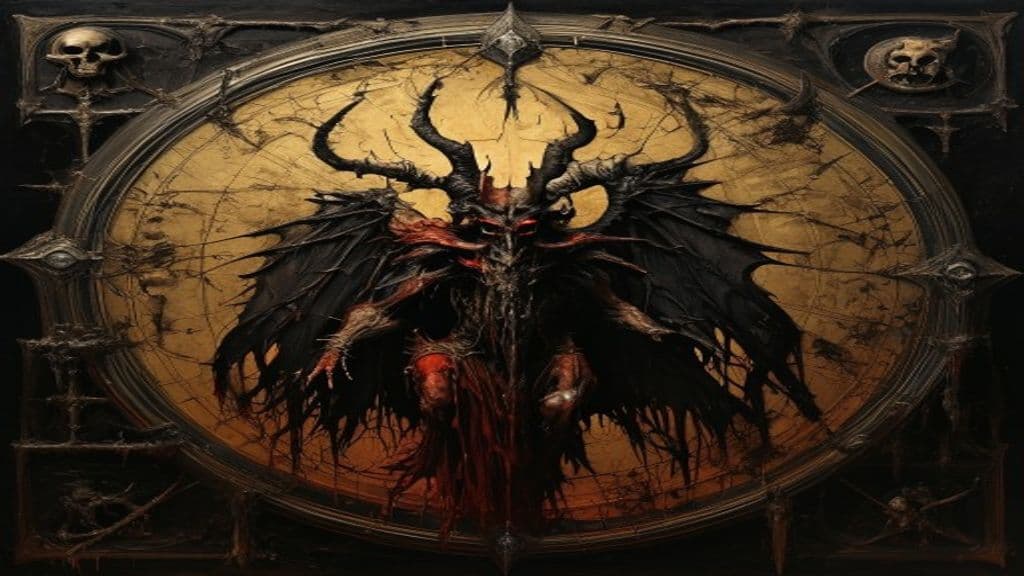
Satanachia appears in the corpus of named infernal beings preserved in Grimoires and later occult compendia. He is attested primarily in summaries and catalogs of the Grand Grimoire tradition and appears alongside other grimoire nobles in later listings and blogs. Different sources place him under higher infernal principals such as Lucifer, Mammon, or Lucifuge, and the Grimoirium Verum-style schemata pair him with entities like Agaliarept as part of a hierarchical infernal command structure. The sources do not provide a mythic birth or cosmogonic origin beyond his functional role inside those grimoire hierarchies.
The supplied sources do not give a consistent textual physical description. Modern derivative material and an occult blog reproduce a graphic 'Sigil of Satanachia,' suggesting a sigilic representation in contemporary occult practice, but no primary grimoire text among the provided materials supplies a detailed corporeal portrayal.
Grimoire‑style summaries describe Satanachia as a high military officer who 'controls either forty‑five or fifty‑four legions of demons' (sources differ on the exact number) and who holds named subordinate spirits such as Pruflas/Pruslas, Aamon/Amon, and Barbatos; Astaroth is also listed under him in at least one summary. The Grand Grimoire is cited in modern summaries ascribing to him the power to 'subjugate all women and girls, and to do with them whatever he wishes.' Secondary and derivative sources (e.g., a game wiki) add attributes such as 'profound knowledge of all the planets,' but those specific claims are not attested in the primary grimoire excerpts cited and should be regarded as later elaborations.

Barbatos
Barbatos is a named spirit in European grimoire tradition, listed among the Seventy-Two spirits of The Lesser Key of Solomon and also appearing in the Grand Grimoire. He is given a ducal rank, commands legions of spirits, and is invoked in ceremonial contexts for knowledge, revelation of hidden things, and reconciliation.
Astaroth
Astaroth is a named adversarial spirit in Christian demonological literature, commonly catalogued as a high-ranking infernal officer (described in sources as a 'Great Duke' or 'Grand Duke' of Hell). The figure represents the Christian polemical reception of ancient Near Eastern goddess-names (Astarte/Ashtoreth) recast within narratives and demonological lists and appears in medieval legendary episodes as well as later occult imagery and modern popular culture.

Lucifer
A multilayered figure whose core identity in the cited sources is the planet Venus as the brilliant morning star (Latin lucifer, 'light-bringer' / Hebrew hêlêl, 'shining one'). In later Jewish and especially Christian exegesis the Isaiah image Helel ben Shachar is reinterpreted as a mythic fall motif and becomes associated with a rebellious heavenly being identified with the adversary; this development overlays the earlier astronomical and poetic personification.
Agaliarept
A named high-ranking spirit from post-medieval grimoire tradition, presented in the Grimoirium Verum and the Grand Grimoire as a commanding officer in a hierarchical host of spirits; credited with revealing secrets and commanding a legion, and cited in later printed occult imprints and modern fiction.
57 Mnemosyne
57 Mnemosyne is a large main-belt asteroid (S-type) discovered in 1859 and named after the Greek Titaness Mnemosyne. It is a non-sentient astronomical body studied for its orbital and rotational properties and has been used in dynamical measurements related to Jupiter.
Aamon
Aamon (also Amon) is a named spirit in early modern Western grimoire tradition (Pseudomonarchia Daemonum; the Ars Goetia / Lesser Key of Solomon). He is presented as a high-ranking infernal officer (Marquis/Prince) who governs forty legions and is credited with knowledge of past and future and with affecting human relationships (reconciling or procuring feuds and favor).
Abrahel
Abrahel is a demonological entity attested in early modern sources (notably Nicholas Rémy's Demonolatria as summarized in modern reference) portrayed as a female sexual spirit who seduced a man in 1581, induced him to kill his son, then restored the child to life in exchange for worship; the revival produced a diminished, foul-smelling corpse that later died again.
Abraxas
Abraxas (Abrasax) is a late‑antique Gnostic and magical name attested as a high-ranking cosmic power in heresiological summaries and as a potent name engraved on amulets (so-called Abraxas stones) in the Greco‑Roman magical milieu. Heresiologists associate Abraxas with rulership of 365 heavens and note the name's numerological value, while archaeological and papyrological contexts show its use as an amuletic formula.
Achamōth
Achamōth is a feminine emanational figure in certain Gnostic systems, attested as a daughter or subordinate aspect of the divine Wisdom, Sophia. She appears in ophitic/Naassene mythic genealogies where she is named as motherly/filial to lower, problematic figures such as Ilda‑Baoth; beyond this genealogical role the supplied sources record little concrete description or ritual material specific to her.
Adam Kadmon
Adam Kadmon (Hebrew: אָדָם קַדְמוֹן) is the Kabbalistic Primordial Man: a supra‑human, archetypal pattern or persona projected at the first stage of creation after God's contraction (tzimtzum). It is a metaphysical template corresponding to the highest aspect of divine intention and the sefirotic structure rather than a historical, corporeal individual.
Aedesia
Aedesia is a proper name attested in the supplied sources with three distinct referents: a fifth‑century Neoplatonic woman philosopher of Alexandria, a modern botanical genus (Aedesia O.Hoffm.) native to parts of West and Central Tropical Africa, and a reused toponym/moon name in a speculative fiction setting. None of the provided materials portray Aedesia as a supernatural being or attribute spiritlike powers to the name.
Aeon (Gnosticism)
In Gnostic religious systems an Aeon is a divine emanation or hypostasis that issues from the supreme divine source and together with other Aeons composes the Pleroma, the realm or fullness of divine reality. Aeons function as personified principles or powers (e.g., Nous, Sophia) that mediate between the ultimate One and lower levels of existence; their names, numbers, and relationships vary across Gnostic schools (Valentinian, Basilidian, Sethian, etc.).
Agaliarept
A named high-ranking spirit from post-medieval grimoire tradition, presented in the Grimoirium Verum and the Grand Grimoire as a commanding officer in a hierarchical host of spirits; credited with revealing secrets and commanding a legion, and cited in later printed occult imprints and modern fiction.
Agares
Agares is a named, ranked spirit in the European grimoire tradition. Frequently presented as an elderly man associated with the eastern quarter, he is credited in multiple grimoires with teaching languages, stopping or retrieving runaway persons, causing earthquakes, and granting noble titles, and is invoked in evocations and object-binding experiments.
Agathos Daimon (Agathodaemon)
A beneficent household and civic daemon attested in classical Greek and Graeco‑Egyptian religion. In domestic Greece it is a household spirit honored with post‑meal libations; in Ptolemaic Alexandria it appears prominently in serpentine civic and household forms and is syncretised with various Egyptian protective and fate deities in late antiquity.
Agrippa
Agrippa is a polyvalent Latin personal name attested across Roman myth (a legendary king of Alba Longa), multiple historical figures (e.g., Marcus Vipsanius Agrippa, Agrippa Postumus, Herod Agrippa I & II), and a Renaissance occult author (Heinrich/Heinrich Cornelius Agrippa). The supplied sources treat Agrippa primarily as an onomastic label rather than a single, consistent supernatural entity.
Community Record
- [1]Satanachia — Wikipedia. Wikipedia, 'Satanachia' article — summary of Grand Grimoire attributions and legion counts.wiki
- [2]Satanachia | Megami Tensei Wiki. Megami Tensei Wiki entry — derivative summary attributing 54 legions and planetary knowledge in later media context.wiki
- [3]Satanachia – V.K. Jehannum (Blog). V.K. Jehannum blog post reproducing a sigil image and listing variant names, subordinates, and superiors.other
- [4]Book of Ceremonial Magic: Chapter III. Internet Sacred Text Archive, 'Book of Ceremonial Magic' — representative grimoire material and related demonological schemata referenced in secondary discussions.literary
- [5]Dukes of Hell: Naming Lusties | Book of the Neglected (blog). Modern occult compilation discussing ranks and attributions in grimoire lists; used as a contextual secondary source for variations.other