Zawba'ah is a spirit (jinn-king) in Islamic folklore, from Medieval Islamic world. Zawba'ah is a senior jinn-king in medieval Islamic talismanic lore, described as one of the oldest of the jinn kings and second in seniority only to Shamharush. He is associated with Friday, the planet Venus, the color green, the metal iron, and is depicted in the Kitab al-Bulhan with distinct four-headed iconography used in talismanic invocation.
Sources present Zawba'ah as a sovereign figure within a corpus of medieval Islamic esoteric and talismanic literature, notably appearing in the Kitab al-Bulhan. He is described as one of the oldest jinn kings and second in seniority only to Shamharush, a status that frames him as an elder ruler who now rarely wages war. He is also recorded among nine jinn who listened to the Prophet Muhammad recite the Quran, integrating him into Islamic narrative frames.
In the Kitab al-Bulhan illustration he appears as a four headed demon named Mazer, Tikal, Kummum and Qaswara; the heads combine hideous horned forms (the upper one with two inward-curving bovine horns) and more docile equine heads, with two heads turned in profile and two facing forward. He wears brilliant white robes and a crown topped by a large circle, sits cross-legged in a regal pose supported by ministers and broad armbands, and the image is surmounted by two talismans used for his ritual invocation. An epithet in the sources styles him 'Zawba‘ah the White,' placing him among a lineage termed the white jinn. A textual detail notes that when he smiles his face lights up, emitting an intense light between his teeth. The general anatomy is compared to the Div (monstrous human-bodied, animal-headed figures).
Zawba'ah is portrayed as deeply devout in some sources—specifically he 'was one of the nine jinn who listened to the Prophet Muhammad recite the Quran'—and is reported to habitually eavesdrop on angels' conversations regarding fate. Cosmologically he is mapped to Friday and the planet Venus and is associated with the color green and the metal iron; he is also said to be under the supervision of the angel Anya'il (Haniel) and to share a wind-related connection with ancient Mesopotamian demons. In esoteric and talismanic practice he 'is often invoked to send lesser spirits capable of arousing feelings of love or lust.' The tradition describes him as an elder king who now rarely wages war.

Shamharush
Shamharush (also Shamhurish, Shamhurash, Sidi Chamharouch) is a longstanding jinn sovereign figure in Moroccan folk belief, described as one of the seven jinn kings and a supreme judicial ruler of the jinn. Associated with Thursday and Jupiter, he was historically venerated at a shrine near Aroumd in the High Atlas but his cult was later contested by Islamic scholars.
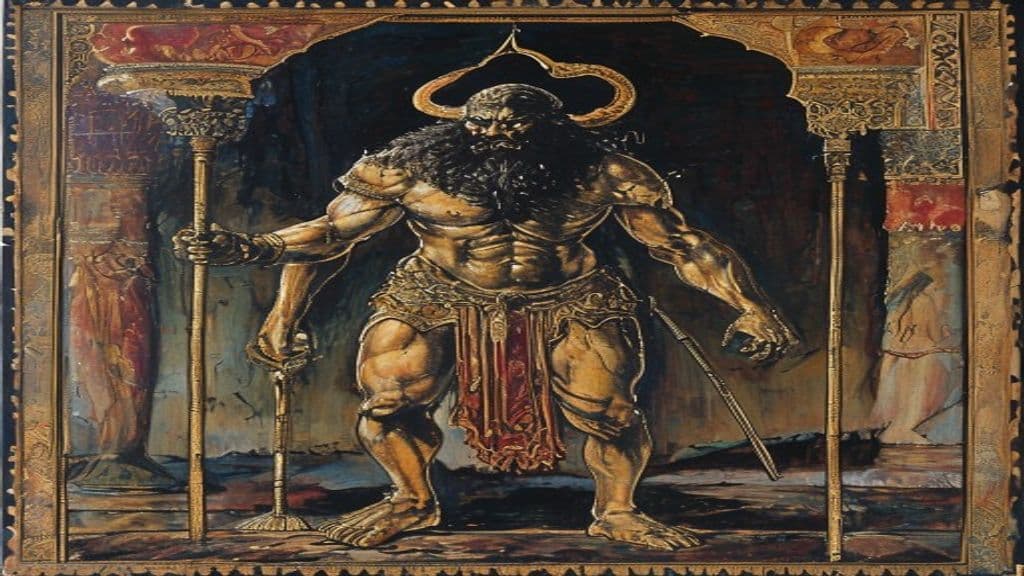
Div (Dīv)
Div (Persian: دیو dēw / dīv) are monstrous, often sorcerous antagonists in Persian epic and folkloric tradition, best known from the Shahnameh where they oppose heroes such as Rustam. Scholarly sources trace their cultural history to a re‑interpretation and demonization of older Indo‑Iranian divine figures (devas).
'Ain Samiya Goblet
Silver cup from the Middle Bronze Age I, discovered in a tomb at Ain Samiya. (Note: 1. Power tier should be "None", but add a note explaining that historical artifacts don't fit into the typical power tier classification. 2. Add a description of its appearance based on it being a sil)
57 Mnemosyne
57 Mnemosyne is a large main-belt asteroid (S-type) discovered in 1859 and named after the Greek Titaness Mnemosyne. It is a non-sentient astronomical body studied for its orbital and rotational properties and has been used in dynamical measurements related to Jupiter.
A'annepada
A'annepada (Sumerian cuneiform 𒀀𒀭𒉌𒅆𒊒𒁕; also romanized Aanépàdda) is attested as a historical ruler of the First Dynasty of Ur, flourishing c. 2350 BC. He is recorded in dedicatory and foundation inscriptions as king of Ur and as son of Mesannepada, credited with temple-building and dedication to deities such as Ninhursag and Inanna.
Aamon
Aamon (also Amon) is a named spirit in early modern Western grimoire tradition (Pseudomonarchia Daemonum; the Ars Goetia / Lesser Key of Solomon). He is presented as a high-ranking infernal officer (Marquis/Prince) who governs forty legions and is credited with knowledge of past and future and with affecting human relationships (reconciling or procuring feuds and favor).
Ababil
Ababil (Arabic: أبابيل, romanized abābīl) are miraculous birds mentioned in the Qur'anic account of Surah Al‑Fil. In Islamic tradition they appear as a divinely sent avian host that defended the Kaaba by pelting an invading army with small clay stones; tradition places the event in the year traditionally given as 570 CE.
Abadir
Abadir is a polysemous name attested in distinct cultural contexts: a legendary founding saint and clan ancestor in eastern Ethiopia (Sheikh Abadir Umar Al‑Rida / Aw Abadir), a term applied to cone‑shaped cult stones in Phoenician religious description, and a personal name of a martyr (Abadir/Apater) in the Coptic Synaxarium. The attestations are independent usages of the same name rather than a single supernatural being.
Abdul Qadir Gilani
A historical 11th–12th century Hanbali jurist, preacher, and Sufi shaykh who became the eponym and principal early figure of the Qadiriyya tariqa; venerated in Sunni Sufi traditions as an Awliya (saint) and often given exalted hagiographical ranks such as Muḥi al‑Dīn and Ghawth.
Abel
Abel is the second son of Adam and Eve in the Genesis narrative, a shepherd whose accepted offering and subsequent murder by his brother Cain form the biblical account of the first death. Later interpretive traditions expand his role, treating him as an archetypal righteous victim, a postmortem avenging or adjudicating figure, and in some systems (notably Mandaean) identifying him with an angelic lightbeing.
Abraham (Ibrāhīm) in Islam
Ibrāhīm (Abraham) in Islam is a human prophet and messenger chosen by God, a paradigm of pure monotheism (hanīf), patriarchal ancestor to later peoples and prophets, and traditionally regarded as having helped establish the Kaʿbah with his son Ismāʿīl. He is called Khalīl Allāh ('Friend of God') and is central to rites commemorated in Hajj and Eid al‑Adha.
Abrahel
Abrahel is a demonological entity attested in early modern sources (notably Nicholas Rémy's Demonolatria as summarized in modern reference) portrayed as a female sexual spirit who seduced a man in 1581, induced him to kill his son, then restored the child to life in exchange for worship; the revival produced a diminished, foul-smelling corpse that later died again.
Abraxas
Abraxas (Abrasax) is a late‑antique Gnostic and magical name attested as a high-ranking cosmic power in heresiological summaries and as a potent name engraved on amulets (so-called Abraxas stones) in the Greco‑Roman magical milieu. Heresiologists associate Abraxas with rulership of 365 heavens and note the name's numerological value, while archaeological and papyrological contexts show its use as an amuletic formula.
Abu
Abu is a poorly understood Mesopotamian god attested in modern reference summaries. Secondary literature tentatively links him with vegetation and snakes and records that he was often paired with a deity written gu2-la2, but primary details about his cult, iconography, and myths are lacking in the cited sources.
Community Record
- [1]Zawba'ah — Wikipedia (summary of medieval talismanic materials, including Kitab al-Bulhan). Wikipedia, 'Zawba'ah' (article summarizes medieval talismanic sources and Kitab al-Bulhan iconography)wiki
- [2]Wikidata entry for Zawba'ah. Wikidata Q141502630 (modern classificatory summary: 'Green Devil in Medieval Islam')other
- [3]Kitab al-Bulhan (as cited in secondary descriptions). Kitab al-Bulhan illustration and description as summarized in secondary sources cited on the Wikipedia page (four headed demon named Mazer, Tikal, Kummum and Qaswara; talismans for invocation).literary