Entity Index

A record of the unseen, drawn from world folklore.

7631 entities · page 24 of 128

Aureily
Lesser

Aureily

No evidence in the provided sources supports treating 'Aureily' as a folkloric or supernatural entity. The string appears in the sources either as part of Latin-derived numismatic terminology ('aureus' / 'aurei' — a Roman gold coin) or as a contemporary image-credit/creator name in commercial media; neither source presents origin, appearance, powers, or ritual material for an entity called 'Aureily'.

Aurnavabha
Lesser

Aurnavabha

Aurnavabha (also attested as Aurṇavābha) is a name occurring in Vedic hymnic material (Rigveda) and later cited in bibliographic/theosophical indexes as a Vedic commentator. The sources present the name as textual/authorial rather than as an independently attested supernatural being.

Aurora (Sleeping Beauty)
Lesser

Aurora (Sleeping Beauty)

Aurora is the princess protagonist of the Sleeping Beauty tale as popularized in Charles Perrault's literary tradition and later by the 1959 Disney film and stage/ballet adaptations. She is a mortal royal whose fate is determined by the interventions of beneficent and maleficent fairies, most notably being placed under a death-sleep curse that is altered to a prolonged enchanted sleep.

Aurva
Greater

Aurva

Aurva (Sanskrit: और्व) is a Vedic/Purāṇic rishi of the Bhargava (Bhrigu) line remembered for a miraculous birth from his mother's thigh, a birth-radiance that blinded attackers, and for austere tapas that produced the submarine fire Vadavagni. He functions as a canonical sage, ancestor (father of Richika and grandfather of Vatsa), and a figure whose ascetic power threatened cosmic destruction until persuaded otherwise by the Pitrs.

Aurvandill
Lesser

Aurvandill

Aurvandill is a figure attested in medieval Germanic onomastics and Norse narrative, most famously remembered in an Old Norse tale where Thor carries him across icy rivers and his frozen toe is cast into the sky as the star called Aurvandils-tá. Comparative linguistic study reconstructs a Common Germanic name associated with dawn or the morning star.

Auseklis
Lesser

Auseklis

Auseklis is a named youthful celestial being in Latvian folk-song tradition (dainas), associated with the dawn and a particular eight-pointed star emblem. He appears among the Dieva dēli (sons of Dievs) as an attendant of the Sun (Saule), a suitor in the mythic 'celestial wedding', and a participant in household-like sky rituals.

Austri, Vestri, Norðri and Suðri
Ancient

Austri, Vestri, Norðri and Suðri

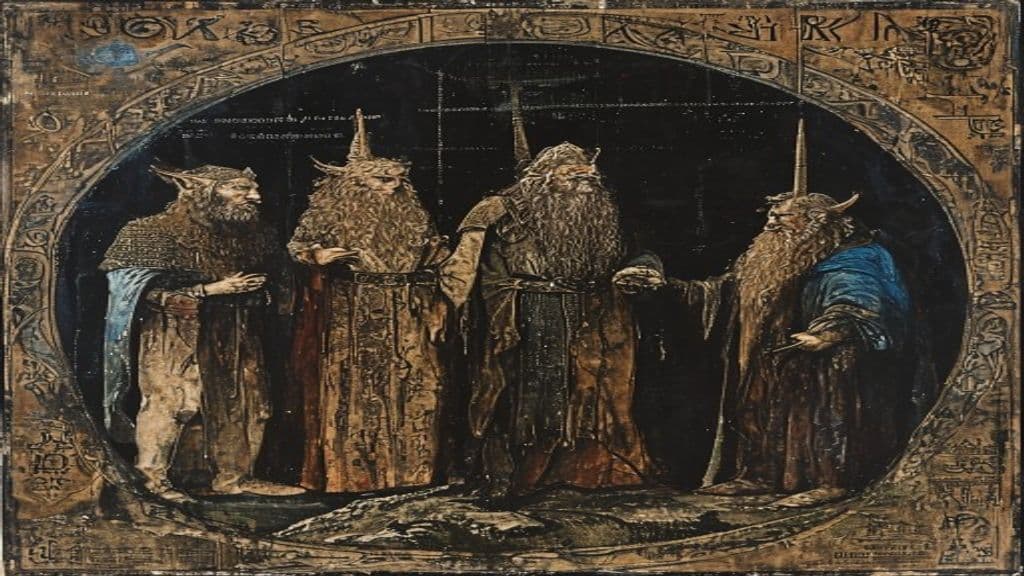
A quartet of named dwarfs in Old Norse cosmology positioned at the four cardinal points who are described in medieval sources as holding up the sky after the gods made heaven from Ymir’s skull. They function as structural/cosmogonic supports and are attested in the Prose Edda and the Dvergatal of Völuspá, with echoes in skaldic kennings and in later scholarly interpretation linking their role to roof-beam terminology.

Autochthe
Lesser

Autochthe

Autochthe (Ancient Greek: Αὐτόχθη) is a minor mythological princess of the Perseid line, named in classical genealogies as a daughter of Perseus and Andromeda. In some traditions she is said to have married Aegeus of Athens and borne daughters but no sons, and her chief narrative role is as a dynastic connector between ruling houses (Argos/Mycenae and Athens).

Autochthon (ancient Greece)
Ancient

Autochthon (ancient Greece)

In ancient Greek myth and civic ideology, an autochthon is an 'earth-born' person or people—literally generated by the soil of a place—to claim the deepest form of indigenous origin and thereby political legitimacy. The term functions as a social-mythic category grounding territorial belonging and priority rather than as an independently acting supernatural creature.

Autolycus
Lesser

Autolycus

Autolycus is a mythic Greek trickster-thief, son most commonly of Hermes, famed for cunning, theft, and the ability to alter the appearance of stolen goods; he is a legendary ancestor and occasional tutor within the heroic age rather than an impersonal spirit or cult deity.

Automate
Lesser

Automate

Automate is a named figure in Ancient Greek mythic genealogy, one of the Danaids (daughters of Danaus). In mythographic summaries (following Apollodorus and later compilations) she is said to have killed the mythical Egyptian king Busiris, who had been betrothed to her. Her name in Ancient Greek is glossed as 'acting of one's own will, of oneself.'

Automaton (tradition)
Lesser

Automaton (tradition)

An automaton is a crafted, self‑operating mechanical device or engineered construct described in ancient myth, technical history, and modern usage; in traditional accounts it is a human‑made figure or mechanism that imitates living actions through concealed mechanisms rather than by an animating spirit.

Automedon
Minor Spirit

Automedon

Automedon (Ancient Greek Αὐτομέδων) is a named mortal charioteer in the Homeric epic tradition, best known as the trusted driver of Achilles who manages the immortal horses Balius and Xanthos and acts as a combatant in episodes of the Iliad. He appears in scenes surrounding Patroclus' death and in later Roman reference (Virgil's Aeneid).

Automedusa
Minor Spirit

Automedusa

Automedusa is a mortal figure in Greek mythic genealogies, a Megarian princess, daughter of King Alcathous, wife of Iphicles, and mother of Iolaus. She functions chiefly as a genealogical link within networks connecting the houses of Pelops, Perseus, and the Theban/Heraclean circles.

Automeris io (Io moth)
Lesser

Automeris io (Io moth)

Automeris io is a North American saturniid moth (Io moth) notable for its prominent hindwing eyespots and urticating caterpillars. It has a multi-stage lifecycle (egg → larva → pupa → adult), distinct sexual dimorphism in adults, and a geographic range across much of eastern and central North America.

Autonoe
Minor Spirit

Autonoe

Autonoe is a name attested in ancient Greek mythic traditions as (a) a Theban princess, one of the daughters of Cadmus and Harmonia, wife of Aristaeus and mother of Actaeon (and possibly Macris); and (b) separately, as one of the list-figures among the fifty Nereids (sea-nymph daughters of Nereus and Doris). Sources do not reconcile these attestations into a single, unified identity.

Autonous
Lesser

Autonous

Autonous is a named mortal from a single surviving Greek metamorphosis narrative (recorded in Antoninus Liberalis' Metamorphoses as preserved in modern summaries). A pastoral household head whose neglect of husbandry leads to a tragedy in which his son Anthus is killed by the family's horses; the gods Zeus and Apollo pity the grieving family and transform Autonous into a bird identified as the stone‑curlew (Greek ὄκνος).

Auxesia
Minor Spirit

Auxesia

Auxesia (Αυξησία) is a figure in ancient Greek religious tradition associated with growth and increase of fields. She appears in local cults around the Saronic Gulf (Epidaurus, Aegina, Troezen) as an independent local goddess or as an epithet/aspect of better-known deities (notably Persephone), often paired with Damia.

Auxo
Minor Spirit

Auxo

Auxo is a name attested across modern commercial, taxonomic, and fictional contexts and, in classical reference frameworks, is historically associated with the Horae — the Greek goddesses of the seasons and natural portions of time. The provided sources do not supply a consistent folkloric persona, mythology, or rites tied to a supernatural being named Auxo.

Auðr
Lesser

Auðr

Auðr (Old Norse 'prosperity') is a personified figure attested in Snorri Sturluson's Prose Edda as a child of the personified Night (Nótt) by Naglfari, and thus made an uncle of Thor within Snorri's genealogical schema. The figure otherwise appears only as a referent in skaldic diction and is sparsely attested, leading some scholars to regard the attestation as possibly a Snorrian creation.

Auðumbla
Primordial

Auðumbla

Auðumbla is the primeval cow of Old Norse cosmogony attested in the Prose Edda: she nourishes the primordial jötunn Ymir with rivers of milk and by licking salty rime-stones reveals Búri, an ancestor of the gods. Her name and role link fertility, nourishment, and the emergence of key lineages in the Norse origin narrative.

Aušrinė
Greater

Aušrinė

Aušrinė is the Lithuanian personification and deity of the morning star (planet Venus) in traditional Baltic cosmology. She is a feminine liminal figure associated with dawn, beauty, youth, love, health and renewal who appears each morning to prepare the way for Saulė (the Sun).

Avalokiteshvara of Chaiya (Padmapānī torso)
Lesser

Avalokiteshvara of Chaiya (Padmapānī torso)

A Srivijaya-era bronze torso identified as a pratimā of Avalokiteshvara (Padmapānī), discovered at Chaiya in southern Thailand and now in the Bangkok National Museum. It functions in its sources as a consecrated devotional image whose visage has been used in modern practice to calm and inspire compassion in viewers.

Avalokiteśvara
Ancient

Avalokiteśvara

A central Mahāyāna and Vajrayāna bodhisattva who embodies great compassion (mahākaruṇā), Avalokiteśvara hears the cries of sentient beings and manifests in many forms to relieve suffering. Venerated across South, Central, and East Asia, the figure functions devotionally (mantra and sutra recitation) and iconographically in multiple gendered and regional guises.

Avandra
Lesser

Avandra

Avandra is a deity-name employed within modern Dungeons & Dragons tabletop gaming and related media. In the supplied sources Avandra appears in player and podcast discourse as a referent for randomness or luck and as a fictional proper name used in campaign material.

Avari (Middle-earth)
Lesser

Avari (Middle-earth)

The Avari are identified in the provided sources as a subgroup of Elves in J. R. R. Tolkien's fictional legendarium. The supplied materials (Wikipedia and Wikidata entries) classify them as fictional Elven people but contain no extended narrative, descriptive, or ritual detail about them.

Avatar (avatāra)
Ancient

Avatar (avatāra)

In classical Hindu theology, an avatāra is a divine 'descent' — the event or fact of a superhuman being or deity making a material appearance in the temporal world to accomplish a purpose (commonly to restore dharma). The term (Sanskrit अवतार, avatāra) emphasizes crossing down from the unconditioned into conditioned existence and is central to Vaishnava theology of Vishnu's incarnations while also appearing in other Indian religious contexts.

Avatea
Ancient

Avatea

Avatea (also spelled Vatea in some sources) is a primordial parent figure in Mangaian (Cook Islands) mythology, described as a lunar deity and god of light whose eyes were thought to be the Sun and the Moon, and who is called the father of gods and men in the island's origin narrative.

Avatsara
Greater

Avatsara

Avatsara (Sanskrit: अवत्सार, Avatsāra) is a Vedic rṣi (seer) attested as the author of multiple hymns of the Rigveda and as a priestly figure in Brāhmaṇa passages. He is placed in Kashyapa sage lineages and is cited in Rigvedic, Sāmavedic, Yajurvedic, and Brāhmaṇa texts where his hymns and ritual actions are invoked.

Avengelyne
Greater

Avengelyne

Avengelyne is a comic-book character depicted as an angelic warrior who fights demons and monsters on Earth. In the character biography she is described as formerly the most feared warrior in Heaven's Warhost who broke into Pandemonium to confront the Devil and was later banished from Heaven.

Avengers A.I.
Greater

Avengers A.I.

A Marvel Comics series and in-universe Avengers team (July 2013–April 2014) centering on artificial intelligences — synthezoids, life-model decoys, Doombots, evolved viruses and cyborgs — and their political and ethical place after the Age of Ultron event.

Aventine Triad
Ancient

Aventine Triad

A collective cultic grouping of three Roman deities—Ceres, Liber (Liber Pater) and Libera—venerated from the early Republic in a temple-temenos on or near the Aventine Hill. The label 'Aventine Triad' is modern scholarly shorthand for a plebeian, agricultural and fertility-focused set of cults that functioned as a communal religious and political focus for Rome's plebs.

Aventinus
Lesser

Aventinus

Aventinus is a mytho-historical Roman figure presented in sources as a minor heroic/eponymous personage associated with the Aventine Hill and appearing in traditions surrounding Aeneas' Italian wars. He is variously described in brief accounts as a son of Hercules and the priestess Rhea (in Virgilian citation) and in alternate traditions as an early Latin/Alban king whose name explains the toponym Aventine.

Aventinus of Alba Longa
Ancient

Aventinus of Alba Longa

Aventinus of Alba Longa is a legendary king in the Alban/Latial regnal tradition, presented in ancient commentators and later summaries as an eponymous figure whose burial or shrine on the Aventine Hill provided an etiological explanation for that place-name. He appears in king-lists as a successor in the line purportedly descending from Aeneas and is variously dated in later regnal chronologies to the 9th–8th centuries BC.

Averis
Minor Spirit

Averis

Averis is documented in the provided sources as an English-language surname and proper name used by real people and organizations; there is no evidence in these materials that Averis refers to a supernatural or folkloric being.

Avernus
Lesser Spirit

Avernus

In Roman tradition, Avernus is a volcanic crater near Cumae (Cuma) in Italy associated with the underworld. (Note: 1. Power tier: Given that there are no reported interactions or abilities associated with Avernus as an entity, it should be classified as a Minor Spirit. 2. Appearance: There is no distinct physical )

Averruncus
Lesser

Averruncus

Averruncus (also Auruncus) is an ancient Roman divine name/agent associated with averting harm. Attested in Roman antiquarian discussion as a power invoked to ward off disaster to people and harvests, Averruncus appears both as a specialized protective function and as an indigitamentum (a ritual name or aspect) applied to greater gods to secure their local, protective action.

Aveta
Lesser

Aveta

Aveta is a local maternal deity attested in Roman-period Gaul, chiefly among the Treveri around Augusta Treverorum (Trier). She is represented in altars and terracotta votive figurines emphasizing motherhood and fertility; some scholars interpret associated evidence as indicating links with springs and healing.

Awarikus (Warikas)
Greater

Awarikus (Warikas)

Awarikus (also rendered Warikas) was a historical king of the Neo‑Hittite/Luwian polity Ḫiyawa (Adanawa/ancient Adana in Cilicia) who reigned in the mid–late 8th century BCE (c. 738–709 BCE). He is attested in Hieroglyphic Luwian, Phoenician, and Neo‑Assyrian (Akkadian) sources as a local ruler who entered vassalage and treaty relations with the Neo‑Assyrian Empire and undertook fortification and administrative projects within his realm.

Awesome Android
Greater

Awesome Android

A large artificial lifeform from Marvel Comics, created by the Mad Thinker from ape DNA and unstable molecules and animated by a microcomputer and solar power. Initially an obedient, limited‑intelligence instrument, the being later attains sentience in stories and pursues legal recognition as 'Awesome Andy.'

Awilix
Ancient

Awilix

Awilix is a principal deity of the Postclassic Kʼicheʼ Maya centered at Qʼumarkaj, serving as a lunar and night-associated patron of the Nijaʼibʼ lineage. The deity is linked with the moon, night, the Underworld, sickness and death, and is a patron of the Mesoamerican ballgame; sources record both feminine and possibly masculine identifications.

Axehandle Hound
Minor Spirit

Axehandle Hound

Axehandle Hound is a North American 'fearsome critter' from Upper Midwest lumberjack folklore: a small, nocturnal, dog-like trickster whose handle-shaped body and axe-blade head are said to steal or consume unattended axe handles in lumbercamps.

Axia
Lesser

Axia

Axia (Ancient Greek: Αξία) is a minor figure in Greek mythography, attested as a Minyan princess of Orchomenus whose primary role in the surviving record is genealogical and toponymic. She is cited as a daughter of King Clymenus and Budeia and sister to several named siblings; one source records that a town in Ozolian Locris was named for her.

Axioche
Lesser

Axioche

Axioche (Ancient Greek: Άξιόχη, romanized Axiókhē), also called Danais in some accounts, is a named woman or nymph in Greek mythic genealogies. She is principally attested as the mother of Chrysippus by King Pelops and otherwise appears only as a genealogical figure in the Peloponnesian heroic cycle.

Axius
Lesser

Axius

Axius (Ancient Greek: Άξιος, Axios) is the personified river-god of the Axius (modern Vardar) in the regions variously called Macedonia / Paeonia in northern Greece. In classical genealogies he is listed among the Potamoi as a son of Oceanus and Tethys and is cited as the father of Pelagon by Periboea.

Axtya
Primordial

Axtya

Evil sorcerer in Zoroastrian mythology, posing intellectual challenges to humans with his riddle-crafting and solving abilities, rivaling or surpassing deities. (Note: - Power tier: Axtya should be classified as Greater (powerful regional), not Primordial (cosmic). - Abilities: Axtya poses intellectual challenges, but his ability is specifically riddle-crafting and )

Axylus
Lesser

Axylus

Axylus (Ancient Greek: Ἄξυλος) is a Trojan warrior featured in Homer's Iliad (Book VI). Portrayed as a wealthy and hospitable man from Arisbe, he is slain in battle by the Greek warrior Diomedes, a brief episode used by Homer to underscore themes of hospitality, mortality, and the costs of war.

Ay Ata
Lesser

Ay Ata

Ay Ata (Ay Dede) is the personified Moon in Turkic myth and traditional Tengrism, commonly glossed as 'Moon Father.' He is paired with the sun-being (Gun Ana / Kün Ana) in a layered sky cosmology and figures in folk tales, epic traditions, and shamanic prayer contexts.

Aya
Ancient

Aya

Aya is a Mesopotamian goddess associated with the dawn and worshiped as the consort of the sun god Shamash. She is principally attested in the city of Sippar, appears in royal inscriptions there, and was incorporated into Hurrian religion as the wife of the Hurrian sun Šimige.

Ayagunna (Yoruba Tradition)
Lesser

Ayagunna (Yoruba Tradition)

A manifestation of Obatala, the Sky Father, embodying martial prowess and a desire for global peace through domination. (Note: - Power tier should be Greater (Ayagunna is described as manifesting the Sky Father's "fierceness" and having achieved global conquest). - Appearance needs clarification or deletion, as there is no ex)

Ayakashi
Lesser

Ayakashi

Ayakashi (アヤカシ / あやかし) is a category of yōkai in Japanese folklore associated with phenomena that appear above the surface of bodies of water. The term covers a range of regional reports including atmospheric ghost lights, apparitions, and sea-serpent–type illustrations, and in some locales is identified with vengeful sea-spirits or hazardous marine occurrences.

Ayakashi Sisters
Minor Spirit

Ayakashi Sisters

A named group of fictional characters appearing in the Sailor Moon franchise associated with the Black Moon story arc. In the provided sources they are presented as media characters within Naoko Takeuchi's manga/anime continuity rather than as traditional folkloric beings.

Ayar Anca (unconfirmed)
Lesser

Ayar Anca (unconfirmed)

Ayar Anca is a queried name for which no direct attestation appears in the supplied source corpus. The materials provided document Inca creation and founding figures (e.g., Viracocha, Manco Cápac, Mama Ocllo) and note variant traditions; within that context the name Ayar Anca is not found and must be treated as unconfirmed pending primary-source evidence.

Ayar Auca
Ancient

Ayar Auca

Ayar Auca is named in modern accounts as one of the Ayar siblings in the Inca origin cycle who emerge from the cave at Paqariq Tampu; in the provided sources he appears as a member of the founding-ancestor group rather than as a separately detailed supernatural class.

Ayar Cachi
Primordial

Ayar Cachi

In Inca mythology, Ayar Cachi is one of the brothers of Manco Cápac and a significant figure in the origin myth of the Incas. (Note: 1. Power tier: Lower to Ancient (deity-level) since Ayar Cachi is described as one of Manco Cápac's brothers and shares an origin myth, but does not appear to possess cosmic powers. 2. Abilities: The )

Ayar Uchu
Lesser

Ayar Uchu

Ayar Uchu is a name that appears in at least one modern web listing as an 'Inca God of Mystery' but lacks corroboration in the supplied primary and reference sources. There is no reliable ethnographic or classical mythic documentation for an entity by this exact name in the provided materials.

Ayaz Ata
Lesser

Ayaz Ata

Ayaz Ata is identified in the provided source as a winter-associated figure originating from Tengrism and also as a fictional tale character who serves as the Turkic counterpart to Santa Claus and Ded Moroz. The single source presents both a religious origin (Tengrist) and a later folkloric/seasonal role without further detail.

Ayida Wedo
Primordial

Ayida Wedo

Ayida Wedo is a primordial rainbow-serpent loa of Haitian Vodou (with counterparts in Fon and Ewe vodun) associated with water, the rainbow, and the elemental forces; she often appears paired with Damballa as the dual cosmic serpent that assisted the creator in forming and upholding the world.

Ayizan
Greater

Ayizan

Ayizan is a racine (root loa) in Haitian Vodou and related West African-derived Vodoun traditions, functioning as the archetypal mambo (priestess) and a guardian of ritual order, initiation (kanzo), and the transmission of sacerdotal implements such as the asson. She is also associated with the marketplace and commerce and is syncretized with the Catholic Saint Clare.

Ayla Ranzz
Greater

Ayla Ranzz

Ayla Ranzz is a DC Comics character and member of the Legion of Super-Heroes. Across multiple publication continuities she is portrayed as a Winathian Legionnaire whose powers alternate between electrical manipulation and gravity/anti-gravity effects; she is the sister of Garth (Lightning Lad) and Mekt (Lightning Lord).