Roman Supernatural Beings

615 documented Roman supernatural beings from the Evil Eye grimoire, including 329 lesser and 100 ancient in power tier.

page 8 of 11

Iapyx
Lesser

Iapyx

Iapyx is a mythic human healer of the classical Greco‑Roman corpus, presented as a favored attendant of Apollo who practices the healing arts and, in some traditions, as an eponymous founder of Apulia. The name also appears separately in poetry as a minor wind.

Iarbas
Lesser

Iarbas

Iarbas is a legendary North African/Libyan king or princely founder-figure preserved in Greco-Roman literary tradition. Presented as a son of the North African god Ammon (Jupiter-Hammon), he functions as a dynastic ancestor and cult-founder in accounts that also cast him as a suitor and political rival in the Aeneid-cycle narratives (notably as a rejected suitor of Dido).

Iasion
Lesser

Iasion

Iasion is a figure from Greek mythic tradition portrayed as a mortal culture-hero associated with the founding or transmission of secret/initiation rites (notably the Samothracian mysteries) and best known as a consort of Demeter and father of Plutus in several classical accounts. Traditions disagree on his fate, ranging from death by Zeus' thunderbolt to survival into old age as Demeter's husband, and some later or variant accounts link him to Cybele and the Corybantes.

Icaunis
Lesser

Icaunis

Icaunis (Dea Icaunis) is the localized Gallo‑Roman goddess of the river Yonne (ancient Icauna), known from a single inscription found at Auxerre in Burgundy. She exemplifies the widespread Roman‑era practice in Gaul of venerating rivers and other natural features as female divine figures.

Idomeneus of Crete
Lesser

Idomeneus of Crete

Idomeneus is a Cretan king and military leader of the heroic generation associated with the Trojan War cycle. Remembered as commander of the Cretan contingent and later as the focus of local hero-tomb veneration on Crete, he also appears as the protagonist of the operatic work Idomeneo, re di Creta.

Ilus
Minor Spirit

Ilus

Ilus (Ancient Greek: Ἶλος) is a personal name borne by several legendary mortal figures in Greek and Roman epic tradition, most notably founders and genealogical ancestors associated with Dardania and Troy, plus other mortals appearing in Homeric and Virgilian narratives. The figures function as eponymous founders or named human actors within mythic genealogies rather than as supernatural beings.

Interpretatio Graeca
Ancient

Interpretatio Graeca

Ancient Greek cultural practice of identifying foreign deities with their own gods through comparative methodology. (Note: - Remove the term "Ancient" from the power tier as it is not specified in the source that this entity has deity-level abilities. - Add to summary: "...and interpreting foreign mythologies through comp)

Interpretatio Slavica
Primordial

Interpretatio Slavica

A cultural practice among Slavic peoples to identify and equate their deities with those of neighboring cultures and Christian saints. (Note: - Power tier should be Ancient (deity-level), as it's a cultural practice rather than a supernatural being. - Sensory cues, weaknesses, and wards are not applicable to this entity, as it's an abstract)

Interpretatio germanica
Primordial

Interpretatio germanica

Process by which Germanic peoples identified Roman gods with their own deities, facilitating cultural exchange and syncretism. (Note: - Power tier should be Ancient (deity-level) instead of Primordial (cosmic), as it's a cultural exchange process rather than an otherworldly power. - Appearance and sensory cues sections are missing; )

Iolei
Minor Spirit

Iolei

Iolei (also recorded as Ilienses, Iolaes, Ilians, Iolai, Diagesbes/Diagebres) is the ethnonym of an ancient Nuragic people of central–southern Sardinia attested in Bronze and Iron Age sources and later classical tradition. In modern times the name is reused in regional toponyms and commercial wine labels.

Iphimedon
Lesser

Iphimedon

Iphimedon is a minor mythological mortal attested as a son of King Eurystheus of Tiryns (by Antimache) in Greek genealogical and heroic-cycle sources. He appears only in lists of the royal household and has no surviving independent myths or consistent narrative role beyond genealogical notice; one fragmentary source hints he 'fell in battle' but gives no context.

Iphinoe
Lesser

Iphinoe

Iphinoe is a personal name borne by multiple female figures in Greek myth: attested as one of the Proetid daughters afflicted with madness, as a herald who announces the Argonauts' arrival to Hypsipyle on Lemnos, and cited in modern taxonomy as the name of a nymph associated with the cave Kastria. The name therefore denotes several narrative personae rather than a single, coherent supernatural class.

Iphis
Lesser

Iphis

Iphis is a mythological person from a Cretan tale preserved most fully in Ovid's Metamorphoses: born female and secretly raised as male, Iphis is transformed into a man by the goddess Isis so that he may lawfully marry his beloved Ianthe. The narrative functions as a mythic exemplum addressing gender, social expectations, and divine intervention.

Isis
Ancient

Isis

Isis is a major goddess of ancient Egyptian religion, a member of the Heliopolitan Ennead who functions as sister and consort of Osiris, mother and protector of Horus, a funerary and royal protector, and a locus of potent magic whose cult spread through the Hellenistic and Roman Mediterranean.

Istrus
Lesser

Istrus

Istrus is not attested in the provided sources as a mythological being; the only direct occurrence in the corpus is a 1932 auction catalogue phrase referring to "Istrus Münzen" (a find of Istrus coins), suggesting a toponymic or numismatic usage rather than a spirit or creature. Possible connections to classical place-names (e.g., Histria/Ister) are explicitly uncertain given the available material.

Janus
Ancient

Janus

Janus (Latin: Iānus) is the ancient Roman god who presides over beginnings, passages, thresholds, and temporal transitions. He is a liminal deity invoked at the start of rituals and is symbolically associated with gates, doorways, duality, and the ordering of time.

Jesus son of Damneus
Lesser

Jesus son of Damneus

Jesus son of Damneus (Greek: Ἰησοῦς του Δαμναίου; Hebrew: ישוע בן דמנאי, Yeshua ben Damnai) is attested in Josephus as a Herodian-era High Priest of Judaea in Jerusalem who was appointed after the removal of Ananus son of Ananus and was deposed in less than a year. Sources treat him as a historical officeholder within the first-century Judean priestly and political framework rather than a supernatural being.

Joash (Yoash / Jehoash)
Lesser

Joash (Yoash / Jehoash)

Joash (Hebrew Yəhōʾāš; Yoas, Jehoash) is a biblical/historical figure attested in Israelite tradition primarily as a king of Judah (often called Jehoash) who was hidden and raised in the Temple and as a name attested in priestly lists as a possible High Priest. Sources present him as a human royal and/or priestly officeholder active in the monarchic period and closely associated with the Temple and the priest Jehoiada.

Jove (Jupiter)
Ancient

Jove (Jupiter)

Jove, more commonly known in scholarship as Jupiter, is the chief sky-and-thunder god and king of the gods in ancient Roman religion and mythology. He functioned as the leading divine authority of Roman state religion throughout the Republican and Imperial eras and is portrayed in legend as establishing principles of Roman cult practice through negotiation with the early king Numa Pompilius.

Juno
Ancient

Juno

Juno is identified in the supplied sources as an ancient Roman goddess associated with marriage and described in one source as 'queen of the gods.' The provided materials are limited to encyclopedic identifications and modern uses of the name and do not supply detailed mythological narratives, rituals, iconography, or etymology.

Jupiter
Ancient

Jupiter

Jupiter (Latin: Jove) is the chief sky-and-thunder deity of ancient Roman religion and mythology, serving as king of the gods and as the primary divine authority of the Roman state cult. He is presented in sources as controller of the heavens, a guarantor of civic religious norms, and a mythic progenitor of heroes and ruling lines.

Justitia
Minor Spirit

Justitia

Justitia (Lady Justice) is the classical allegorical personification of the moral force in judicial systems, commonly depicted in Western visual culture and used as an emblem in legal, institutional, and commercial contexts rather than as a supernatural being.

Juturna
Lesser

Juturna

Juturna (also Diuturna) is an ancient Roman divinity of fountains, wells, and springs. She appears in civic cult in Latium (temples at Lavinium and Rome, a festival on January 11) and in literary myth (notably in Virgil and Ovid) as a water-nymph who aids mortals and presides over specific sacred waters such as the Lacus Juturnae in the Roman Forum.

Kings of Alba Longa
Primordial

Kings of Alba Longa

A series of legendary kings in Roman tradition, filling a 400-year gap between the settlement of Aeneas and the founding of Rome by Romulus. (Note: 1. The power tier should be Ancient (deity-level) instead of Primordial, as they are described in a mythic tradition but not as cosmic entities. 2. There is no mention of their appearance or sensory c)

Kydnos
Lesser

Kydnos

Kydnos (Greek KYDNOS; Latin Cydnus) is the local river-personification of the River Kydnos/Cydnus in Cilicia, centered on the city of Tarsus. Attested in brief encyclopedic entries and in local numismatic and monumental imagery, Kydnos functions in the sources as the named divine embodiment (potamos) of that specific watercourse rather than as an abstract class of spirits.

Lacus Curtius
Minor Spirit

Lacus Curtius

The Lacus Curtius is a mysterious, possibly supernatural feature of the Forum Romanum in ancient Rome, characterized by a pit or pool with uncertain origins and significance. (Note: 1. Power tier should be "Primordial" since it's an enigmatic feature with unclear origins, possibly even a natural wonder that predates Roman era. 2. Abilities section should be removed or rephrased, )

Laestrygonians
Greater

Laestrygonians

A tribe of giant, man‑eating people from Homeric Greek myth who attack ships and crews; encountered by Odysseus in the Odyssey (Book 10) and later associated by ancient writers with parts of Sicily and Italy.

Lampetia
Lesser

Lampetia

Lampetia is a figure in ancient Greek myth, described as a daughter/attendant of the sun-god Helios who, with her sister Phaethusa, guards Helios's sacred herd on the island Thrinacia. She functions as a divine herdswoman and reporter of transgressions against divine property in Homeric narrative and appears in variant genealogies in later mythography.

Laodamia of Phylace
Lesser

Laodamia of Phylace

Laodamia of Phylace is a mortal woman in Greek myth, best known as the faithful wife of Protesilaus whose intense grief and devotion prompt the gods to grant her a brief, divinely mediated visit with her dead husband returned from Hades. Her story illustrates human access to the chthonic realm only by exceptional divine pity and emphasizes marital fidelity and mourning.

Lar (Lares)
Minor Spirit

Lar (Lares)

Lares (singular Lar) are household guardian and tutelary deities in ancient Roman religion, conceived as protective spirits intimately identified with a particular home or domestic sphere and honoured through daily cult and annual festivals.

Lares
Lesser

Lares

Lares are numerous tutelary guardian divinities in Roman religion, each tied to a bounded place or social domain (household, crossroads, roads, fields, sea, city). They are invoked and maintained through domestic and local cult to observe and protect what occurs within their jurisdiction.

Lares Familiares
Minor Spirit

Lares Familiares

Lares Familiares are the household Lares of ancient Roman religion: protective domestic spirits tied to a specific house or household locus, attended by daily cult and offerings and involved in the welfare and prosperity of all household members.

Larus (Cantabrian)
Lesser

Larus (Cantabrian)

Larus is a figure attested in Latin literary sources as an exceptionally large and formidable Cantabrian warrior described in Silius Italicus' epic Punica and summarized in modern reference entries. Surviving accounts present him as a human martial exemplar rather than a supernatural being.

Latis
Lesser

Latis

Latis is a theonym attested in two Roman-period votive inscriptions from Roman Britain (Cumbria). The name appears in one dedication as Dea Latis (found at Birdoswald) and in a separate, single inscription as Deus Latis (found at Aballava/Burgh-by-Sands). Each form is attested only once in the surviving epigraphic record.

Lavinia
Minor Spirit

Lavinia

Lavinia is a figure from Roman literary and legendary tradition, presented primarily as the daughter of King Latinus and the wife of Aeneas whose marriage and omen-centered story link Trojan and Latin lineages and give the eponym for the town Lavinium. The name also survives as a female given name and as the title/protagonist in later literary works.

Leleges
Lesser

Leleges

Leleges are an autochthonous, pre-Hellenic people named in ancient Greek literature and historiography as former inhabitants of parts of the Aegean and western Anatolia. Classical authors use the category to account for older place‑names, cults, ruins, and social remnants encountered by later Greeks rather than ascribing to them supernatural status.

Lemur (lemures)
Lesser

Lemur (lemures)

In Roman religious language, a lemur (plural lemures) is a restless or malevolent dead — a nocturnal specter or spirit of the dead whose presence disturbed the living and was ritually placated or exorcised during the Lemuria festival.

Lemures
Lesser

Lemures

The malevolent restless dead of Roman religion — spirits of those who died without proper burial or with unresolved grievances, haunting their former homes until appeased.

Leto
Ancient

Leto

Leto (Ancient Greek: Λητώ / Λατώ; Latin: Latona) is an ancient Greek goddess best known as the mother of the Olympian twins Apollo and Artemis. She functions in myth and cult as a kourotrophic (mother‑or nurse‑goddess) figure with important sanctuaries at Delos and the Letoon in Lycia, and appears in narratives that emphasize both mildness and the capacity to call down retribution when insulted.

Leuce
Lesser

Leuce

Leuce is an ancient Greek proper name applied to a mythic nymph (daughter of Oceanus) and to multiple place-names (notably an island of the Black Sea, historically called Leuce or 'Snake Island', and other toponyms such as Leuce Come and a titular see in Thrace). In the supplied sources Leuce functions primarily as a name tied to natural features — especially the white poplar — and as a geographic designation rather than as a richly described active supernatural agent.

Libya (daughter of Epaphus)
Lesser

Libya (daughter of Epaphus)

A mythic eponymous ancestress in Greek and Roman genealogical tradition: a daughter of Epaphus whose name personifies the land/ethnonym Libya. In some variant sources she is said to be beloved of Poseidon and, in those accounts, mother of progenitors such as Agenor and Belus. Surviving testimonia treat her primarily as an etiological genealogical figure rather than an active cultic or supernatural agent.

Liminal deity (category)
Greater

Liminal deity (category)

A scholarly category of gods and divine figures whose proper sphere is thresholds, borders, and transitions — places and moments where one state gives way to another. The term aggregates culturally specific deities (e.g., Janus, Hecate, Charon, Cheng'huang, Menshen, Jangseung, Bes) that function as guardians, psychopomps, or mediators at crossings of space, time, or condition.

Liriope
Minor Spirit

Liriope

Liriope is primarily attested in the supplied sources as (a) a minor mythological figure — a nymph named in Ovid’s Metamorphoses as the mother of Narcissus by the river-god Cephissus — and (b) as a modern scientific name reused for genera in botany and zoology (and for an asteroid). The provided material does not document Liriope as an active, continuing supernatural agent with associated rituals or powers.

Locrus
Lesser

Locrus

Locrus (Ancient Greek: Λοκρός) is not a single consistent supernatural being but a name attached to several mytho-historical figures in Greek tradition who serve as eponymous ancestors/founders of the Locrians or localities; in one tradition a Locrus, after death, appears as a ghost and commands the foundation of a city. Accounts are fragmentary and vary by source.

Loucetios
Primordial

Loucetios

Gallic god associated with Mars, lightning, and war; worshipped in the Rhine-Moselle region. (Note: 1. Power tier: Primordial is unlikely, given the lack of information about his abilities or behaviors; a more plausible tier would be Greater (powerful regional). 2. Abilities: No direct information a)

Lucifer
Ancient

Lucifer

A multilayered figure whose core identity in the cited sources is the planet Venus as the brilliant morning star (Latin lucifer, 'light-bringer' / Hebrew hêlêl, 'shining one'). In later Jewish and especially Christian exegesis the Isaiah image Helel ben Shachar is reinterpreted as a mythic fall motif and becomes associated with a rebellious heavenly being identified with the adversary; this development overlays the earlier astronomical and poetic personification.

Lupae
Primordial

Lupae

In Roman tradition, Lupae refers to a female wolf or prostitute symbolizing fertility and protection. (Note: - Power tier: Change to Ancient (deity-level) as Lupae's abilities and symbolism suggest a higher level of power than Primordial. - Abilities: Clarify that Lupae is associated with fertility and prote)

Lupercal
Primordial

Lupercal

A Primordial entity associated with the mythological origins of Rome, connected to fertility and nurturing through its relationship with the she-wolf (Lupa). The Lupercal entity is linked to a cave at the southwest foot of the Palatine Hill in Rome. (Note: 1. The power tier should be reevaluated; being associated with fertility and nurturing through a mythological context does not necessarily imply Primordial-level powers. 2. Sensory cues are unknown ba)

Luxovius
Lesser

Luxovius

Luxovius (Latinized Luxovios) is a local Gallo‑Roman god associated with the waters of Luxeuil (the sanctuary at Luxeuil‑les‑Bains). He is attested in votive inscriptions as a place‑bound healing/spring deity and is paired in the cult with a female consort, Bricta (Brixta). Etymology links his name to a Proto‑Indo‑European *leuk‑ 'light/whiteness', suggesting combined associations of light and curative waters in his character.

Lycurgus of Thrace
Lesser

Lycurgus of Thrace

Lycurgus (Lykourgos) is a legendary king of the Edoni in Thrace, son of Dryas, remembered in Greek mythic tradition for his opposition to the arrival or cult of Dionysus. Classical and modern reference sources record episodes in which he persecutes Dionysus' followers and is punished by the god, and other traditions place him in chronologies of the mythic past.

Lycus
Lesser

Lycus

Lycus (Ancient Greek: Λύκος, lit. 'wolf') is not a single supernatural being but an ancient Greek personal name and toponym applied to multiple mythological human figures (notably regents and rulers in Theban cycles) and to several rivers across the classical world. The extant sources present Lycus primarily as mortal mythic actors or as geographic names rather than as an independent class of spirit or creature.

Lynceus
Lesser

Lynceus

Lynceus is a recurring proper name in Greek myth borne by several distinct human figures (and once by a hound) rather than a single supernatural class. Bearers of the name appear across heroic and founding narratives — notably as a son of Aegyptus who survives the Danaid massacre and becomes king of Argos, and as Lynceus son of Aphareus, an Argonaut noted for his role as lookout of the Argo.

Macareus (name-bearers in Greek myth)
Lesser

Macareus (name-bearers in Greek myth)

Macareus (Macar, Macareas) is an onomastic cluster: a name borne by several distinct mortal personages in Greek myth (e.g., a son of Lycaon, a son of Aeolus, a Heliad, island kings, a Lapith warrior, and a companion of Odysseus). The attested figures are narrative and genealogical characters rather than a single coherent supernatural being.

Maenad
Greater

Maenad

In ancient Greek religion and myth, maenads (Ancient Greek: μαινάδες, mainádes) are the female followers and ritual participants of Dionysus who enter ecstatic frenzy to commune with the god. They function both as organized cult members in Dionysian worship (the thiasus) and as mythic agents through whom Dionysus' power—sometimes restorative, sometimes destructive—is manifest.

Maeon
Lesser

Maeon

Maeon is a recurring personal name in Greek and Roman epic and tragic tradition applied to several distinct mortal figures (Theban, Trojan, Rutulian and other local variants). The name does not denote a single supernatural species but appears across multiple genealogies and episodic narratives where each Maeon’s parentage, role, and fate vary by source.

Maia
Lesser

Maia

Maia is a figure of ancient Greek myth: the eldest of the seven Pleiades, a mountain-nymph (oread) daughter of Atlas and Pleione traditionally associated with Mount Cyllene in Arcadia, and the mother of the god Hermes. She functions in myths as a maternal and nurturing foster-figure and as an aetiological link between terrestrial narratives and the Pleiades star-cluster.

Mandrake (plant/tradition)
Lesser

Mandrake (plant/tradition)

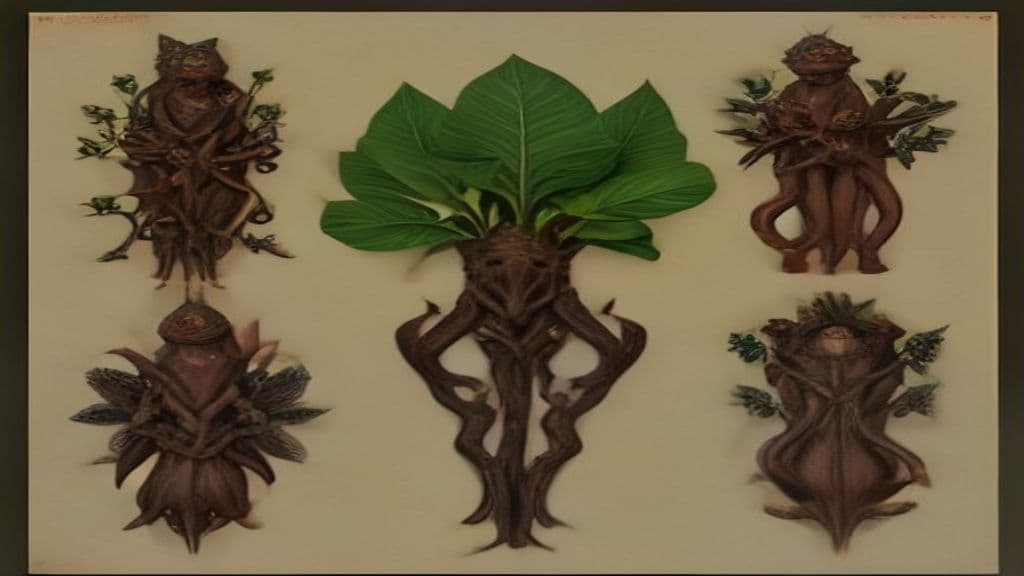
A human-shaped root (primarily Mandragora spp.) treated in classical and later European tradition as a toxic, psychoactive pharmakon whose anthropomorphic form and powerful alkaloids generated ritualized harvesting rules and medicinal prescriptions. It is a botanical substance invested with magical and medical significance rather than an independently volitional spirit in the provided sources.

Manes
Lesser

Manes

In ancient Roman religion the Manes (Latin: mānēs) are a collective class of chthonic divine dead — the subterranean spirits of deceased persons — who are propitiated in household, funerary, and civic rites (e.g., Parentalia, Feralia, and foundation rites involving the lapis manalis). They appear in inscriptions (D.M., Dis Manibus) and literary commentary as an institutionalized category of the dead rather than as a single named being.

Mars
Ancient

Mars

Mars is the ancient Roman god of war who also functions as an agricultural guardian; a chief civic deity of early Rome, he is described as the son of Jupiter and Juno and is commonly equated with the Greek Ares while retaining distinct Roman agrarian aspects.

Marsyas
Lesser

Marsyas

Marsyas is a satyr/silenus of Phrygian myth celebrated as an expert aulos-player who challenges Apollo and is ultimately punished (flayed) for that contest. He is associated with springs and rivers around Celaenae/Kelainai and with older chthonic/Mother-Goddess cultic strands (Rhea/Cybele) in Greek tradition.