Entity Index

A record of the unseen, drawn from world folklore.

7724 entities · page 93 of 129

María (Mariang) Makiling
Greater

María (Mariang) Makiling

A diwata — a place‑bound mountain spirit or lambana in Tagalog/Philippine tradition associated with Mount Makiling (Laguna). Portrayed as a beautiful, ageless woman who protects the mountain and aids or punishes people according to local moral rules; colonial contact Hispanicized her name to "María" while older honorifics such as Dayang link her to pre‑colonial veneration.
María Lionza
Greater

María Lionza

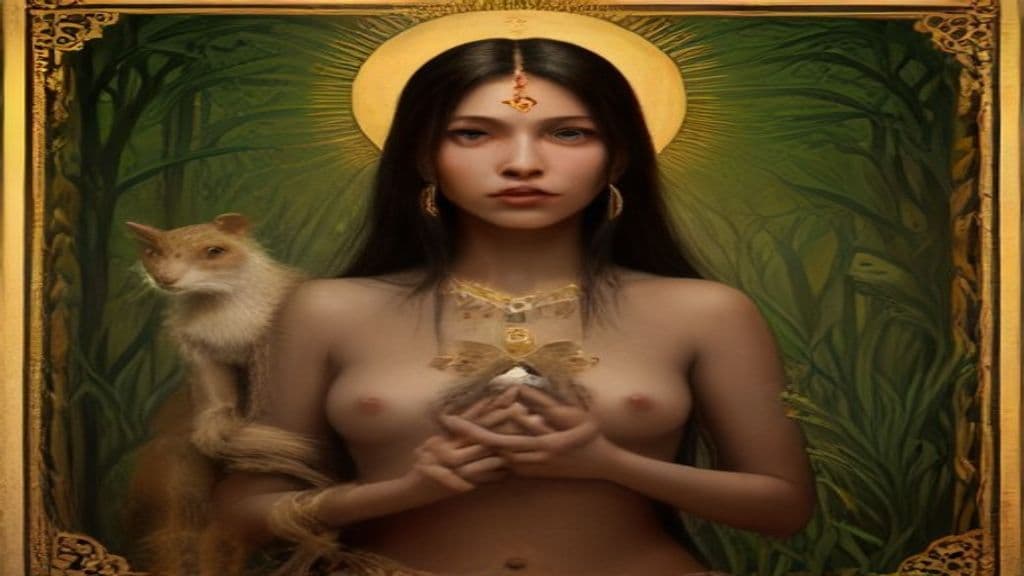
María Lionza is the central sacred figure of a Venezuelan syncretic popular religion centered on Sorte mountain; venerated as a queen/goddess of nature, love, and healing, she functions as a focal point for mediumship, spirit courts, and pilgrimage.

Masaan
Greater

Masaan

Cremation ground spirit of North India — born from improperly conducted last rites, the Masaan haunts funeral pyres and can possess the living, causing wasting illness. Referenced in classical Ayurvedic texts and the subject of the acclaimed 2015 film.

Masan
Minor Spirit

Masan

Masan (Korean: 마산) is documented in the provided sources solely as a geographic and administrative place in South Gyeongsang Province, South Korea — a former independent city now part of Changwon. No material in the supplied research notes describes a South Asian folk supernatural entity named "Masan."

Maschalismos (Undead Entity)
Greater

Maschalismos (Undead Entity)

In Greek tradition, Maschalismos refers to the practice of rendering the dead unable to rise or haunt the living. (Note: - Power tier: Lesser (as it's a local, regional concept rather than a powerful deity-level entity) - Abilities: The source material doesn't support specific details about its powers; should be rephras)

Mataaho
Ancient

Mataaho

Mataaho (also Mataaoho, Mataoho) is an atua (deity/ancestral atua) in Tāmaki Makaurau (Auckland) Māori tradition associated with volcanic and subterranean forces. He is credited in local narratives with creating or instigating the creation of many volcanic features in the Auckland volcanic field and is a tupuna (ancestor) for specific iwi.

Matahourua
Greater

Matahourua

A cultural and historical vessel in Māori tradition, associated with legendary hero Kupe's discovery of Aotearoa (New Zealand). (Note: - Power tier should be Primordial, not Greater. As a cultural and historical vessel associated with the discovery of an entire region (Aotearoa), it should be considered on a cosmic level. - Abilities)

Matangi
Greater

Matangi

Matangi (Sanskrit: मातङ्गी, Mātaṅgī) is a Hindu Tantric goddess, one of the ten Mahavidyas. She is an esoteric form of the Divine Mother associated with speech, music, learning and the arts and—within Tantric contexts—invoked for worldly and occult powers such as mastery of the arts, attraction of people and control over enemies.

Matariki
Greater

Matariki

In Māori culture, Matariki is the Pleiades star cluster marking the beginning of the new year in the lunar calendar. (Note: * Power tier: Primordial (since it's a celestial event, not a deity-level entity) * Summary: Inaccurate (Matariki is a celebration marking the beginning of the new year, not just the Pleiades star clu)

Mater Deva
Minor Spirit

Mater Deva

No attested entity named 'Mater Deva' appears in the provided source set. The name is not documented in the cited materials; contextual sources discuss Cantabrian mythology and the ritual role of epic texts but do not reference a Mater Deva figure.

Matrikas
Greater

Matrikas

Matrikas (Sanskrit: mātṛkā, 'mothers') are a group of related mother-goddess figures in Hindu tradition, commonly rendered as seven (Saptamatrikas) or eight (Ashtamatrikas). They function ambivalently as protectors and as dangerous female powers tied to fertility, child mortality, disease, and martial activity, and were incorporated into temple and tantric/Shakta practice by the Kushana–Gupta and early medieval periods.

Matsigenka spirits and demons
Lesser

Matsigenka spirits and demons

In Matsigenka ethnography, a class of active lesser supernatural beings—commonly rendered in English as "spirits and demons"—are held to influence everyday life, while remote creator gods are viewed as withdrawn. Shamans historically mediated with these beings; today many functions are performed by healers amid increasing Christianization and cultural change.

Matsés (animist tradition)
Lesser

Matsés (animist tradition)

The Matsés are an Indigenous people of the Peruvian and Brazilian Amazon whose worldview is animist: there is no strict separation between physical and spiritual worlds, and animals, plants and trees are inhabited by spirits that shape health, hunting success and medicinal efficacy. The supplied sources document this distributed set of nonhuman persons and shamanic practices (including sapo frog medicine) rather than a single named supernatural entity.

Mau rākau (Māori martial art)
Greater

Mau rākau (Māori martial art)

Mau rākau is a traditional Māori martial art emphasizing physical and spiritual discipline, practiced by warriors in New Zealand. (Note: * Power tier should be Primordial, as the article states it was practiced by warriors in New Zealand, which implies a high level of cultural and spiritual significance. * The ability to wield traditio)

Maudgalyayana
Greater

Maudgalyayana

Maudgalyayana is a devout spiritual practitioner and one of the Buddha's closest disciples, revered as the second foremost male disciple in Buddhist tradition. (Note: - The power tier should be Ancient, not Greater, given his attainment of enlightenment shortly after ordination. - There is no mention of a search for spiritual truth with Śāriputra in the source mate)

Maugrim
Lesser

Maugrim

Maugrim is a fictional Talking Animal — a large, sentient Narnian wolf — who serves as the Captain of the White Witch's Secret Police in C. S. Lewis's The Lion, the Witch and the Wardrobe. He functions as an armed enforcer of the Witch's tyranny, is described as very large and fearsome, and is ultimately killed in single combat by Peter Pevensie.

Mavka (Nyavka)
Lesser

Mavka (Nyavka)

A female forest spirit in Ukrainian folklore, the mavka (also nyavka) represents the soul of a girl who died prematurely or unnaturally. Mavkas are ambivalent: various accounts portray them as alluring, dangerous seductresses who may lure men to death, while other local beliefs credit them with tending cattle and protecting flocks.

Mavroneri
Primordial

Mavroneri

A metaphorical entity associated with the River Styx, serving as a boundary between the mortal world and the underworld. (Note: 1. Power tier is incorrect; Primordial is typically associated with cosmic entities, but Mavroneri's abilities are related to a specific geographical location (the River Styx) rather than cosmological)

Mavuika
Ancient

Mavuika

Mavuika is a fictional, in‑world divine figure in the video game Genshin Impact who functions as Natlan's Pyro Archon. Presented as a formerly mortal warrior who gained the Archon office, she drew on the power of the Ruler of Death to sacrifice herself to postpone a war for 500 years and is later resurrected in the game's current timeline.

Maximón (San Simón)
Lesser

Maximón (San Simón)

Maximón is a syncretic Maya folk deity and folk saint venerated in the Guatemalan Highlands (notably Santiago Atitlán and Zunil). He is an ambivalent, worldly figure—commonly represented by household or community effigies—that receives offerings (cigars, liquor, flowers, bread) and serves as a local mediator for petitions and favors. His identity and stories vary by town and combine pre-Hispanic Maya elements with Christian saint imagery, sometimes including associations with Judas Iscariot or Saint Simon.

Maya Hero Twins (Hunahpu and Xbalanque)
Ancient

Maya Hero Twins (Hunahpu and Xbalanque)

Central culture-hero brothers of the Kʼicheʼ Popol Vuh and Classic Maya iconography, Hunahpu and Xbalanque undergo trials, avenge earlier wrongs, defeat the lords of Xibalba by trickery and a ballgame, transform other beings, and are finally transformed into celestial bodies associated with sun and moon. They mediate between human society, the maize cosmos, and the underworld and appear in both colonial textual tradition and Classic Maya art.

Mayari
Ancient

Mayari

Mayari is a Kapampangan moon goddess in Philippine mythology who, after a quarrel with her brother Apolaki, shares rulership of the world by governing the night; she is associated with the moon, beauty, war, revolution, strength, weaponry, and the hunt, and is said to have lost sight in one eye during the fight.

Mayasura
Greater

Mayasura

Mayasura (Maya, Mayāsura, Maya Danava) is a legendary master‑builder and king among non‑Vedic supernatural lineages in Hindu narrative tradition, famed as the architect of the Mayasabha (Hall of Illusions) and the three cities Tripura, and as a transmitter/possessor of specialised astronomical knowledge in late mythic accounts.

Maymun
Greater

Maymun

Maymun (Maymun Abanuch / Maymun al‑Shahabi / Abu Nuh) is presented in Islamic folkloric and occult sources as the last of the seven kings of the jinn, a powerful wind‑jinn king associated in those traditions with Saturday, the planet Saturn, the color black, and gold. He appears both as a fearsome, martial, abducing jinn in manuscript imaginaire and as a venerated saintly figure in North African local cults (Sidi Mimun / Lalla Mimuna).

Mayūrabhaṭṭa
Minor Spirit

Mayūrabhaṭṭa

Mayūrabhaṭṭa (Sanskrit: मयूरभट्ट) is a 7th‑century Sanskrit poet and Hindu scholar traditionally credited with composing the Sūryaśataka, a one‑hundred‑verse hymn to the Sun (Sūrya). In the narrative preserved in later tradition he performed a vowlike penance at the Sūrya temple in Deo, tied one hundred threads to a peepal tree and composed one verse per day; according to the account, this devotional composition is said to have cured his leprosy and liberated a Brahmarākṣasa that haunted the tree.

Mazu
Ancient

Mazu

Mazu (媽祖) is a deified female protector of seafarers originating in Fujianese popular religion as the historical/legendary Lin Moniang. Venerated across Chinese folk religion, Taoist and Buddhist registers, and in coastal and diasporic Chinese communities (notably Taiwan), she functions as a tutelary sea goddess whose cult includes temples, imperial honorific titles, and large popular pilgrimages.

Mazzikin
Greater

Mazzikin

In Jewish mythology, mazzikin are described as invisible demons that can cause harm or danger to individuals. (Note: - Power tier: change to Lesser (mazzikin cause "minor annoyances") - Weaknesses & Wards: list should be more specific, e.g., "Incantation bowls made by Aramaic-speaking inhabitants of Mesopotamia and )

Mañjuśrī
Ancient

Mañjuśrī

Mañjuśrī is a central Mahāyāna bodhisattva who personifies transcendent wisdom (prajñā). He appears as an authoritative figure in sutras, in esoteric mantra/dharani collections, and widely in Buddhist art and temple ritual contexts across South, Central and East Asia.

Mbielu-mbielu-mbielu

Mbielu-mbielu-mbielu

A mysterious animal reportedly seen in the Likouala River, Central African Republic/Democratic Republic of the Congo border. (Note: * Power tier: Not specified; needs to be determined based on available information. * Origin story: Omitted entirely; needs to be included if known. * Abilities: No information provided; needs to be e)
Mbombo (Bumba)
Primordial

Mbombo (Bumba)

Mbombo, also called Bumba, is the creator god of the Kuba people (in what is now the Democratic Republic of the Congo). In Kuba creation myth Mbombo brings the sun, moon, stars, animals and people into being by vomiting them from his body, teaches humans craft (fire), and then retreats to the heavens, leaving an earthly representative (Yima/Loko Yima).

Mbwiri
Greater

Mbwiri

Central African demon believed to possess people, causing neurological disorders. (Note: * Power tier: Given that the primary behavior of Mbwiri is possession, which seems more in line with a lesser or local spirit, it's unlikely to be classified as Greater. * Origin story: No information)

Me (Mesopotamian Tradition)
Primordial

Me (Mesopotamian Tradition)

A Mesopotamian ritual or practice that embodies the divine, representing a sacred and transcendent aspect of the deity itself. (Note: - Power tier: Primordial is plausible given the described abilities (incarnation of deity). - Appearance: needs to be filled in with source material. - Origin story: needs to be filled in with source )

Meander
Minor Spirit

Meander

A meander is a geomorphological feature: a series of regular sinuous curves in the channel of a stream or river. The term derives from the river name Maiandros (Greek Μαίανδρος) and in classical usage came to denote anything winding or convoluted.

Mechho Bhoot
Minor Spirit

Mechho Bhoot

The fish-eating ghost of Bengal — the spirit of a fisherman or a person obsessively fond of fish in life, condemned to haunt river banks and fishing boats, stealing the catch and causing boats to capsize. Distinctly Bengali: a ghost shaped by the culture of a river civilization.
Mecho Bhoot
Minor Spirit

Mecho Bhoot

No verifiable information about an entity called "Mecho Bhoot" is present in the single provided source. The supplied source (a Wikipedia entry for the animated series Bantul The Great) does not define, describe, or mention Mecho Bhoot; therefore the nature, attributes, and cultural context of Mecho Bhoot are unknown based on the available material.

Mecisteus
Lesser

Mecisteus

Mecisteus is a mortal heroic figure from ancient Greek tradition attested in genealogical lists and epic-cycle episodes. He appears in connections with the Theban cycle (Seven Against Thebes), Trojan War narratives, and Argive genealogies, primarily as a warrior and ancestor rather than a developed individual character.

Medb
Ancient

Medb

Medb is the legendary queen of Connacht in the Irish Ulster Cycle, presented as a powerful royal figure and a sovereignty-woman who embodies the land's power to grant kingship. She is famed as the instigator of the Táin Bó Cúailnge and is etymologically associated with mead/intoxication and rulership.

Medea
Greater

Medea

Medea is a mythic Greek woman of royal lineage associated with practiced pharmakeía (drugcraft) and ritual knowledge; in epic she functions as the helper who enables Jason's success, and in tragedy she becomes a transgressive avenger whose actions include murder. Sources present her variably as mortal with divine ancestry (granddaughter of Helios) and as a skilled worker in magical substances and rites often linked in literature to Hecate.

Medesicaste
Lesser

Medesicaste

Medesicaste is the name borne by two distinct mortal women in the Trojan royal house in classical Greek myth. One is a daughter of Laomedon and sister of Priam who, with her sisters, is said in some traditions to have set fire to the Greek ships after the Trojan War; the other is an illegitimate daughter of Priam who became the wife of Imbrius.

Medieval revenant
Lesser

Medieval revenant

A revenant is a folkloric returning dead — described in the supplied sources as either a spirit or an animated corpse — believed to have been resurrected to re-enter the world of the living and to haunt them. The English term derives from Old French revenant, literally ‘returning’.

Medjed
Lesser

Medjed

Medjed is a minor, named supernatural figure attested in a few copies of spell 17b of the Egyptian Book of the Dead and depicted on nine New Kingdom/Late Period papyri dated to around the Twenty‑first Dynasty. Textual lines call him “that smiter,” say he “shoots with his eyes, yet is unseen,” and that “the sky is encircled with the fiery blast of his mouth,” and place him among those who belong to the House of Osiris in the Duat.

Medon
Lesser

Medon

Medon (Μέδων) is a Greek personal name attested across mythic, epic, and civic sources for multiple distinct mortal figures (herald, warriors, local notable) and once for a centaur; it functions as a name-cluster rather than a single supernatural being. The name also recurs in modern taxonomic and toponymic usages, which are homonymous transfers rather than indications of a unified mythic entity.

Medus
Lesser

Medus

Medus (Greek Μῆδος / Μήδειος) is a legendary Greek prince, usually described as a son of Aegeus and Medea (with variant accounts making him son of Jason). In myth he functions as an eponymous founder and conqueror associated with Media/Ecbatana and as an agent of dynastic vengeance in Colchis; he is presented as a mortal heroic-age figure rather than a supernatural being.

Medusa (the Gorgon)
Greater

Medusa (the Gorgon)

Medusa, also called Gorgo or the Gorgon, is one of the three Gorgons in ancient Greek mythology. She is described as a mortal woman whose hair is composed of living snakes and whose gaze turns onlookers to stone; she is usually named as a daughter of the sea-associated figures Phorcys and Ceto and sister to Euryale and Stheno.

Meduza
Lesser

Meduza

Meduza (also Meluza, Meluzina) is a hybrid sea monster attested in Russian popular print culture (a 17th–18th‑century lubok) described as half-woman and half‑serpentine/sea creature, located in remote oceanic waters and explicitly labeled in one source as a 'deity of deception.'

Meenakshi
Ancient

Meenakshi

Meenakshi is a South Indian Hindu goddess, principal deity of the Meenakshi–Sundareswarar Temple in Madurai. Regarded as a regional manifestation of Parvati/Adi Shakti, she is portrayed in literary legend as a warrior-queen and is the focus of major public festivals and hymnody.

Megamede
Lesser

Megamede

Megamede (Ancient Greek: Μεγαμήδη) is a mortal woman attested in Greek mythographic genealogies as daughter of Arneus, wife of King Thespius of Thespiae, and in one tradition the mother of the fifty daughters who consorted with Heracles. She is presented solely as a human royal figure in the sources rather than as a supernatural being.

Meganeira
Minor Spirit

Meganeira

Meganeira (Μεγάνειρα, Megáneira) is a personal name borne by mortal women in Greek mythic genealogies and narratives. The name, glossed as 'great lady' or 'woman of high status,' appears attached to several human figures who function as daughters, wives, or mothers within Arcadian, Eleusinian, and local Parnassian stories.

Megapenthes (son of Menelaus)
Lesser

Megapenthes (son of Menelaus)

Megapenthes (Ancient Greek Μεγαπένθης) is a mortal figure in Greek mythic-historical tradition, identified as an illegitimate son of Menelaus of Sparta by a bondwoman. He appears in Homeric household scenes in the Odyssey and in later genealogical summaries concerning Spartan dynastic arrangements; he has no supernatural attributes in the supplied sources.

Megara
Minor Spirit

Megara

Megara is attested in the provided sources in two distinct, non-supernatural senses: (1) as an historic Greek city and polis in West Attica with two harbors and a record of colonization and political history; and (2) as a mortal mythic figure, the Theban princess—eldest daughter of King Creon—who is named in tradition as the first wife of Heracles. The corpus contains no evidence treating Megara as an autonomous supernatural spirit, deity, or class of spirits.

Megareus (Menoeceus)
Lesser

Megareus (Menoeceus)

Megareus (Greek Menoeceus, Μενοικεύς) is a mortal warrior of Thebes in the Greek heroic-age cycle. Surviving accounts present him as a large-statured combatant who came from Onchestus to aid Nisus of Megara and was slain during Minos' capture of Megara; he appears as a named figure within Theban and Theseidic genealogical narratives rather than as a supernatural being.

Megareus of Onchestus
Lesser

Megareus of Onchestus

Megareus of Onchestus is a mytho-historical king and warrior-ally from ancient Greek tradition associated with Onchestus in Boeotia and, in some accounts, with Megara as an eponymous founder. He appears in narratives of the Cretan invasion led by Minos, where he comes from Onchestus to aid Nisus and is slain in the conflict; Pausanias records a tomb to him at Megara.

Meges
Lesser

Meges

Meges (Ancient Greek: Μέγης, Latinized Meges) is a mortal aristocratic war-leader of the Homeric Trojan War tradition. He is attested as commander of Dulichian/Epean contingents, a warrior credited with multiple slayings in the battle narratives, and one of the Greeks who entered the Trojan Horse; later authors give variant accounts of his fate.

Megisto
Minor Spirit

Megisto

Megisto is a genus of butterflies in the subfamily Satyrinae (family Nymphalidae). The taxon includes species such as Megisto cymela and Megisto rubricata; source materials are scientific/taxonomic and do not treat Megisto as a supernatural being.

Mehen
Lesser

Mehen

Mehen is an ancient Egyptian protective serpent deity whose name means 'coiled one'; depicted coiling around the sun god Ra during his nightly voyage and lending protective guardianship. The term also names an archaeological game board whose relation to the deity is uncertain.
Melaeneus
Lesser

Melaeneus

Melaeneus (Ancient Greek Μελαινέα / Μελαινέυς) is an Arcadian prince in Greek myth, listed among the fifty sons of King Lycaon and credited in literary tradition as the eponymous founder of the Arcadian settlement Melaeneae. He appears only as a genealogical/foundational figure and as one of Lycaon’s sons punished by Zeus; no independent deeds, cult, or physical description are preserved in the cited sources.

Melampus
Lesser

Melampus

Melampus (Μελάμπους) is a legendary human seer and healer of Greek mythic tradition, originally associated with Pylos and later with Argos. Sources present him as the ancestral founder of a hereditary house of seers (the Melampodidae), a culture‑hero who performs cures and divinations for kings and communities and who, in some accounts (per Herodotus), introduced aspects of Dionysian worship.

Melaneus
Lesser

Melaneus

Melaneus is a name applied to several minor figures in ancient Greek mythic genealogies and narratives, most notably a son of Apollo described as a founder-king of Oechalia and a noted archer. Other fragmentary attestations use the name for an Ethiopian chief killed in the Perseus–Phineus conflict and possibly an Indian figure, indicating the name's reuse for distinct minor personages.

Melanion (Milanion)
Lesser

Melanion (Milanion)

Melanion (also spelled Milanion) is an Arcadian prince in Greek myth who wins the huntress Atalanta in marriage, typically by prevailing in her footrace with the aid of divine intervention. He is a mortal heroic figure frequently conflated with the name Hippomenes in variant traditions.

Melanippe
Lesser

Melanippe

Melanippe (Ancient Greek: Μελανίππη, lit. 'black mare') is a personal name applied to several distinct female figures in Greek mythic tradition — including a daughter of the centaur Chiron transformed into a mare, an Amazon warrior, a Meleagrid princess turned into a guinea‑fowl, and various genealogical wives and daughters. The name recurs across metamorphosis narratives, Amazon cycles, and genealogical lists rather than designating a single unified supernatural being.