Entity Index

A record of the unseen, drawn from world folklore.

7724 entities · page 96 of 129

Moggallāna (Mahāmaudgalyāyana / Maudgalyāyana)
Greater

Moggallāna (Mahāmaudgalyāyana / Maudgalyāyana)

Moggallāna (birth-name Kolita) is presented in early Buddhist texts as one of the Buddha's two foremost male disciples, famed for entering deep jhāna and using supernormal meditative powers to visit devas and observe the states of petas; his eyewitness reports form the narrative frame of the Vimanavatthu and Petavatthu and are used didactically to teach karma and ethical practice.

Mogollon Monster
Lesser

Mogollon Monster

A regionally anchored American folkloric cryptid reported along Arizona's Mogollon Rim, described as a large, bipedal, hairy humanoid whose accounts function as wilderness cautionary tales and local popular‑culture legend.

Mohini
Lesser

Mohini

South Indian spirit of a beautiful woman who died of a broken heart or by betrayal — she appears on roadsides at night, enchants men into following her, and leads them to ruin or death.

Moirai
Ancient

Moirai

In ancient Greek religion and mythology, the Moirai (μοῖραι) are a triad of personified destinies who spin, allot, and cut the thread of life. They function as apportioners of fate, ensuring that both mortals and gods live out the portions assigned by the universe's ordering principles.

Mokele-Mbembe
Ancient

Mokele-Mbembe

A water-dwelling entity in Central African tradition, described as reptilian or a member of an extinct sauropod lineage. (Note: 1. Power tier: should be Primordial (cosmic level) since it's often described as a legendary creature rather than a deity-level being. 2. Origin story: The source material does provide etymology, stat)

Mokosh
Ancient

Mokosh

Mokosh is a reconstructed Old East Slavic female theonym, etymologically tied to wetness and marshy places and commonly represented in scholarship as a goddess associated with waters, fertility, and the earth. She is known from brief medieval mentions and later folkloric echoes rather than any surviving mythic narratives; many detailed attributes are scholarly reconstructions and contested.

Molus of Aetolia
Minor Spirit

Molus of Aetolia

Molus is a minor figure recorded in Greek mythic genealogies as a member of an Aetolian royal family. The available source treats him as a legendary mortal used to organize lineage rather than as an active supernatural agent or cult figure.

Molus of Crete
Lesser

Molus of Crete

Molus is a figure in Cretan mythic genealogy, presented in surviving sources as a son in the house of Minos and chiefly significant as the father of Meriones, the Cretan warrior at Troy. He is also attested in one account as the subject of a ritual image shown at a Cretan festival: an image of a headless man called Molus, linked to a tradition that he attempted to violate a nymph and was later found decapitated.

Momoy
Lesser

Momoy

Momoy is the Chumash lexical term for the sacred/medicinal plant Datura wrightii and, in Chumash contexts, the spirit-power associated with that plant. It is an entheogenic medicine used in ritual and healing contexts to induce visions, support spiritual wellbeing, and to help 'keep the soul in the body' during frightening encounters; it is also recognized as poisonous and dangerous if mishandled.

Momu
Lesser

Momu

Momu is a figure in Chinese legendary tradition described as a legendary empress and goddess, remembered as a wife of the Yellow Emperor and traditionally credited with inventing the mirror and with a healing episode that led to her involvement in divine administration. Later popular traditions also group her among a set called the "Five Ugliest Women of Ancient China."

Monaciello (Munaciello)
Lesser

Monaciello (Munaciello)

A traditional Neapolitan household and city sprite, the Monaciello ('little monk') is a short, stocky, robed figure of local oral lore who inhabits Naples' underground waterworks and who visits homes, sometimes rewarding hospitality and sometimes playing spiteful tricks.

Mongolian Death Worm (Oov)
Primordial

Mongolian Death Worm (Oov)

A cryptid or mythological animal said to live in the Gobi Desert, associated with death. (Note: 1. Power tier should be Lesser (local spirit) since it's a desert-dwelling creature with unproven abilities and no concrete description. 2. Appearance, Abilities, Sensory cues, Weaknesses, and Wards n)

Monkey-man of Delhi
Lesser

Monkey-man of Delhi

A modern Indian urban‑legend and mass‑panic phenomenon centered on reports of a monkey‑like attacker roaming New Delhi in mid‑2001. Media coverage and eyewitness reports described a frightening, inconsistent figure blamed for nighttime attacks, injuries, and panic; subsequent investigations suggested a mix of hoaxing, copycats and mass hysteria.

Monopod
Lesser

Monopod

A class of mythological humanoid peoples described in classical, medieval, Chinese, and Norse sources as having a single central leg with a very large foot. Treated in literature and maps as a wondrous race inhabiting the margins of the known world rather than as a lone monster.

Monotheism in pre-Islamic Arabia
Greater

Monotheism in pre-Islamic Arabia

Followers of Abrahamic faiths, such as Christianity and Judaism, who believed in a single all-powerful God in pre-Islamic Arabia. (Note: * Power tier: Lesser (not Greater) - monotheistic beliefs were not limited to powerful regional deities but had a relatively local presence in pre-Islamic Arabia. * Origin story: The exact timing is u)

Monster (tradition)
Greater

Monster (tradition)

A broad cultural category for imagined creatures that transgress natural and social norms. In literature, mythology, religion, and popular culture, monsters mark otherness, danger, or omenatic significance rather than denoting a single, uniform being.

Monster Slayer (Nayenezgani)
Lesser

Monster Slayer (Nayenezgani)

Within the limited sources supplied, 'Monster Slayer' is used as an English label on a Wikipedia disambiguation page to refer to Nayenezgani, identified there only as "a character from the Navajo creation myth." The provided materials contain no narrative, descriptive, or ritual information about this figure beyond that single listing.

Moon Rabbit (Maya Tradition)
Primordial

Moon Rabbit (Maya Tradition)

A mythical figure associated with lunar mythology, said to pound elixir or medicine for mortals and occasionally foodstuffs. (Note: 1. Power tier: Downgrade to Ancient, as while it's associated with lunar mythology, its abilities are not cosmic in scope. 2. Abilities: Add that the contents of the mortar differ among cultural tradi)

Moon god (lunar deity)
Ancient

Moon god (lunar deity)

A lunar deity is a divine figure representing the Moon or aspects of it; across cultures such deities personify the Moon, its phases, and its governance of the night and may perform varied functions depending on local tradition.

Mopsus
Lesser

Mopsus

Mopsus is a legendary seer of the Graeco-Anatolian tradition known from archaic Greek poetry and later Anatolian and Phoenician inscriptions. He appears in myth as a prophetic figure—sometimes son of Manto or of Apollo—and in epigraphic records as an eponymous ancestor (Muksa/Muksos) connected to early Iron Age dynastic houses in southern Anatolia.

Morana (seasonal goddess)
Ancient

Morana (seasonal goddess)

A pan-Slavic female figure personifying the death of winter whose ritual demise at winter's end is linked to the rebirth of spring goddesses such as Kostroma, Lada, or Vesna. Sources treat her as an ancient goddess associated with seasonal rites and with dreams.

Morax
Greater

Morax

Morax is a named spirit in demonological listings described in secondary sources as a high-ranking infernal officer—styled a Great Earl and President of Hell—who commands many legions and is said to teach astronomy and the liberal sciences. The figure is also reused in diverse modern fictional and occult contexts where attributes are adapted.

Mordecai
Lesser

Mordecai

Mordecai is a central human figure in the Book of Esther (Hebrew Bible), portrayed as an exilic Judean courtier in Susa who acts as guardian to Esther, exposes a plot against King Ahasuerus, refuses to bow to the official Haman, and whose actions precipitate the events commemorated by the festival of Purim.

Morgan le Fay
Greater

Morgan le Fay

A mutable figure of the Arthurian tradition variously portrayed as an enchantress, healer, fairy-queen, or human noblewoman. Early accounts emphasize her role as a healer and leader of supernatural women at Avalon; later prose romances often recast her as an ambivalent or antagonistic sorceress in relation to Arthur and his court.

Moritasgus (Apollo Moritasgus)
Lesser

Moritasgus (Apollo Moritasgus)

Moritasgus is a Celtic epithet for a healing deity attested in four inscriptions at Alesia. In two of those inscriptions he is explicitly identified with the Greco‑Roman god Apollo, and his consort is named as the goddess Damona.

Mormo
Lesser

Mormo

A Greek child-eating bogeywoman used to frighten children into obedience, sometimes depicted as a shape-shifting female phantom who bit naughty children.

Moroi
Lesser

Moroi

A moroi is a revenant or undead spirit in Romanian and neighbouring Central/Eastern European folklore associated with failed birth/death rites and nocturnal harm. Traditions variously describe it as a phantom, a kind of vampire or ghost, or the spirit of an unbaptized infant or malformed child born of supernatural conception.

Morphe (μορφή)
Lesser

Morphe (μορφή)

Morphe (Greek: μορφή) is a lexical term meaning "form," "shape," or "outward appearance" attested in ancient Greek and discussed in New Testament exegesis. The provided sources show no coherent folkloric or mythic entity named "Morphe"; modern uses of the sequence "Morphe" in brand and project names are likewise non-mythic appropriations of the word or signifier.

Morrheus
Lesser

Morrheus

Morrheus is an Indian chief and mortal warrior who opposes Dionysus and his thiasos in Nonnus’s epic Dionysiaca. He appears in the poem as a capable combatant who wounds members of Dionysus’s retinue, is subject to divine intervention, and is twice removed from battle by stratagems of dream and seduction.

Moryana
Ancient

Moryana

In Slavic folklore, Moryana is a complex sea spirit who rules the winds and poses a threat to ships. (Note: - The power tier is incorrectly assigned (Ancient) given that it only rules the winds and poses a threat to ships, which would be more consistent with a Greater power tier. - Sensory cues: coastal reg)

Mot
Greater

Mot

Mot is the Ugaritic/Phoenician personification and divine power of death; in mythic texts he appears as a son of ’El whose residence is a pit and whose appetite for the living brings sterility and conflict with the storm-god Baal.

Mothman
Lesser

Mothman

A modern American folkloric figure originating from a cluster of 1966–67 sightings around Point Pleasant, West Virginia. Described in press reports and later retellings as a large humanoid or winged creature with notable eyes, the Mothman legend has been variously interpreted as misidentified wildlife, hoaxing/sensationalism, or a paranormal omen linked in some retellings to the Silver Bridge collapse.

Mothra
Ancient

Mothra

Mothra (Japanese: モスラ, Mosura) is a moth-like giant monster (kaiju) originating in Japanese popular media. First appearing in a 1961 serial/novelization and Toho's 1961 film Mothra, the character is recurrently portrayed as a colossal, often heroic/protective kaiju associated with an island culture and featured across multiple Toho and later Monsterverse films.

Motoro
Minor Spirit

Motoro

Motoro is a tribal god of the Ngariki people of Mangaia in Polynesia. In the available account he is called i'o ora ('god of the living') and is noted for a myth in which he was cast into the sea during a quarrel with his elder brothers; his spirit later arrived at Mangaia on a piece of hibiscus. His followers were exempt from being used as human sacrifices.

Motutaiko Island
Greater

Motutaiko Island

In Māori tradition, Motutaiko Island is a culturally significant island within Lake Taupō, associated with the black petrel bird and reflecting the Māori worldview's emphasis on connection between natural features and human society. (Note: - Power tier: Minor Spirit (given its local significance and limited abilities) - Weaknesses: drought not mentioned in source material - Wards and weaknesses inconsistent with the provided information)

Mount Meru (Buddhist Tradition)
Primordial

Mount Meru (Buddhist Tradition)

Sacred, five-peaked mountain at the center of all physical, metaphysical, and spiritual universes in Buddhist cosmology. (Note: 1. Power tier: Downgrade to "Primordial" to "Greater". A Primordial entity would be a fundamental aspect of the universe's creation or structure, rather than a specific geographical location. Mount Me)

Mount Qaf
Greater

Mount Qaf

Legendary mountain in Persian tradition and Arab mythology, considered homeland of the jinn. (Note: * Power tier: Primordial (based on being created directly from "shining emerald material" by God) * Abilities: Not explicitly described in source material; should be removed or rephrased * Sensory cue)

Mountain God (Korean tradition)
Greater

Mountain God (Korean tradition)

Tutelary deity associated with mountains in Asian cultures, similar to dizhu shen and City Gods. (Note: 1. Power tier: Reduce to Lesser (Mountain Gods do not necessarily possess deity-level powers) 2. Appearance: Provide specific information about physical appearance or characteristics 3. Abilities: Cla)

Mountain spirit (Shanling / Wushan) — limited-source entry
Lesser

Mountain spirit (Shanling / Wushan) — limited-source entry

The supplied corpus provides only minimal, non-ethnographic attestations: an English Wikipedia disambiguation page listing geographic places called 'Spirit Mountain' and a Wikidata item classifying 'mountain spirit' as a 'type of sprite.' No primary or traditional Taoist descriptions, rituals, or narratives are present in the provided materials.

Moussa Gname
Greater

Moussa Gname

A revered culture hero of the Songhai people, celebrated for his pivotal role in shaping West African folklore and mythology. (Note: * Power tier: Unclear, but likely Lesser or Minor Spirit given the lack of specific abilities * Origin story: Should be revised to "Origin unknown" as no detailed origin story is found in the source m)

Mozagro
Minor Spirit

Mozagro

Mozagro is attested in the provided sources as a modern toponym and commercial name rather than a supernatural being. It appears as a geographic feature (Pico Mozagro referenced in pastoral/cattle imagery), a triangulation station in Cieza, Spain, and as the name of a contemporary digital agribusiness marketplace serving smallholder farmers. The supplied materials contain no folkloric, mythic, or supernatural descriptions of Mozagro.

Mozas del Agua
Lesser

Mozas del Agua

Mozas del Agua (literally "Water Lasses") are a named category of Cantabrian water-associated female supernatural beings appearing in regional folklore source lists. The supplied sources list them alongside other northern Iberian water-fairies (Anjanas, Xanas/Janas, lamias) but provide no independent narratives, iconography, or documented rituals specific to them.

Moʻo (example: Kihawahine)
Ancient

Moʻo (example: Kihawahine)

Moʻo are identified in the supplied sources as Hawaiian lizard deities; the supplied material gives Kihawahine as an exemplar, described as a shapeshifting lizard goddess whose deification originated when the bones of a chiefly daughter were deified and whose home was the wetland pond Mokuhinia on Mokuʻula.

Mr. Beaver
Minor Spirit

Mr. Beaver

Mr. Beaver is a fictional anthropomorphic beaver character who appears in the secondary world of C. S. Lewis's The Chronicles of Narnia. The provided sources identify him only as a character entry in lists/databases of Narnia characters.

Mr. Tumnus
Lesser

Mr. Tumnus

A faun of Narnia who befriends Lucy Pevensie, hesitates to obey the White Witch's orders, is arrested and petrified under her rule, and is later restored by Aslan and serves as a royal adviser to the Pevensies.

Mtskhetos
Greater

Mtskhetos

Epic hero and legendary founder of the city of Mtskheta in Georgian mythology, son of Kartlos. (Note: - Power tier: Minor Spirit (since there's no indication of deific or powerful regional abilities) - Abilities and behaviors: lack of specific information on his abilities and behaviors means they shou)

Muhnochwa
Minor Spirit

Muhnochwa

The 'face-scratcher' of Uttar Pradesh — in 2002 a mass panic gripped hundreds of villages as people reported waking with facial scratches from an invisible entity, triggering mob violence and one of modern India's most documented supernatural hysteria events.

Mujina (貉)
Lesser

Mujina (貉)

A Japanese folkloric shapeshifting creature associated with badger-like and tanuki-like animals; classed among yōkai, mujina perform transformations, illusions, and pranks, and in some tales repay kindness or enact retribution when harmed.

Muldhan
Minor Spirit

Muldhan

Muldhan (rendered in source metadata as MULDHAN) appears only as a subject/index keyword in multiple Bengali-language bibliographic records examined; the accessible records provide no descriptive, ritual, or ethnographic information about the term beyond its repeated indexing. The catalog entries link the keyword with cemetery-related cataloging contexts but do not themselves describe a spirit, revenant, or guardian role.

Muldjewangk
Lesser

Muldjewangk

A water-creature of Ngarrindjeri tradition associated with the Murray River and Lake Alexandrina. Described variously as merfolk-like or a gargantuan monster, Muldjewangk figures appear in stories that warn of river dangers, wreck fishing gear, and in at least one account attack a steamboat.

Mullissu
Greater

Mullissu

Assyrian goddess and consort of Asshur, associated with fertility, marriage, and family. (Note: 1. Power tier: Based on her association with a major deity (Asshur) and potential identity with Ninlil, a goddess on par with Enlil, Mullissu's power tier should be Primordial or Ancient, not Greater.)

Mummy (undead) (Egyptian tradition)
Lesser

Mummy (undead) (Egyptian tradition)

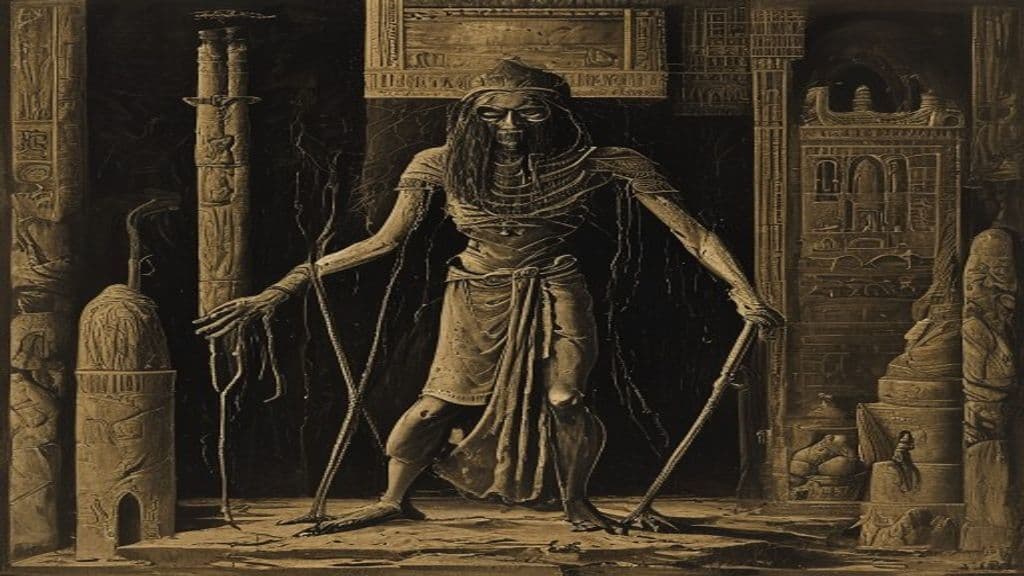
In Egyptian folklore, a mummy is an undead creature believed to be the reanimated corpse of a deceased person. (Note: * Power tier: Should be Primordial, given the association with cosmic entities and magical powers tied to ancient Egyptian rituals. * Abilities: Clarify that supernatural abilities refer to those on a)

Mumudu (Mamu)
Lesser

Mumudu (Mamu)

Mumudu (more commonly Mamu) is a Mesopotamian deity associated with dreams, attested both as described in god lists as one of the seven Šassūrātu/assuratu and in other texts as a daughter of the sun god Shamash/Utu who could be called the 'Utu of dreams'. Surviving excerpts provide no iconography or ritual prescriptions tied specifically to her.

Muneeswarar
Lesser

Muneeswarar

Muneeswarar is a Tamil folk Hindu rural guardian deity venerated especially in Tamil Nadu and Tamil diaspora communities as protector of plantations, estates, and as an attendant or emanation connected to Shiva and to major folk goddesses such as Mariamman. His cult exists in both orthodox Vedic/Agamic temple modes and in non-Vedic folk modes, and much of his history and attributes are preserved in oral tradition and temple practice rather than in Vedic or Purāṇic texts.

Munisuvrata
Ancient

Munisuvrata

Munisuvrata (Munisuvratanātha) is the twentieth tīrthaṅkara of the present Jain avasarpini (descending half cycle), a human exemplar who, according to Jain tradition, attained kevala jñāna and later liberation. He is venerated in temple cults, liturgical poetry, and monumental images across the Indian subcontinent.

Munjeon (Munjeon Bonpuri)
Lesser

Munjeon (Munjeon Bonpuri)

A Jeju Island household deity-concept focused on the house doorway, preserved in a shamanic narrative genre (Bonpuri) that explains the doorway's place within the Gasin, the ensemble of household deities.

Munjya
Minor Spirit

Munjya

Spirit of a Konkani boy who died before his sacred thread ceremony, forever trapped between childhood and adulthood — mischievous, lonely, and hungry for belonging.

Murmur
Lesser

Murmur

Murmur is a named infernal figure attested in modern reference compilations and cultural listings of Western grimoire/demonological names. The supplied sources show Murmur appears as an entry on Wikipedia/Wikidata and in contemporary creative occult writing, but the present corpus does not include primary grimoire texts or historical conjurations specifying origin, appearance, or powers.

Muses
Ancient

Muses

Divine inspirational figures of ancient Greek religion and mythology who personify and authorize the arts, literature, and learned knowledge; traditionally enumerated as nine daughters of Zeus and Mnemosyne in the Hesiodic account and associated with sacred springs and cult sites such as Mount Helicon and Delphi.

Musgosu
Lesser

Musgosu

Musgosu (alternately attested as busgosu) is a named figure in the folk catalogs of Cantabria and is also mentioned in Asturian popular-legends material. Available sources record the name and regional placement but provide no detailed ethnographic description; one comparative commentary equates the name with the Basque Basajaun as an analogue rather than supplying direct Cantabrian testimony.