Chinese Supernatural Beings

184 documented Chinese supernatural beings from the Evil Eye grimoire, including 65 lesser and 50 greater in power tier.

page 2 of 4

Diao Si
Minor Spirit

Diao Si

Insufficient source evidence to document a distinct Taoist spirit or demon called 'Diao Si.' The supplied material is a general overview of Taoism and does not contain attested information about an entity by this name; contextual notes indicate where such a concept might fit within Taoist cosmology, but no specific claims about origins, appearance, powers, rituals, or wards can be supported by the provided source.

Dilong (地龍)
Lesser

Dilong (地龍)

Dilong (地龍; dìlóng, "earth dragon") is a category-name in Chinese dragon taxonomy denoting dragons associated with the earth/ground. The term is polyvalent in sources: it designates an earth-associated dragon-type in cosmological and omen literature, and by analogy names earthly animals (notably the earthworm) used in materia medica.

Diting
Greater

Diting

Diting (Chinese: 谛听; pinyin: Dìtīng) is a divine mythical creature in Chinese Buddhist hagiography traditionally described as the steed and attendant guardian of the bodhisattva Kṣitigarbha (Dizang). Described as a composite beast with extraordinary hearing and discernment, Diting is associated in legend with guarding hell and distinguishing truth from falsehood in support of Kṣitigarbha's salvific activities.

Diyu (Buddhist tradition)
Primordial

Diyu (Buddhist tradition)

The realm of the dead or 'hell' in Chinese mythology, combining elements from Buddhist and traditional Chinese beliefs about the afterlife. (Note: 1. Remove "Primordial" power tier designation as it implies cosmic-level power, which is not supported by the source material (Diyu is described as a realm or "hell", not an entity with vast cosmologi)

Dragon (Long)
Greater

Dragon (Long)

Long (龍, "dragon") is a pervasive cultural and artistic motif that appears in Taoist sacred-geographical contexts, Chinese literature, and modern exhibitions; the provided sources treat it as part of the broader mythic imagery present around Taoist sites and ritual scenes rather than as a single, consistently described doctrinal entity.

Dragon King
Ancient

Dragon King

A high-ranking serpent/dragon ruler associated with water, weather, and territorial guardianship across East, South and Southeast Asian folk-religious traditions. Treated as a divine or semi-divine authority (Nāgarāja / lóng / Ryū / Yongwang) who presides over seas, rivers, wells and rainfall and is an object of ritual supplication, especially in rainmaking and agricultural contexts.

Eight Immortals (八仙; Bā Xiān)
Greater

Eight Immortals (八仙; Bā Xiān)

The Eight Immortals are a group of legendary xian (immortals) in Chinese mythology and popular Taoist-related religion, portrayed as once-human figures who attained transcendence. They function as exemplars of Taoist immortality, patrons of varied social roles, and popular auspicious figures in art, ritual cults, qigong, and martial arts.

Eight Pillars (八柱, bāzhù)
Ancient

Eight Pillars (八柱, bāzhù)

The Eight Pillars (Chinese: 八柱, bāzhù) are a cosmological feature in Chinese mythology consisting of eight mountain-pillars located in the eight cardinal directions that function as supports/axes of the world, conduits between Earth and Heaven, and loci for paradises and supernatural inhabitants.

Emperor Ku
Ancient

Emperor Ku

A legendary mytho-historical sage-sovereign in early Chinese tradition, presented as a descendant of the Yellow Emperor and counted in many lists among the culture-hero rulers (commonly one of the Five Emperors). He is credited with ordering ritual musical technologies, instituting court ceremonial practice, and founding lineages that later legitimated dynasties.

Emperor Shun
Ancient

Emperor Shun

Emperor Shun (舜), also called Di Shun or Yu Shun, is a legendary sage-king in early Chinese tradition, counted among the Five Emperors. Sources portray him as a moral exemplar whose filial piety, modesty, ritual offerings, and administrative reforms model ideal rulership and the ordering of society.

Emperor Yao (堯)
Ancient

Emperor Yao (堯)

Emperor Yao is a legendary sage-king of early Chinese tradition, counted among the Five Emperors. He is famed as a moral exemplar who confronted the Great Flood, instituted calendrical/astronomical officials, and—by traditional accounts—selected Shun as his successor after testing his virtue.

Emperor Zhi (帝挚 / 帝摯, Dì Zhì)
Ancient

Emperor Zhi (帝挚 / 帝摯, Dì Zhì)

A quasi‑historical prehistoric sovereign in classical Chinese chronicle tradition, recorded as a son of Emperor Ku who reigned poorly for nine years before being deposed and succeeded by his younger half‑brother Yao. Treated by later historiographers as a negative exemplar in dynastic moral narratives rather than a supernatural being.

Erlang Shen
Greater

Erlang Shen

Erlang Shen (二郎神) is a Chinese folk-religious and Daoist divine warrior associated with flood control, justice, hunting, and the subdual of demons. Venerated as a local river/irrigation protector who was later incorporated into Daoist pantheons and popular literary cosmologies, he is commonly depicted as a third-eyed spear-wielding hero accompanied by a celestial hunting dog.

Eunuch
Lesser

Eunuch

A eunuch is a human male who has been castrated (testicles removed or destroyed) and who, in many societies, occupied specific social and institutional roles—especially in royal courts, harems, and religious or administrative offices. The term historically designates both an office (bed-keeper, chamberlain) and, in many contexts, men who had undergone castration and filled those offices.

Feilian
Greater

Feilian

Feilian is a named Chinese wind-being originating in southern (Chu) tradition and attested in early Chu poetry (Chu ci). In later commentarial and historiographic traditions the figure became identified with or subsumed under the Zhou/Taoist wind-deity Fengbo; Feilian is represented variously as a chimeric winged beast, a local wind-power, and in some accounts as a historical or mytho-historical personage linked to late Shang narratives.

Feng Meng
Lesser

Feng Meng

Feng Meng (also spelled Beng Meng) is a figure from Chinese mythology described as the apprentice of the divine archer Houyi (Yi) who, driven by envy of his master's skill, murdered Houyi with a club made from a peach tree.

Fengbo
Lesser

Fengbo

Fengbo (also written Feng Bo) is identified in modern English-language reference catalogs as a Taoist deity of the wind. Available supplied sources provide only this categorical identification and do not supply further traditional narrative, iconography, ritual, or functional detail.

Fenghuang
Greater

Fenghuang

The fenghuang (鳳凰 / 鳳皇) is a mythological composite bird in Chinese tradition that functions primarily as an auspicious cosmic and moral symbol. Reputed to reign over other birds and to appear in times and places of supreme peace and prosperity, it is also an imperial emblem later associated with the Empress and with Confucian virtues and celestial mapping.

Fengli
Lesser

Fengli

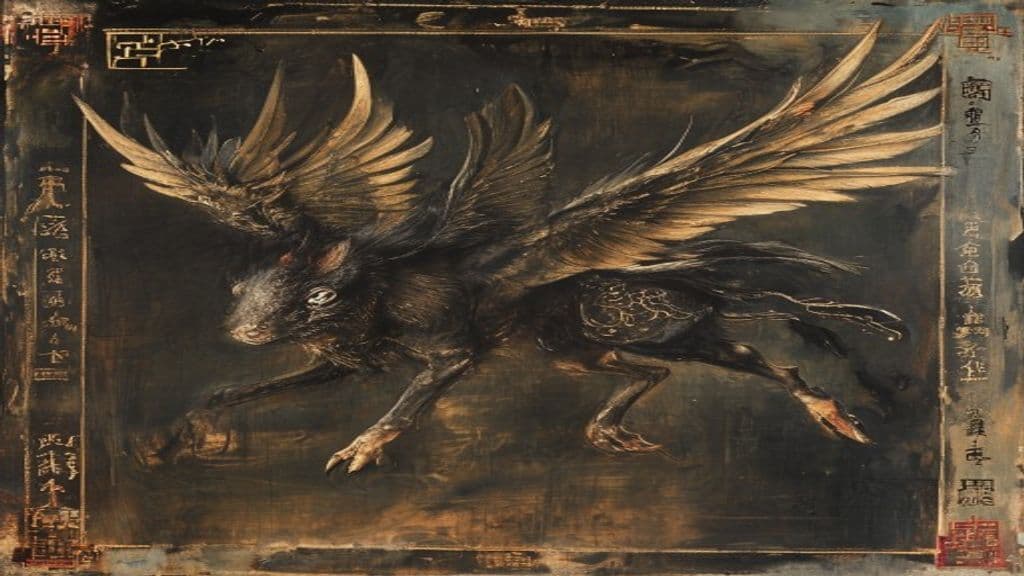
Fengli is a legendary or mythified flying mammal of Chinese tradition whose descriptions were collated in encyclopedic and materia medica works such as the Taiping Yulan and the Bencao gangmu. Surviving modern summaries treat it as a marvelous fauna entry within literate compilations rather than as a well-documented zoological species.

Fictitious Kings in Korean Genealogies
Minor Spirit

Fictitious Kings in Korean Genealogies

Entities appearing in 15th-16th century genealogies of Cheongju Han, Haengju Gi, and Taewon Seonu descent groups. (Note: - Power tier is Minor Spirit (but no description of abilities implies they might be lower still) - Origin story lacks clear indication that association with Jizi is an "Early Modern fabrication", inst)

Five Poisons (五毒, wǔ dú)
Lesser

Five Poisons (五毒, wǔ dú)

A culturally defined set of five hazardous animals in Chinese (and related Vietnamese) folk belief associated with the Dragon Boat Festival/Duanwu (the fifth day of the fifth lunar month). The term names a seasonal cluster of perceived dangers (snakes, scorpions, centipedes, toads, spiders) and denotes traditional prophylactic and talismanic responses; in modern usage the phrase is also repurposed as a political metaphor for five perceived threats to state security.

Flame Emperor (Yan Emperor / Yandi)
Ancient

Flame Emperor (Yan Emperor / Yandi)

A legendary pre‑dynastic Chinese ruler later remembered and venerated in some traditions as a fire‑associated ancestral figure or deity. He appears in early Chinese origin myths and is paired with other foundational legendary rulers such as the Yellow Emperor in accounts of archaic conflicts.

Four Heavenly Kings
Greater

Four Heavenly Kings

A quartet of Buddhist devas who guard the world by the four cardinal directions, serve Śakra in the Cāturmahārājika heaven, and vow to protect the Buddha, the Dharma, and the Buddha's followers. They are standard protective figures in East Asian Buddhist temple complexes and are included among larger groups of dharmapalas in Chinese practice.

Four Holy Beasts
Ancient

Four Holy Beasts

A set of four sacred animals in Chinese and broader East Asian cultural and astronomical tradition, mapped to the four cardinal directions and used as auspicious, protective, and cosmological symbols in literature, architecture, and material culture.

Four Perils (Sì Xiōng)
Greater

Four Perils (Sì Xiōng)

The Four Perils (四凶; Sì Xiōng) are a set of four malevolent figures in ancient Chinese literature—Hundun, Qiongqi, Taowu, and Taotie—recorded variously as monstrous creatures inhabiting mythic mountains, moral exemplars of vice, or eponymous lineal ancestors used in historiographic critique. Accounts differ across sources, so each name functions simultaneously as a beast in mytho-geography and as a symbol of disorder or vice in moral-historical texts.

Four Symbols (Sì Xiàng)
Ancient

Four Symbols (Sì Xiàng)

A set of four mythological creatures in Chinese cosmology—Azure Dragon, Vermilion Bird, White Tiger, and Black Tortoise‑Snake—serving as celestial asterisms and directional guardians integrated into ritual, astrological, and state symbolism.

Fox spirit
Greater

Fox spirit

A widespread class of mythical beings associated with foxes (often represented by red-fox imagery in many traditions) characterized by cunning, shapeshifting, trickery, and ambiguous moral roles; prominently attested in East Asian folklore and present in modern literature and media as romantic, vengeful, or matchmaking figures.

Fukurokuju
Greater

Fukurokuju

Fukurokuju is a beneficent, long-lived deity in Japanese popular religion, counted among the Seven Lucky Gods (Shichifukujin) and associated primarily with wisdom, longevity, and good fortune. His figure reflects syncretic assimilation of Chinese Taoist star-deity material (notably the Southern Polestar and the Three Star Gods tradition) into a distinct Japanese auspicious deity.

Fusang
Ancient

Fusang

Fusang is a mytho-geographical concept in early Chinese literature functioning both as a cosmological eastern world-tree (the Tree of the Sun) and as a flexible toponym for a remote island or eastern land. In cosmological texts it is paired with a western counterpart (Ruomu) and houses ten solar birds; in narrative registers it appears in legendary voyage accounts (e.g., Xu Fu) and in a reported fifth-century travel account attributed to Hui Shen (recorded in the Book of Liang).

Fuxi
Primordial

Fuxi

Fuxi (伏羲 / Fu Hsi) is a primordial culture-hero in Chinese myth credited in traditional accounts with establishing social institutions (marriage, family), teaching technologies (hunting, fishing, cooking, music), and originating systems of knowledge such as divination and the eight trigrams (ba gua). Frequently paired with Nüwa, he occupies a foundational role in prehistoric cosmology and ritual memory rather than a narrowly historical figure.

Golden‑Nosed White‑Haired Mouse Spirit
Greater

Golden‑Nosed White‑Haired Mouse Spirit

A cultivated mouse spirit (金鼻白毛老鼠精, Jīnbí Báimáo Lǎoshǔ Jīng) appearing in the 16th‑century novel Journey to the West. She cultivated at Vulture Peak, stole and consumed the Buddha's fragrant flowers and candles, disguises herself to deceive humans, kills several monks, and attempts to force Tang Sanzang into marriage to obtain his yang and attain the rank of Taiyi Golden Immorta (太乙金仙) before being exposed and captured by heavenly officers.

Gonggong
Ancient

Gonggong

Gonggong is a legendary prehistoric Chinese figure, portrayed in literary and mythic sources as a powerful water-associated being whose destructive act damaged the cosmic supports of the heavens and caused great floods; his story functions as an etiological myth explaining river directions and certain celestial observations.

Guan Gong (Guan Yu / Guan Di)
Greater

Guan Gong (Guan Yu / Guan Di)

Guan Gong is the honorific cult form of the historical late Eastern Han general Guan Yu (courtesy name Yunchang), a prominent follower of Liu Bei whose memory was transformed through literature and popular religion into a widely venerated 'Warrior Saint' figure with temples, images, and cultural presence across China and overseas Chinese communities.

Guanyin
Ancient

Guanyin

Guanyin (Guān Yīn, short for Guanshiyin/Guanshiyin 觀世音) is the Chinese manifestation of the bodhisattva Avalokiteśvara associated with compassion. Venerated across Buddhist, Taoist, and Chinese popular-religion contexts, Guanyin is petitioned through temple devotion, recitation, and festivals as a merciful intercessor who 'perceives the sounds of the world.'

Gui (wandering ghost)
Lesser

Gui (wandering ghost)

Gui (鬼), often rendered 'wandering ghost' or you hun ye gui (wandering spirits), are human-derived spirits in Chinese/Taoist popular religion that remain unsettled after death—commonly through violent or unhappy death or neglect by descendants—and are addressed through ancestor rites, Ghost Festival observances, and specialist ritual interventions.

Heibai Wuchang (Black and White Impermanence)
Lesser

Heibai Wuchang (Black and White Impermanence)

A paired set of underworld envoys in Chinese folk religion, the Heibai Wuchang (黑白无常) are color‑coded figures—one black, one white—charged in popular belief with escorting the spirits of the dead to the underworld and venerated in some City God temple contexts and popular ritual life.

Heifeng Guai
Greater

Heifeng Guai

Heifeng Guai (黑风怪), the Black Wind or Black Bear Spirit, is a localized spirit‑monster from the 16th‑century Chinese novel Journey to the West. In the narrative it appears as a dark‑complexioned man armed with a Black Tassel Spear but is revealed to be a huge black bear (xiongpi, 熊罴); after being subdued by Guanyin it is bound with a Golden Cincture and converted into a mountain guardian.

Heshana Qaghan (Ashina Daman)
Ancient

Heshana Qaghan (Ashina Daman)

Heshana Qaghan (personal name Ashina Daman) was a historical khagan of the Western Turkic Khaganate active in the early 7th century CE. Sources record him as a ruler whose heavy taxation and the massacre of numerous Tiele chieftains provoked rebellion, leading to his displacement, diplomatic submission to the Sui court (including marriage to a Chinese princess in 611), and eventual delivery to Eastern Turk emissaries to be executed by 619.

Hiderigami (Hanba)
Ancient

Hiderigami (Hanba)

Hiderigami (Japanese) / Hanba (Chinese, 旱魃) is a drought‑associated supernatural being in East Asian tradition. Treated variously as a goddess, spirit/ghost, monster, and later vampire‑like or shape‑changing entity, it is chiefly known for causing severe drought and drying up waters in affected places.

Hou Yi
Greater

Hou Yi

Hou Yi (后羿) is a mythic Chinese culture‑hero famed as an extraordinary archer who, by commission of a sky/imperial authority in variant traditions, shot down multiple suns and slew dangerous monsters. He is associated with receiving an immortality elixir, the tragic separation from his wife Chang'e (linked to the Mid‑Autumn Festival), and with variable portrayals ranging from mortal tribal leader to semi‑divine xian or legendary king.

Hua Po (Flower Demon)
Lesser

Hua Po (Flower Demon)

The provided source corpus contains no attestation of a supernatural being named 'Hua Po' or 'Flower Demon.' Materials in the corpus instead reference unrelated names and topics (e.g., Hua Mulan, modern literature, opera conventions), and do not document a flower‑associated demon figure.

Huang Shigong
Ancient

Huang Shigong

Semi-mythological Taoist hermit and legendary scribe who imparted knowledge and wisdom through written texts. (Note: - Power tier: Primordial (since he's semi-mythological and a figure from ancient Chinese culture, but not explicitly stated as deity-level) - Appearance: "No physical description is provided in the so)

Huangmei Dawang
Ancient

Huangmei Dawang

A formidable supernatural being in the Buddhist tradition associated with immense power and strength. (Note: - Summary: Inaccurate. Huangmei Dawang is a major antagonist, not associated with "immense power and strength". - Power tier: Possibly incorrect. Although it has significant spiritual authority and ca)

Huli jing (Fox spirit)
Lesser

Huli jing (Fox spirit)

Huli jing (狐狸精), commonly rendered in English as "fox spirit," are shapeshifting supernatural beings from Chinese folklore and mythology. Classified among the broader class of yāoguài, they are morally ambivalent figures that may be benevolent, malevolent, or trickster-like depending on the tale and context.

Hun and Po
Ancient

Hun and Po

Hun (魂) and po (魄) are complementary soul-aspects in classical Chinese thought: hun is the more ethereal, yang-associated component that departs the body after death, while po is the more corporeal, yin-associated component tied to physiological and lunar-linked functions and which remains with the corpse.

Hundred‑Eyed Demon Lord
Greater

Hundred‑Eyed Demon Lord

A powerful non‑human spirit figure from the 16th‑century Chinese novel Journey to the West (Chapter 73). Presented in the story as a centipede spirit who disguises himself as a Daoist abbot, reveals a hundred glowing eyes beneath his ribs that emit a blinding golden light, and serves poisoned tea to the pilgrims before being subdued by the bodhisattva Pilanpo.

Hungry ghost (E gui)
Lesser

Hungry ghost (E gui)

Listed in a compiled catalogue of supernatural beings from Chinese folk culture and contemporary literature, 'hungry ghost (E gui)' appears as an itemized class of supernatural being in the provided sources. The supplied materials contain the name but do not give further descriptive or ritual detail.

Huodou
Greater

Huodou

A legendary fire-associated beast from texts describing southern China, depicted as a large black dog that 'eats fire' and emits flames; in classical passages it is treated as an omen or sign of conflagration and is grouped with calamities.

Huoshu (火鼠)
Lesser

Huoshu (火鼠)

The huoshu or huo shu (火鼠), literally "fire rat" or "fire mouse," is attested in modern reference works as a fantastical beast in Chinese tradition. Available cited references (Wikipedia and Wikidata) provide only this lexical identification and classification; no further descriptive, narrative, or ritual material is supplied in those sources.

Hùndùn
Primordial

Hùndùn

The primordial chaos of Chinese cosmogony — sometimes personified as a faceless deity of the center, sometimes as the undifferentiated void from which all things emerged and to which they return.

Imugi (proto-dragon)
Lesser

Imugi (proto-dragon)

Imugi (이무기; also transcribed Imoogi) is a Korean folkloric proto‑dragon — a large serpentine, aspirant creature described in modern summaries as a 'lesser dragon' that may become a true Korean dragon through a transformative act.

Jade
Lesser

Jade

Jade is a material and cultural concept referring to two distinct groups of ornamental rocks—nephrite and jadeite—valued across many societies (not a supernatural being). It has deep historical, ritual, and symbolic significance especially in East Asia and Mesoamerica, and carries folk associations with health and social status.

Jiangshi (hopping corpse)
Lesser

Jiangshi (hopping corpse)

A jiangshi (jiāngshī, 僵尸) is a reanimated human corpse in Chinese popular belief and media that moves with a stiff, hopping gait and is commonly depicted in modern sources as subject to control or containment by Taoist priests using talismans and ritual implements. The contemporary image is heavily shaped by Hong Kong cinema, which standardizes visual motifs (Qing robes, yellow fulu, glutinous rice) and priestly intervention.

Jiaotu
Lesser

Jiaotu

Jiaotu is a named member of the folkloric set known as the Nine Sons of the Dragon in Chinese decorative tradition, traditionally associated with secrecy and threshold protection and commonly represented as a carved motif on doors.

Jurōjin
Lesser

Jurōjin

Jurōjin (寿老人) is one of the Seven Gods of Fortune (Shichifukujin) in Japanese popular religion and art, functioning as the personification and auspicious deity of longevity and wisdom. A syncretic figure derived from the Chinese Taoist 'Old Man of the South Pole,' he appears in painting, sculpture, and small devotional objects from the Muromachi–Edo periods onward.

Kalaviṅka
Lesser

Kalaviṅka

A Buddhist fantastical creature described as a human-headed, bird-bodied being famed for its exquisite, Dharma-preaching voice; represented across South, East, and Southeast Asian Buddhist art and liturgical contexts with regional iconographic variation.

Khan of Heaven (Tian Kehan / Tengri Khagan)
Minor Spirit

Khan of Heaven (Tian Kehan / Tengri Khagan)

A politico-religious title used in Tang‑era diplomacy that linked imperial rulership to the supreme sky/heaven concept (Chinese Tian / Turkic Tengri). It functioned as a formula of recognition conferring celestially sanctioned authority on the Tang emperor in relations with Turkic and other Inner Asian polities between the early 7th century and the late 8th century.

Kim Gyo-gak
Greater

Kim Gyo-gak

A historical Silla prince who became a Buddhist monk and is believed by Mount Jiuhua monks to have been the terrestrial manifestation (reincarnation) of the bodhisattva Ksitigarbha (Chinese: Jijang). His life at Mount Jiuhua is credited with transforming the mountain into a major Ksitigarbha sacred site.

Kitchen God (Zao Jun / Zao Shen)
Lesser

Kitchen God (Zao Jun / Zao Shen)

The Kitchen God is a Chinese domestic deity associated with the household stove/hearth who monitors family conduct and annually reports that conduct to the Jade Emperor, influencing the household's fortunes. He is typically represented by a paper effigy or plaque kept above the stove and is the focal figure of year-end household rites around the Little New Year.

Kuafu (夸父)
Greater

Kuafu (夸父)

Kuafu is a mythic giant in Chinese tradition known for attempting to chase and capture the Sun; his pursuit is used etiologically to explain landscape features (drained rivers, a peach forest, and in some versions a mountain range) and proverbially as an emblem of audacious but ultimately futile striving.