Other Supernatural Beings

842 documented Other supernatural beings from the Evil Eye grimoire, including 352 lesser and 181 minor spirit in power tier.

page 11 of 15

Lime Tree (Germanic Tradition)
Greater

Lime Tree (Germanic Tradition)

The lime tree is a sacred and symbolic plant in Germanic tradition, associated with protection, peace, and healing. (Note: - Power tier: Primordial (Given its association with protection from harm, evil spirits, or negative energies, which suggests a more cosmic level) - Abilities: Remove "good dreams" as it is not suppor)

Lover jinn (Parī / Peri)
Lesser

Lover jinn (Parī / Peri)

A supernatural being from Persian-origin tales commonly called parī or peri, depicted as a winged and beautiful creature that appears in supernatural narratives, including motifs of supernatural beings forming romantic attachments to humans. Sources contrast parīs with jinn by noting parīs typically feature in supernatural-tale contexts.

Lupae
Primordial

Lupae

In Roman tradition, Lupae refers to a female wolf or prostitute symbolizing fertility and protection. (Note: - Power tier: Change to Ancient (deity-level) as Lupae's abilities and symbolism suggest a higher level of power than Primordial. - Abilities: Clarify that Lupae is associated with fertility and prote)

Ma (Vietnamese ghost)
Lesser

Ma (Vietnamese ghost)

Ma are wandering souls or spirits of the dead in Vietnamese cultural belief who, depending on ritual treatment, may become protective ancestors or remain restless ghosts that affect the living's luck and daily life. They are embedded in practices of ancestor worship, domestic offerings, and the work of spirit mediums.

Madam Pigott
Lesser

Madam Pigott

A named White Lady ghost of Newport and Chetwynd Park, Shropshire, said to be the restless spirit of a deceased woman tied to the Pigott family and to specific local landmarks; traditions describe repeated nocturnal appearances, interactions with riders, and two different local remedies (clerical Psalm-reading exorcism and a Romani-style bottling and drowning).

Magnes the shepherd
Minor Spirit

Magnes the shepherd

Magnes the shepherd is a legendary etiological figure credited in classical and medieval sources with the discovery of magnetic ore when the iron parts of his shoes and staff adhered to a rock. He functions as an eponymous origin-figure linking a person or place-name to the term for magnet and the recognition of magnetism.

Makaradhwaja
Lesser

Makaradhwaja

Makaradhwaja is a figure in regional South Asian Ramayana-derived folk traditions described as an offspring produced when a drop of Hanuman's sweat entered a Makara; he is raised in Patala by the underworld-king Ahiravana and serves as a gatekeeper who confronts Hanuman during a rescue episode. The name is also used independently in Ayurvedic/rasashastra literature for a Kupipakwa herbo‑mineral preparation.

Makuragaeshi
Lesser

Makuragaeshi

A Japanese folkloric phenomenon literally meaning "pillow flip" (枕返し or 反枕), described as a bedside yōkai or nocturnal spirit that comes during sleep to turn over a sleeper's pillow or change the orientation of head and feet. Accounts vary: some depict a small-child or bōzu-like figure (makura-kozō), others describe the effect as produced by the spirit of someone who died in the room, domestic tricksters (zashiki-warashi), animal/tree spirits, or temple-associated apparitions.

Mala'ika
Greater

Mala'ika

Mala'ika are angels — heavenly, created spiritual beings described in the supplied sources as created by God from a luminous origin and primarily known from Qur'anic and later Islamic literature; the provided materials do not supply Coptic-language forms or Coptic-specific folklore details.

Mam
Ancient

Mam

Mam is a pan‑Maya kinship term used as a respectful appellation for aged ancestral powers and several local elder deities. It names a set of distinct local figures—mountain spirits, earth deities, a ritual straw effigy used during the Uayeb, and particular cult figures such as the Tzutujil Mam Maximón—each tied to specific places, seasons, or social domains.

Mami Wata
Greater

Mami Wata

Mami Wata is a class of water-associated female supernatural beings and deities found across parts of West, Central, East and Southern Africa and in the African Atlantic diaspora. Associated with wealth, fertility, healing, beauty and possession phenomena, Mami Wata figures combine mermaid-like and snake- or crocodile-linked imagery and have absorbed foreign visual forms through historical contact.

Manaul
Greater

Manaul

Manaul is a birdlike mythic figure in multiple Philippine indigenous traditions, variously portrayed as an omen-bearing bird sent by Bathala or Amihan, a king who guides destinies and instigates cosmic conflict, and a rebellious/cosmogonic agent who creates islands.

Mandrake (plant/tradition)
Lesser

Mandrake (plant/tradition)

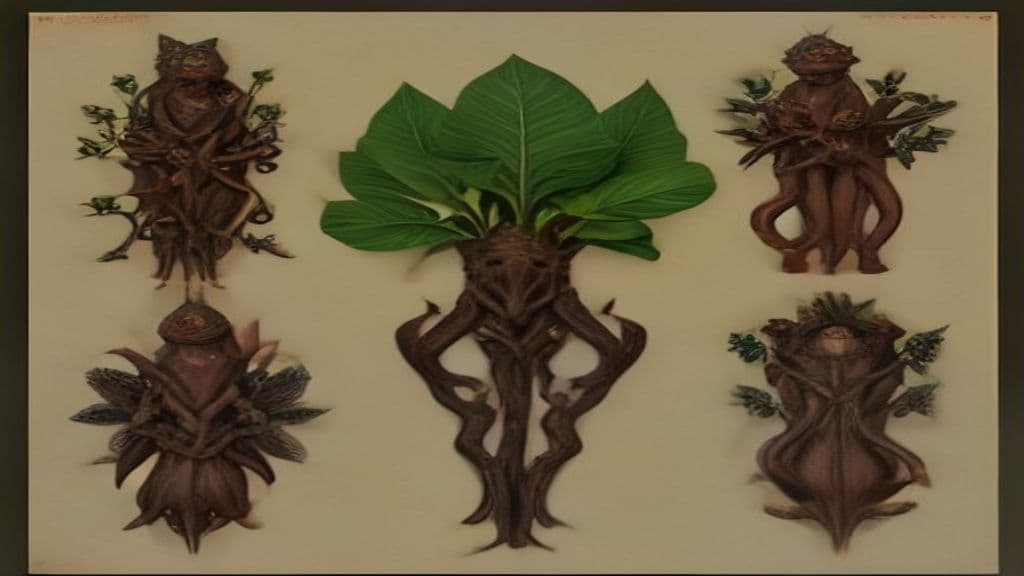
A human-shaped root (primarily Mandragora spp.) treated in classical and later European tradition as a toxic, psychoactive pharmakon whose anthropomorphic form and powerful alkaloids generated ritualized harvesting rules and medicinal prescriptions. It is a botanical substance invested with magical and medical significance rather than an independently volitional spirit in the provided sources.

Mangindusa
Ancient

Mangindusa

Mangindusa is a deity figure in Tagbanwa (Tagbanuwa) cosmology of Palawan. Sources variably present Mangindusa as a creator or as a high god within a layered indigenous cosmos, but ethnographic reports conflict about the exact status and functions of the figure.

Manipogo
Lesser

Manipogo

Manipogo is a named lake‑monster figure in Manitoba folklore, described in local oral tradition and modern reports as a large serpentine creature inhabiting Lake Manitoba. The modern name was coined in 1960 by analogy with Ogopogo and the creature functions as a regional folkloric emblem referenced in sightings, local media, and community events such as the St. Laurent Manipogo Festival and Manipogo Provincial Park.

Manseren Manggoendi
Primordial

Manseren Manggoendi

A mythical hero from the Numfor-Biak region of Papua, Indonesia, associated with world recreation and transformation. (Note: * Power tier: Should be Ancient (deity-level) instead of Primordial (cosmic), as there's no indication that Manseren Manggoendi has cosmic-level powers. * Abilities: Clarify or expand on what "signifi)

Manzat
Ancient

Manzat

Manzat is a Mesopotamian and Elamite goddess personifying the rainbow, attested in Mesopotamian god-lists and Elamite royal and temple inscriptions; she is associated with heavenly phenomena and the prosperity of cities and had cultic standing in Middle Elamite temple contexts.

Mara (Tagin)
Lesser

Mara (Tagin)

Mara (also rendered Mra or Mura) is an ethnonym for a human subgroup of the Tagin (Na) peoples of Arunachal Pradesh, India. Attested sources describe the Mara as inhabitants of Limeking in Upper Subansiri (just south of Taksing), with cultural ties to the indigenous Donyi Polo religion and considerable Tibetan Buddhist influence; the supplied corpus contains no documentation of a supernatural being named Mara within Tagin belief.

Maria Sinukuan
Greater

Maria Sinukuan

Maria (Mariang) Sinukuan is a Kapampangan mountain diwata associated with Mount Arayat who, in oral tradition and later folklore, oversees the mountain's abundance, aids villagers in need, and punishes greed. The figure is also linked in local narratives to an earlier pre‑colonial deity known as Aring (Apúng) Sinukuan, a solar/war god; sources describe a Spanish‑era reshaping that introduced the Marian honorific and a feminized diwata form in later tradition.

Marozi
Minor Spirit

Marozi

The marozi is a name given in early 20th‑century Kenyan naturalist reports to purportedly spotted adult lions—lion-like felids retaining rosette-like juvenile markings and occurring at unusually high elevations in the Aberdare Mountains and Kinangop Plateau. Sources treat the marozi as a taxonomic puzzle or regional morph rather than a supernatural being.

Marraco (Gegants del Clot)
Lesser

Marraco (Gegants del Clot)

The Marraco is a dragon or frightening creature in Catalan myth associated with the city of Lleida, described in sources as possessing a mouth wide enough to swallow a human whole and commonly invoked in tales told to frighten children.

Matrikas
Greater

Matrikas

Matrikas (Sanskrit: mātṛkā, 'mothers') are a group of related mother-goddess figures in Hindu tradition, commonly rendered as seven (Saptamatrikas) or eight (Ashtamatrikas). They function ambivalently as protectors and as dangerous female powers tied to fertility, child mortality, disease, and martial activity, and were incorporated into temple and tantric/Shakta practice by the Kushana–Gupta and early medieval periods.

Meander
Minor Spirit

Meander

A meander is a geomorphological feature: a series of regular sinuous curves in the channel of a stream or river. The term derives from the river name Maiandros (Greek Μαίανδρος) and in classical usage came to denote anything winding or convoluted.

Mecisteus
Lesser

Mecisteus

Mecisteus is a mortal heroic figure from ancient Greek tradition attested in genealogical lists and epic-cycle episodes. He appears in connections with the Theban cycle (Seven Against Thebes), Trojan War narratives, and Argive genealogies, primarily as a warrior and ancestor rather than a developed individual character.

Medieval revenant
Lesser

Medieval revenant

A revenant is a folkloric returning dead — described in the supplied sources as either a spirit or an animated corpse — believed to have been resurrected to re-enter the world of the living and to haunt them. The English term derives from Old French revenant, literally ‘returning’.

Meduza
Lesser

Meduza

Meduza (also Meluza, Meluzina) is a hybrid sea monster attested in Russian popular print culture (a 17th–18th‑century lubok) described as half-woman and half‑serpentine/sea creature, located in remote oceanic waters and explicitly labeled in one source as a 'deity of deception.'

Megisto
Minor Spirit

Megisto

Megisto is a genus of butterflies in the subfamily Satyrinae (family Nymphalidae). The taxon includes species such as Megisto cymela and Megisto rubricata; source materials are scientific/taxonomic and do not treat Megisto as a supernatural being.

Melanippe
Lesser

Melanippe

Melanippe (Ancient Greek: Μελανίππη, lit. 'black mare') is a personal name applied to several distinct female figures in Greek mythic tradition — including a daughter of the centaur Chiron transformed into a mare, an Amazon warrior, a Meleagrid princess turned into a guinea‑fowl, and various genealogical wives and daughters. The name recurs across metamorphosis narratives, Amazon cycles, and genealogical lists rather than designating a single unified supernatural being.

Melqart
Ancient

Melqart

Melqart is the principal tutelary deity of the Phoenician city of Tyre, venerated as the city's divine patron, protector of its colonies, and a central figure in Phoenician/Punic civic religion. He is associated in the sources with an annual 'awakening' festival often interpreted as a dying-and‑rising motif, and his name was invoked to sanction oaths and protect settlements.

Mengues / Mengue
Lesser

Mengues / Mengue

The term 'Mengues' (also attested as 'Mengue') is documented in the provided sources only as an onomastic item — a surname, a village toponym in Cameroon, and as a name/title used in Spanish-language and contemporary artistic works. The sources contain no evidence that 'Mengues' denotes a supernatural or folkloric entity.

Menhit
Ancient

Menhit

Menhit (also Menhyt, Menchit) is a Nubian-origin lioness war goddess incorporated into Egyptian religion as a martial tutelary and solar-associated deity. She is commonly depicted as a lioness bearing a solar disk and the uraeus and is linked in myth to the Eye of Ra tradition and to royal protective iconography.

Menninkäinen
Greater

Menninkäinen

A mischievous, goblin-like spirit in Finnish mythology that guards treasures and enjoys riddles and games of dominance. (Note: 1. Power tier: Lower to Primordial or Ancient, given the description of guarding treasures and enjoying games of dominance. 2. Origin story: Remove "originally described as spirits that lived in isola)

Menshen (門神)
Lesser

Menshen (門神)

Menshen, or "door gods," are paired guardian deities in Chinese popular religion and related practices placed at thresholds to repel harmful influences and encourage beneficial ones. They appear as images, tablets, or statues affixed to doors and gates and are commonly replaced each Chinese New Year as part of household renewal.

Mermaid
Greater

Mermaid

An aquatic folkloric being with the head and upper body of a female human and the tail of a fish, appearing across many cultures as both omen of maritime danger and occasional benefactor or romantic partner to humans.

Mermerus
Lesser

Mermerus

Mermerus is a mortal figure in Greek mythic genealogies, most commonly named as one of the two sons of Jason and Medea (paired with Pheres) whose fate figures in the Medea domestic tragedy. The name also appears independently in other epic contexts (notably as a minor Trojan warrior killed in battle) and in fragmentary/local genealogical notes linking a Mermerus into royal lines.

Mesopotamian deity
Ancient

Mesopotamian deity

In ancient Mesopotamian traditions, deities are anthropomorphic supernatural persons who possess extraordinary powers and are central to cosmology, creation, and social order. They are frequently represented in material culture (idols, stelae, cylinder seals) and are associated with a numinous quality called melam that produces intense bodily and emotional reactions in humans.

Minepa
Minor Spirit

Minepa

Minepa is a name attested both as a Tanzanian place-name and, in a small number of modern compilations and database entries, as a spirit label associated with the Makua (Makuwa). Documentary evidence treating Minepa as a supernatural being is sparse and consists largely of secondary lists and a machine-readable database tag rather than ethnographic description.

Minnie Quay
Lesser

Minnie Quay

A place‑bound apparition from Forester (present-day Forester Township), Michigan: Mary Jane "Minnie" Quay is a local ghost legend of a teenage girl who drowned in 1876 and whose spirit is said to haunt the pier, beaches, and cemetery. The tale survives in local oral tradition, regional ghost literature, and popular retellings; a customary practice of leaving offerings at her gravesite is associated with the legend.

Minoan Genius
Lesser

Minoan Genius

A recurrent composite supernatural attendant in Bronze Age Minoan iconography, typically depicted as a libation-bearer and cultic supporter in sacrificial, processional, and ritual scenes. The label "Minoan Genius" is a modern scholarly convention; the figure appears widely on seals, sarcophagi and other ritual art in Minoan Crete and later in Mycenaean contexts.

Minyans
Lesser

Minyans

A named people and ancestral lineage in Greek literary tradition, associated especially with Orchomenus in Boeotia and the eponymous founder Minyas; in modern scholarship the term is also applied (controversially) to a Middle Helladic pottery horizon called 'Gray Minyan ware.'

Mitama
Minor Spirit

Mitama

Mitama (mi + tama) is a Japanese term for an honored spirit that can denote either the spirit of a kami (divine being) or the soul of a dead person. In Shinto practice a kami's mitama may be housed in a physical object (shintai or mitamashiro).

Miyatanzipa
Lesser

Miyatanzipa

Miyatanzipa is a named deity attested in the Hittite religious corpus (Anatolia, c. 1600–1180 BCE). The deity appears in divine-name lists and in mythic fragments as one of the gods who sat under a hawthorn (ippiyas/Thippiyas) tree awaiting the return of Telipinu and is invoked in short ritual formulae.

Moon god (lunar deity)
Ancient

Moon god (lunar deity)

A lunar deity is a divine figure representing the Moon or aspects of it; across cultures such deities personify the Moon, its phases, and its governance of the night and may perform varied functions depending on local tradition.

Mopsus
Lesser

Mopsus

Mopsus is a legendary seer of the Graeco-Anatolian tradition known from archaic Greek poetry and later Anatolian and Phoenician inscriptions. He appears in myth as a prophetic figure—sometimes son of Manto or of Apollo—and in epigraphic records as an eponymous ancestor (Muksa/Muksos) connected to early Iron Age dynastic houses in southern Anatolia.

Morgan le Fay
Greater

Morgan le Fay

A mutable figure of the Arthurian tradition variously portrayed as an enchantress, healer, fairy-queen, or human noblewoman. Early accounts emphasize her role as a healer and leader of supernatural women at Avalon; later prose romances often recast her as an ambivalent or antagonistic sorceress in relation to Arthur and his court.

Motoro
Minor Spirit

Motoro

Motoro is a tribal god of the Ngariki people of Mangaia in Polynesia. In the available account he is called i'o ora ('god of the living') and is noted for a myth in which he was cast into the sea during a quarrel with his elder brothers; his spirit later arrived at Mangaia on a piece of hibiscus. His followers were exempt from being used as human sacrifices.

Mozagro
Minor Spirit

Mozagro

Mozagro is attested in the provided sources as a modern toponym and commercial name rather than a supernatural being. It appears as a geographic feature (Pico Mozagro referenced in pastoral/cattle imagery), a triangulation station in Cieza, Spain, and as the name of a contemporary digital agribusiness marketplace serving smallholder farmers. The supplied materials contain no folkloric, mythic, or supernatural descriptions of Mozagro.

Muldhan
Minor Spirit

Muldhan

Muldhan (rendered in source metadata as MULDHAN) appears only as a subject/index keyword in multiple Bengali-language bibliographic records examined; the accessible records provide no descriptive, ritual, or ethnographic information about the term beyond its repeated indexing. The catalog entries link the keyword with cemetery-related cataloging contexts but do not themselves describe a spirit, revenant, or guardian role.

Mummy (undead) (Egyptian tradition)
Lesser

Mummy (undead) (Egyptian tradition)

In Egyptian folklore, a mummy is an undead creature believed to be the reanimated corpse of a deceased person. (Note: * Power tier: Should be Primordial, given the association with cosmic entities and magical powers tied to ancient Egyptian rituals. * Abilities: Clarify that supernatural abilities refer to those on a)

Mynes
Lesser

Mynes

Mynes is a name applied to at least two mortal figures in Greek myth: a king of Lyrnessus slain by Achilles in the Trojan-cycle tradition (husband of Briseis), and a Lacedamonian genealogical figure recorded as father/ancestor in early Athenian genealogies (father of Pedias). He is a human/mythical mortal rather than a supernatural being.

Myrina
Minor Spirit

Myrina

Myrina is a name attested in Greek-language sources that functions as a toponym (several ancient towns and a modern town on Lemnos) and as the name of several female characters in Greek mythology; it is also used in modern taxonomy for a genus of butterflies. The supplied sources do not present a single, consistent supernatural entity called Myrina, and material about ritual, appearance, or powers for a unified mythic figure is absent from the provided corpus.

Máttaráhkká
Lesser

Máttaráhkká

Máttaráhkká is a Sámi mother figure associated with fertility, childbirth, and the giving of the physical body to a child. She is a domestic, chthonic presence said to dwell in the ground beneath the goahti and was traditionally petitioned by women during pregnancy; after Christianization she was often syncretized with the Virgin Mary.

Nakchhong
Lesser

Nakchhong

Nakchhong (नाक्छोङ) is the shamanic tribal priestly office of the Khambu Rai (Kirat) community. Serving as the main priest of the Sakela (Sakewa) shrine, Nakchhong functions as an intermediary between the living and ancestral/local spirits and leads seasonal rites such as Udhauli and Ubhauli.

Napir
Ancient

Napir

Napir is the Elamite god of the moon attested in short Elamite and modern reference entries. The theonym is recorded in Elamite cuneiform (transliterated Na-pi-ir) and is likely derived from the Elamite nap/napir meaning "god."
Narada
Ancient

Narada

Narada is a rishi-like sage-divinity in Hindu tradition: a travelling musician, storyteller, and divine messenger credited with transmitting devotional wisdom, juridical teachings, and news among gods and humans. He appears across epics and Puranas as a devotee-exemplar of Vishnu, a sometimes-mischievous mediator, and the attributed author of devotional and juridical texts.

Nasreddin Hoca (Nasreddin Hodja)
Ancient

Nasreddin Hoca (Nasreddin Hodja)

Nasreddin Hoca is a legendary folk trickster and anecdotal persona prominent in Turkish and broader Islamic oral tradition. He functions as a comic teacher and social critic in hundreds of anecdotes and performances, using wit and ironic reversal to expose hypocrisy, instruct, or entertain rather than as a supernatural spirit or deity.

Nestor (name and uses)
Minor Spirit

Nestor (name and uses)

Nestor is presented in the supplied sources primarily as a personal and place name used across literary, geographic, maritime, scientific, and cultural contexts. While one cited headword refers to a mythological figure, the provided material contains no folkloric descriptions, supernatural attributes, or ritual traditions associated with Nestor.

New Zealand bellbird (Anthornis melanura)
Lesser

New Zealand bellbird (Anthornis melanura)

A medium-sized honeyeater endemic to Aotearoa New Zealand, valued for its melodious, bell-like song and regarded as taonga by Māori. Treated in scientific sources as Anthornis melanura, it is the only extant mainland member of its genus and an important contributor to New Zealand soundscapes and dawn chorus.

Ngen
Lesser

Ngen

In Mapuche cosmology, the ngen (Mapudungun: 'owner') are spirits that manage, govern and arrange different features of nature; they are custodial proprietors of particular natural domains and are to be respected and offered to when humans seek resources from nature.

Ngải (research note)
Lesser

Ngải (research note)

The supplied sources do not document a Vietnamese earth- or plant-spirit called "ngải" used in sorcery. Materials provided instead show homographs or similar forms of the sequence 'ngai/ngài/ngāi' in unrelated cultural contexts (an East African creator deity "Ngai", the Māori tribal name "Ngāi Tahu", and Vietnamese honorific usages such as "Ngài"). This entry records only what is present in the provided sources and identifies gaps where data on a Vietnamese ngải is absent.